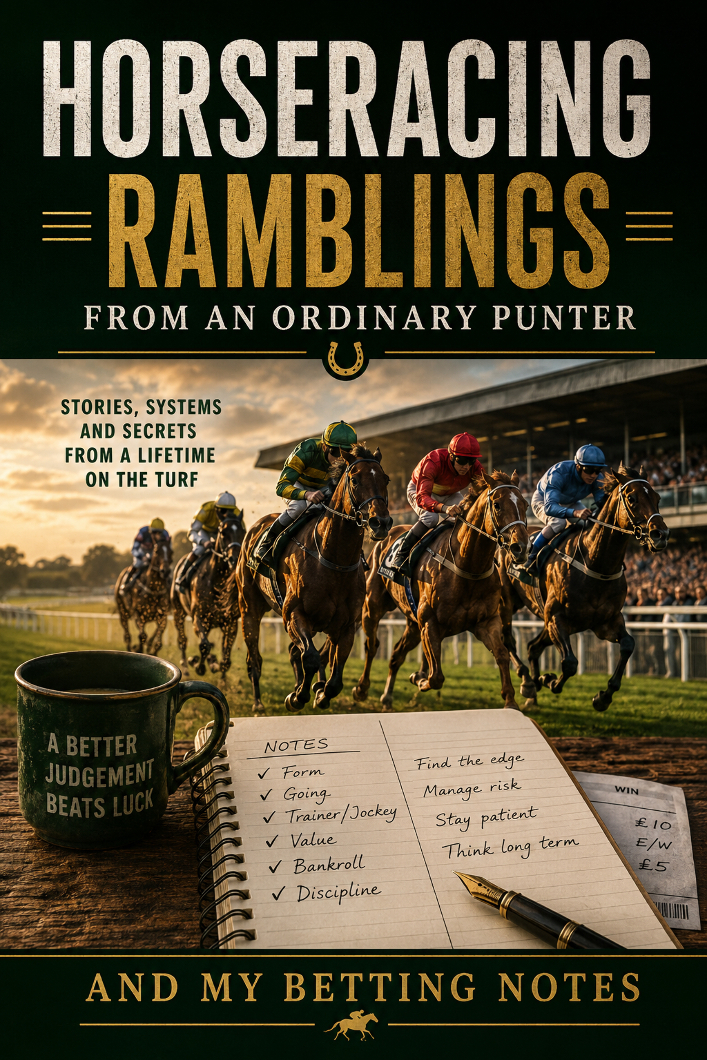
Horseracing Ramblings From An Ordinary Punter: And My Betting Manual
My grandfather liked to bet on racehorses, as did his father before him. Gambling, you could say, was in the blood. Tales of betting coups and near misses were passed down through the generations. Life always seemed to revolve around horseracing and betting—betting mainly.
From a very young age, My Granddad would take me racing at Kempton, Sandown, or Windsor. If we weren’t there in person, we’d be in front of the television, shouting the winners home. When one of his selections came in, he’d press a few shillings into my hand as my share of the winnings. To me, it was magic.
My Granddads methods fascinated me. His selections weren’t made on a whim but often followed one of his “systems.” I didn’t fully understand them then, but the idea that there was a puzzle behind the racing intrigued me. He’d wink and tease, “One day this will all be yours, my boy.” I had no clue what he meant, but I played along.
Sadly, he passed away from throat cancer when I was just fourteen. Still, my interest in horse racing never left me, though it stayed under my mum’s radar for a while.
By 1979, I’d just turned sixteen and had started an apprenticeship as a chef at the Park Lane Hotel in Piccadilly, London. The split shifts gave me the afternoons free, and it wasn’t long before I found myself following fellow cooks down the road to the Mecca betting shop in Shepherd’s Market, just a short walk from the hotel.
The place was a world of its own. Punters from every walk of life crowded in, united in their battle against the bookmaker. The air was thick with cigarette smoke and banter. Cheers would erupt when a favourite scraped home, as it did the day Lester Piggott steered one home by a neck. His name meant little to me at the time, though by the following year—when he’d notched up 156 winners - it meant a lot more as he was my favourite jockey.
That shop became my classroom. I’d stand listening to the Extel commentaries, studying the form, watching the odds go up on the board. Around me, old regulars swapped war stories—about winners they’d “nearly backed” or losers they’d “nearly avoided.” It was a curious education, but I was hooked.
On my eighteenth birthday, my nan gave me an envelope my grandfather had left for me. Inside was £100 in crisp notes, but it wasn’t the money that caught my attention. Alongside it was a handwritten letter, instructions to his horse racing systems, and—most intriguingly—a letter from Hawthorns Turf Accountants politely informing him they no longer wanted his business. That was all the proof I needed: Grandpa had known what he was doing.
The Envelope of Secrets
That envelope from my grandfather changed everything. The £100 was generous, but it was the other contents that mattered more: a set of neatly written notes outlining his “systems.
Flat Racing
- The horse had won or been placed second in its last run
- The Selection is top rated
- The Selection is Favourite and the betting forecast in the Sporting Life is between 1-2 to 2-1 with the second Favourite forecast at least 3 points bigger
- Less than twelve runners in the race
- The horse had ran in the last twenty days
- The horse was Favourite in at least one of the last three runs
- The Jockey and trainer are at the top of their game
National Hunt Racing
- Only bet in Novice hurdle and chase races
- The selection finished Second, third or forth last time out but has won a similar race in its career.
- Less than nine runners in the race
- The horse was Favourite last time it ran
- The jockey and trainer are top of their game.
There was also notes on general observations.
- Stick to handicaps, where the weight reveals the trainer’s intentions.
- Look for horses dropping in class or carrying less weight than before.
- Pay attention to recent runs—fitness matters more than reputation.
- Always respect the market: if the odds shorten, someone knows something.
- Never chase a loser. Tomorrow always brings another race.
I didn’t realise it then, but these principles were the foundation of my own betting education. They weren’t foolproof—no system is—but they gave me a structure. Something to cling to in a world where chaos often reigns.
It also explained that letter from Hawthorns Turf Accountants. Grandpa had clearly beaten them badly enough for them to close his account. In those days, a bookmaker “showing you the door” was the highest compliment.
Conor Murphy’s Million
Stories of racing folklore always fascinated me. One of my favourites is that of Conor Murphy, a young stable lad working for Nicky Henderson at Seven Barrows. Like most lads in the yard, he dreamed of backing a winner—but in 2011 he went a step further.
Conor struck a £50 accumulator with five of Henderson’s horses, all aimed at the Cheltenham Festival. Five selections, one bet, all needing to win. To most, it was a romantic punt, the kind of slip you frame for fun. But racing has a way of turning dreams into miracles.
When the dust settled at Cheltenham, every horse obliged. Conor’s £50 was transformed into £1 million. Overnight, the stable lad became a millionaire.
What I love about the story isn’t just the fairytale ending—it’s the way it shows racing’s magic. Here was a lad who mucked out boxes at dawn, suddenly walking into a new life. He later moved to America, set up as a trainer, and made a name for himself.
For punters like me, Conor’s story was a reminder: every so often, lightning does strike. But more importantly, it showed the depth of knowledge held by those closest to the horses. The stable staff, the unsung heroes, often know more than the bookmakers ever will.
Bill Benter – The Man Who Beat the System
In the modern era, few stories in racing folklore rival that of Bill Benter, the man who did the unthinkable: he built a system so precise it could predict winners with remarkable accuracy — and in doing so, he made over a billion dollars.
The final race at Happy Valley, Hong Kong, had just been run. It was Tuesday, 6th November 2001, and the city buzzed with talk of the biggest jackpot in its history being landed by a single ticket. The sum was staggering — over one hundred million Hong Kong dollars, around £20 million at the time. The ticket holder? None other than Bill Benter.
For Benter, the money wasn’t the point. He had already earned vast fortunes. What drove him was something greater: the challenge of conquering the supposedly impossible.
His journey began in the 1980s, when he was far from a wealthy man. Having just applied for a job as a night cleaner at McDonald’s, fate intervened. Friends introduced him to Alan Woods, leader of an Australian card-counting team that had taken Las Vegas by storm. Woods was fearless — once smuggling $10,000 through Manila airport hidden in his underwear — but more importantly, he was disciplined. He ran his blackjack team like a business: pooled money, shared profits, and reduced risk through teamwork.
Benter was captivated. Within weeks he was in Monte Carlo, earning $80,000 a year at the blackjack tables, living a James Bond existence with tuxedoed waiters serving him champagne. But success brought scrutiny. The casinos soon barred them, and the team had to seek a new game. Woods had already spotted the vast betting pools in Hong Kong racing. The city of just over five million wagered more on a single night’s racing than an entire English festival. It was a goldmine — for anyone with an edge.
Benter realised that to succeed he needed something stronger than hunches or intuition. He taught himself advanced statistics and computer programming. Woods supplied him with stacks of Hong Kong racing yearbooks, and Benter hired two women to input thousands of results by hand into his growing database.
Armed with primitive green-screen computers, Benter flew to Hong Kong in 1985. He and Woods set up in a bare office above a McDonald’s, racing papers stacked high, their lives consumed by data. But the early days were tough. By the end of their first season, they had blown $120,000 of their $150,000 bankroll. Woods and Benter split — Woods wanting the lion’s share of control, Benter refusing.
Back in the U.S., Benter regrouped. He returned to card-counting to build fresh capital, but every spare hour was spent refining his racing model. By 1988, with an improved algorithm and renewed determination, he was back in Hong Kong. This time, he cracked it.
His system factored in everything — class, pace, weight, going, trainer form, sectional times — hundreds of variables layered into one predictive model. It wasn’t perfect, but it didn’t need to be. With accurate probability assessments, Benter could identify value — horses whose chances were greater than their odds implied.
In his first year back, he made nearly $800,000. From there, the numbers soared. His statistical edge, combined with the discipline of staking properly (drawing on principles like the Kelly Criterion, which balanced risk and reward), meant he could ride out bad runs and let the maths win over time.
By the 1990s, Bill Benter wasn’t just winning — he was dominating. Bookmakers dreaded his action. His fortune grew into the billions, and yet, in the end, he gave much of it away to charity.
Benter’s story has become almost mythical among punters. To some, it proves that racing can be beaten. To others, it shows that only with genius, patience, and relentless discipline can the game truly be mastered.
Either way, his legacy is clear: he didn’t just bet on horses. He redefined the science of gambling itself.
William Hill & Dorothy Paget – The Colour of the Game
If Bill Benter represents the cold, clinical side of betting, then the likes of William Hill and Dorothy Paget remind us of the wild, eccentric heart of the turf.
William Hill — a name now plastered across high streets — began life in far humbler circumstances. Born into a mining family, he left school at twelve, worked on a farm, and by the 1920s was running betting pitches on Birmingham’s street corners. He had no time for gentlemanly airs or racing etiquette. Hill was all business: sharp, ruthless, and utterly determined to get the edge. He built an empire by offering punters what others didn’t — fairer odds, credit accounts, and later, mail-order coupons. By the 1960s, William Hill was no longer a man but a national institution.
And then there was Dorothy Paget, perhaps the most remarkable owner-punter the sport has ever seen. The daughter of Lord Queenborough, she inherited vast wealth and spent much of it fuelling her passion for racing. She lived at the track, often sleeping through the day and emerging in the small hours to place colossal bets.
Paget wasn’t just eccentric; she was fearless. She once stormed into a bookmaker’s office in Mayfair and demanded to be laid a six-figure bet on a horse trained by Fulke Walwyn. When the bookmaker hesitated, she barked: “I’m not asking you to marry me, I’m asking you to lay me the bet.” Few refused her twice.
Her record as an owner was glittering. She had her greatest success with Golden Miller, winner of five consecutive Cheltenham Gold Cups in the 1930s, and the Grand National in 1934. Yet her betting habits were legendary. She could lose thousands in a single afternoon without blinking, then strike again the next day as if nothing had happened.
Dorothy Paget embodied the spirit of the fearless punter: eccentric, flawed, but utterly devoted to the game. Where Benter dissected races with algorithms, she bet with her heart, her instincts, and her extraordinary bankroll. Between the cold science of Hong Kong and the chaotic passion of Cheltenham, you find the full spectrum of what makes racing so irresistible.
And finally, a tale that always makes me smile.
At Chepstow races, a new Welsh announcer was hired. On his very first day, he confidently declared over the tannoy:
“Attention please! The Stewards have informed me that Miss Dorothy Paget’s Fanny has been scratched in the paddock.”
The betting market turned upside down within minutes. A new favourite was installed and the atmosphere was in chaos. Then, the same announcer returned to the microphone:
“May I have your attention again please! The Stewards now inform me that, to the best of their knowledge and belief, Miss Dorothy Paget’s Fanny has never been entered!”
The crowd erupted. The poor announcer was promptly sacked, but the story has lived on ever since.
As the old saying goes: if it isn’t true, it should be.
Closing Part One
From Grandpa’s envelope of secrets, to Conor Murphy’s million, to the cold precision of Bill Benter, and the wild eccentricity of Dorothy Paget — the stories of racing all circle around the same truth: this game is never just about horses. It’s about people, luck, discipline, madness, brilliance, and sometimes pure comedy (as the poor Chepstow announcer proved).
But stories, however colourful, only get you so far. If you really want to survive in the betting ring, you need more than anecdotes — you need principles. Systems. Rules to stop you from giving it all back on a bad day.
And that brings us to Part Two.
Horse Racing Manual
A guide to disciplined, data-driven, and profitable betting
Introduction
Winning at horse racing isn’t about luck — it’s about discipline, insight, and process. Each race is a test of judgement, not emotion. Every successful bettor understands one principle above all: don’t gamble — invest with analysis and restraint. This manual teaches the mindset, methods, and management that separate long-term winners from casual punters.
Study the Form — Knowledge Is Your Edge
Before any bet, study the data. Understanding “form” — a horse’s recent performances and conditions — gives you the information advantage.
Key elements to analyse:
- Recent Wins & Placings – Is the horse improving or declining? Look for consistent top-3 finishes or clear upward trends.
- Trainer & Jockey Form – Are they in form recently? Some partnerships consistently outperform at certain courses.
- Course & Distance Record – Has the horse succeeded here before, or at a similar trip? Horses are often “course specialists.”
Ground (Going) Preference – A mudlark on soft ground can flop on firm going. Match surface and weather to the horse’s profile. - Fitness & Recency – Horses running within 28 days are often fitter and sharper.
Rule of thumb: If you don’t have time to analyse a race properly — don’t bet.
Understand Bet Types — Balance Risk and Reward
Different bets carry different risks. Diversify your approach.
Core Bet Types:
- Win Bet: Straightforward — your horse must finish first.
- Each-Way (E/W) Bet: Two bets — one to win and one to place (usually top 2–4). Excellent for value runners at longer odds.
- Exotic Bets (Exacta, Trifecta, Forecast, Quinella): Predict top finishers in exact or any order. High-risk, high-reward.
- Multiple Bets (Doubles, Trebles, Accumulators): Combine selections across races — increases potential profit but also risk.
Pro Tip: Most consistent bettors favour win and each-way bets where value can be quantified.
Value Is King — Not Favourites
Don’t chase favourites. A true professional looks for value, not popularity.
How to identify value:
- Compare your own tissue price (your calculated odds) with the bookmaker’s odds.
- Bet only when your estimate of success exceeds the implied odds.
- Avoid overbet short-priced favourites; they’re often underpriced by public money.
Ask yourself:
“Would I lay these odds if I were the bookmaker?”
If the answer is no — you’ve found potential value.
Bankroll Management — The Foundation of Longevity
Your bankroll is your business capital. Protect it ruthlessly.
Rules of disciplined staking:
- Set a Budget: Define a bankroll you can afford to lose without emotional impact.
- Bet Small: Stake 1–5% of your bankroll per race.
- Flat Staking: Keep your stake consistent — no chasing losses.
- Never Chase: If you lose, walk away. Stick to your process.
- Track Everything: Record bets, profits, losses, and conditions to find long-term patterns.
Remember: Winning is about survival. Avoiding ruin means you can exploit winning runs when they come.
Analytical Mindset — Think Like a Trader
Betting is a numbers game, not a hunch. Approach each wager as a calculated trade.
Adopt these habits:
- Objectivity: No emotional bias. Forget names, reputations, or sentimental favourites.
- Market Awareness: Monitor odds movements; smart money often reveals insider confidence.
- Selective Aggression: Bet only when all indicators align — never out of boredom.
- Continuous Learning: Keep a betting diary, note reasoning, review mistakes and successes.
The “WHY Filter” — your golden rule before betting:
- Why this horse? (Form, fitness, suitability.)
- Why these odds? (Value compared to your estimate.)
- Why this race? (Competition, field strength, and class.)
If any “why” is unclear — skip the bet.
Race Selection — Pick Your Battles
Not every race deserves your money.
When to bet:
- Horses with proven recent form (within 1–28 days)
- Top 3–4 in the betting market — over 75% of winners come from this group.
- Races where your analysis identifies a tangible edge (course bias, draw advantage, stable form).
When to avoid:
- Maiden races unless you’ve tracked market signals or trainer hints.
- Early-season and post-season flat racing — form unreliability.
- First-time-out runners — difficult to assess without data.
Market Mastery — Learn from Odds Movement
Odds tell stories. Watch them closely.
- Compare opening shows vs current prices and Racing Post forecasts.
- Late drifters can signal stable doubts or lack of confidence.
- Steady or shortening odds often confirm readiness and trainer intent.
Combine this with your form analysis — the market validates, but doesn’t dictate.
Professional Habits — Your Daily Routine
- Keep a betting log with date, race, selection, stake, odds, result, and notes.
- Review results weekly — identify where your judgement was right or wrong.
- Stay organized: use spreadsheets or dedicated software.
- Track horses to follow that ran well without winning (“coming to the boil”).
Over time, your own data will outperform any tipster service.
Psychology of Winning — Control Emotion
The best bettors master their temperament.
Rules for emotional discipline:
- Detach from results: Each bet is independent. Wins and losses are just statistics.
- Survive bad runs: Losing streaks are inevitable — stay within limits.
- Don’t chase euphoria: Winning can be as dangerous as losing — overconfidence leads to sloppy bets.
- Be patient: Great bets stand out. Wait for them.
At gambling, the deadly sin is to mistake bad play for bad luck.”
Long-Term Strategy — Think Like a Pro
- Treat betting as a marathon, not a sprint.
- Focus on expected value and risk management.
- Maintain discipline through both good and bad variance.
- Constantly refine your methods — evolve with data, trends, and markets.
- Keep emotion, greed, and impatience out of your process.
Quotes to Remember
“No horse can go as fast as the money you bet on him.”
“We don’t bet to gamble — we bet to win. Winning is the addiction, not gambling.” — J.P. McManus
It’s a game of maths and margins — find what the market underrates.”
“At gambling, the deadly sin is to mistake bad play for bad luck.”
The worst thing that can happen to a gambler is to let recent losses or wins knock them off keel emotionally.”
Methods — Think Like a Pro
- Open accounts with multiple bookmakers to secure the best odds.
- Assess the true chances of horses, and bet based on your evaluation.
- Always ask: “How will this race be run?” and “Will it suit my horse?”
- Watch as many races as possible, and analyze all horses in a race, not just the ones you back.
- Identify horses coming into form; back them at the right rating—they’ll often pay their way over time.
- Going and draw are crucial in determining outcomes.
- If there’s uncertainty, wait until the last minute to place a bet.
- Follow horses that travel well or show a strong turn of foot in competitive races.
- Keep entries for big races—they reveal trainer expectations.
- Read and archive trainer interviews; they often provide insights into going, distance, and young horses.
- Maintain your horse tracker.
Final Word
Horse racing betting is about edge, patience, and control.
Do the research, find value, manage your bankroll, and play the long game.
You’re not gambling — you’re executing a disciplined, data-backed investment strategy in a world of uncertainty.
Bet smart. Bet selectively. Bet with purpose