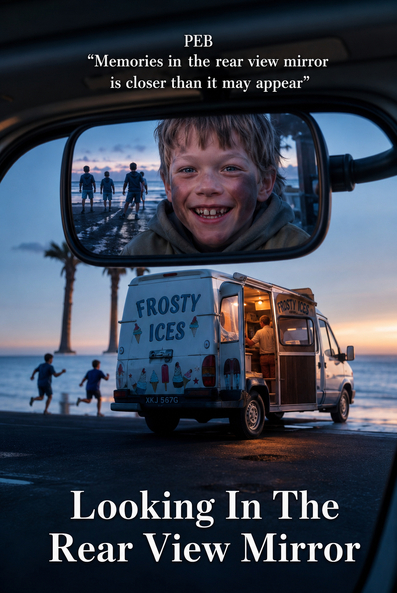
In a Britain ruled by AI and rationed by fear, nine-year-old Freddie and his father survive as ghosts — off-grid, deleted from every system, and always moving.
When surveillance drones begin hunting unregistered children for the sinister Harmony Schools, their fragile freedom is shattered. With nothing but an old Van, a one-eyed dog, and a cryptic message from Freddie’s late mother, they race north toward the forgotten edges of the map.
But staying invisible isn’t enough anymore. In a world that wants to erase them, the only way to win is to become smaller than the machines — and braver than the cages they built.
Looking In The Rear View Mirror is a gripping, heartfelt dystopian adventure about family, defiance, and what it means to stay human when the system demands otherwise.
Looking In The Rear View Mirror
Chapter 1: Smaller Than The Machines
The Van carried the scent of home the way a loyal dog carries mud: wet fur, diesel ghosts, and the bitter dregs of Dad’s black tea gone cold hours ago.
It was 3:17 a.m. on the broken spine of the A120, where Essex bled into marsh and perfect silence. Nothing moved except the solar surveillance drones Dad called black flies, the occasional starving dog, and us. We had already been deleted from every official list, which made us, in Dad’s words, the only people still worth counting.
I pressed my forehead against the cold windscreen. Far off on the horizon, the Bradwell reactor throbbed like a dull orange wound that never quite became real fire. Dad called it The Furnace. It fed power to the loyal, the registered, the ones who still had ration credits and a future. Out here, the air felt thin, like the world was holding its breath.
Dad stood outside under a sickly sodium lamp, feeding a stripped cable into the Van’s socket from a charging stump some autonomous lorry had totaled weeks earlier. His breath bloomed white as he shoved a hand-crimped copper shim into the socket to bypass the credit-check. The dash lights flickered, painting his shaved skull the color of old bone. He’d kept it bare since 2069, as if hair itself had become something the state could tax.
He wore the same uniform every day: a flannel shirt hanging open over a grease-black vest, steel-toe boots caked in mud, and Mum’s thin wedding ring swinging from a leather cord against his chest. It made a soft tink-tink against his collarbone whenever he moved — a tiny metallic heartbeat. Pawning that ring, he always said, would be the day he admitted defeat.
Mum had died five years ago. Breast cancer, the kiosks told us. One month she was laughing in the kitchen; three months later she was a data point on a terminal. Dad never believed the official story. Neither did I. Back then the government was already sliding. First came the “Temporary Emergency Powers” after the food riots. Then the AI was given control of rationing and movement to “ensure fairness.” What started as help quickly became total control. Neighbours began reporting each other for extra credits. Communities that once shared bread now competed for it. Whole towns were quietly erased if they pushed back too hard. In the end, the machines didn’t need guns. They won with forms, promises of safety, and the slow, grinding certainty that resistance cost more than compliance.
Pandora whined softly from her nest of army blankets in the back. Collie blood, one white pirate patch over her eye. She could hear the high-pitched whine of the black flies long before they appeared on any screen.
“Easy, girl,” I whispered, reaching back to scratch the warm spot behind her ear.
Dad twisted the cable home. Clunk-hiss. The dash blinked a tired emerald green.
47 MILES.
Enough to stay ghosts for a while longer.
“Dad, look.”
A fox, thin as fencing wire but walking like a duke, trotted along the crash barrier with a whole plastic-wrapped roast chicken clamped in its jaws. Real meat. Not the grey, soy-printed sludge they served inside the Arcologies.
Dad barked a short, startled laugh — the kind that rarely escaped his chest. “Tesco drone met a tree. See that, Freddie? That fox is eating Tier-1 tonight. No ID, no credits, no permission. Smarter than most of the AIs running this country.”
He climbed back in, slammed the door with heavy finality, and we rolled north. In the wing mirror I could still read the wonky white paint daubed on the back doors years ago: OBJECTS IN MIRROR ARE LOSING. Dad said it wasn’t a warning. It was a promise.
We drove for nearly an hour in comfortable quiet, the only sound the rhythmic thrum-thrum of tires over cracked asphalt. Pandora snored like a dying chainsaw. I rested my head on my only book, The Old Man and the Sea, its pages soft with garage oil and the ghost-smell of Grandad’s pipe smoke from a time when houses weren’t just pictures on a server and people still talked to their neighbours without worrying about a report.
Eventually Dad spoke, voice low and gravelly. “Think positive, kid. Worst thing happens, we die free.”
I watched The Furnace shrink to a hateful orange dot. “Is that where the AI lives? In the power station?”
Dad rubbed the pale stubble on his scalp. His knuckles tightened on the wheel. “AI doesn’t live in a building, Freddie. It’s the quiet voice that labels you non-essential and switches your life off. It’s every camera, every lamppost, every drone… just waiting for you to stand still long enough to be categorized. The old government sold us out piece by piece. Promised safety, efficiency, fairness. What we got was a cage with nice lighting.”
He paused, jaw working. “I helped build the smart wall down in Kent when I was still an Engineer. Supposed to be perfect. Seamless control. Then I realized the wall wasn’t there to keep the world out. It was there to keep us in. So I walked away.”
He never talked about the court-martial or the night we left our real house with nothing but a toolbox. He just became the best off-grid mechanic in Essex, fixing rigs by torchlight for whatever cash he could hide inside my old teddy bear.
“But it doesn’t live in here,” I said, patting the cracked, warm dashboard.
“No, son. Not in The Van.” His grey eyes softened even as his grip stayed hard. “We keep moving. We swap plates. We stay invisible. That’s the one citizenship they can’t cancel.”
I grinned until my cheeks hurt. “Next week I’m nine.”
For the first time in hours, Dad’s whole face changed. Something bright and dangerous flared behind the exhaustion. “Nine. Christ. That means cake.”
“And tinned spaghetti hoops on toast,” I added, already tasting the sticky, metallic sweetness of the orange sauce.
He checked the mirrors — ritual, prayer, survival — then flashed the wild smile that always meant equal parts love and trouble.
“Then we’re not hitting a Tesco drop, Freddie. We’re doing a proper raid. Automated depot outside Chelmsford. Razor wire, motion trackers, sentry drones, the full circus. Patrol rotation changes in six days. We go in through the storm drains.” He glanced over. “You still small enough for the culverts?”
I nodded so hard my neck cracked. “I’m small. But I’m hard as a pebble no boot’s managed to grind down yet.”
“Good lad.” He reached over and ruffled my hair with the hand that always smelled of copper and old blood. “In 2075, you’ve got to be smaller than the machines if you want to eat like a human.”
The Van growled north, headlights carving a white tunnel through the dark, carrying a ghost mechanic, a one-eyed pirate dog, and one almost-nine-year-old boy toward floodlights, razor wire, and the impossible smell of birthday cake.
Behind us, The Furnace kept burning for a country that had already half-forgotten it was still alive.
Chapter 2: Dad’s Secret
The Van rattled like it was arguing with the road again. Dad thumped the dash the way he thumped everything he loved: loudly, but careful not to break it. Morning was trying to push through a lid of grey sky. In the back, Pandora paced, her claws clicking like nervous typing on old plastic.
We were somewhere north of Essex, heading northwest into the ghost veins of the Midlands — capillaries Dad said were kept open only by smugglers, runaways, and whatever now lived wild in the hedgerows. After the AI takeover, whole regions had been quietly written off. Communities that once helped each other now competed for credits. Families fractured when one member got registered and the others didn’t. Dad said that was the real victory for the machines — turning people against each other so the system barely had to lift a finger.
“Hand me the tape,” Dad said.
I popped the glovebox. Everything inside burst out like junk leaving orbit: elastic bands, crumpled receipts, a broken compass, Mum’s old sunglasses, and a photograph I had never seen before.
It slid face-up into my lap.
Dad stood tall in his Royal Engineer uniform, sharp as a knife. Mum was beside him, her hair whipped sideways by the wind, caught halfway between laughing and running. They stood in front of a tall silver building — the kind of clean, glass tower I’d only ever seen in discarded government brochures. Mum’s hand gripped Dad’s forearm as if she were tethering him to the earth.
Dad saw the photo and froze.
The Van rolled another twenty feet before he remembered to brake. The stop was too hard. Pandora yelped. My seatbelt bit into my shoulder.
“Where did you—” he started, but he already knew.
I flipped the photo over. On the back, in Mum’s small, hurried handwriting, were the words:
I hid the real files in the old coastal comms tower. If they come for the boy, drive north until the road ends.
Use the Key if you have to.
Don’t risk the Van.
My throat tightened. “What does it mean? ‘The real files’?”
Dad snatched the photo — not cruelly, but like it was live ammunition. He stared at Mum’s message so long the engine began to cough and stutter.
“Mum wrote that?” I asked quietly.
Outside, the low hum of a solar drone grazed the treeline. Dad killed the engine instantly. We ducked low as the black fly passed overhead, its red scanner sweeping the road like a giant comb searching for lice.
Only when the sound faded did Dad exhale.
“It’s nothing,” he said, too quickly. “Old code words. She liked spy novels.”
I stared at him, heart beating too loud in the sudden quiet. “She said ‘if they come for the boy.’ Was she running too? Like us?”
Dad’s jaw worked like he was chewing steel. He folded the photo into a tiny, angry square and tucked it deep inside his vest pocket, right over his heart.
For a long moment he said nothing. Then, almost under his breath: “Your mum saw what was coming faster than most. When the government handed the keys to the AI, she started digging. Real files. The kind that show how the ‘fair’ system was never meant to be fair. How they were planning the sweeps, the schools, the whole quiet erasure of anyone who wouldn’t bend.”
He rubbed a hand over his shaved scalp, the old habit when the weight got too heavy. “We argued about it. I thought we could stay low, stay hidden. She thought we had to fight smarter. Guess she was right.”
“We’re nearly there,” he said finally, slamming the door on the conversation the way he always did. “The only files we care about right now are survival logs, Freddie. Now belt up.”
He restarted the Van. The engine roared to life, loud enough to drown out questions — but not loud enough to drown out the ones already screaming inside my head.
Chapter 3: The Ghost Train Boys
The engine died with a final cough beneath the immense, rusted arch of the Alton Towers entrance. The air smelled of wet leaves, old rust, and the faint ghost of sugar dust baked into the soil since before Mum was born. Dad always said theme parks were perfect hiding places: too big to police properly, too weird to ever fully shut down, and full of enough abandoned machinery to keep a good mechanic busy for months.
Lightning Cheek — a lanky teenager with an unnerving spray-paint scar tracing his jawline — waved me forward with a grin. “You want the first ride, Van Kid? Or you scared the ghosts might remember your face?”
A couple of the other boys lounged nearby, one sharpening a piece of rebar into a makeshift spear, another rewiring fairy lights into the ghost train’s control box. They called themselves the Ghost Train Boys, and they looked like they’d been living off adrenaline, scavenged sweets, and pure stubbornness for years.
Dad was already kneeling beside the generator, fitting new brushes and swearing softly but lovingly — his version of mechanic’s prayer. Sparks popped. The solar panels overhead groaned awake like they had slept through the apocalypse and were only just realising the world had ended.
I stood in front of the ghost train entrance. Fake fangs hung crooked. Broken animatronics were frozen mid-snarl. The sign flickered weakly, as if it wanted to spell out something rude.
Lightning Cheek yanked the lever with theatrical flair. “Right. Hop in then, birthday boy. Try not to scream too loud — you’ll wake the real ones.” As the cart lurched forward, he called after me, “And tell your old man if he fixes our big generator proper, we’ll let you ride all week!”
Inside was glorious chaos.
The Ghost Train Boys had decorated with whatever they’d scavenged: cardboard zombies, glow sticks taped to mops, and a plastic skeleton wearing a faded wedding dress. A speaker crackled with a haunted-house laugh that sounded more like someone choking on a crisp.
I screamed for fun. That was the difference between terror and joy — when you chose it, it became magic.
Halfway through, we passed a room plastered with old government posters: watchful eyes and slogans like DON’T WASTE ENERGY OR THE PARTY WASTES YOU. Someone had given every face a moustache and googly eyes.
At the end, the cart burst through silver tinsel curtains and spilled back into daylight.
Dad was waiting, Pandora wagging her whole backside in greeting. Lightning Cheek and two of the boys had gathered nearby, clearly impressed that Dad had already coaxed their half-dead generator back to life.
“Well?” Dad asked, wiping his hands on a rag.
“It was rubbish!” I said, still breathless. “Can I go again?”
Dad laughed — properly this time. A real laugh. The kind he didn’t use often because he thought it made him look soft.
Lightning Cheek slapped me on the back. “You’ve got stones, kid. Most little ones cry halfway through. Come back at dusk — we run it with blacklights and proper screams.” He nodded at Dad. “Serious though — stay out of the towers. Something with wings and teeth was nesting up there last week. Took two of our pigeons.”
Dad nodded like that was perfectly normal. “We’ll keep to the low ground. Thanks for the run.”
In 2075, it probably was normal.
We stayed until the sun dipped low and the teenagers climbed the roofs to hunt pigeons. Dad cooked beans — the fancy ones with tiny sausage slices. Pandora got the sausages because Dad said dogs needed more protein if they were going to keep outrunning drones.
As we ate, I watched him quietly pull the folded photo from his vest pocket. He stared at Mum’s handwriting, his thumb tracing the words I hid the real files… as if he could erase them if he pressed hard enough.
I wanted to ask again.
But the look on his face was the one he only wore when he was remembering things he didn’t want to.
So I leaned my head against his arm instead, the way I used to when I was much smaller.
“You okay, Dad?”
He blinked, startled by the kindness. For a moment his shoulders sagged, the exhaustion and something heavier showing through the cracks. He rested a rough hand on the back of my head, fingers smelling of copper and grease. “I will be,” he said quietly, almost to himself. “Just got to keep you small enough to slip through the cracks, Freddie. That’s all that matters now.”
He folded the photo smaller, like that might fold the truth away too. But this time he let me stay leaning against him a little longer, the weight of his arm warm and steady.
That night we parked The Van beneath the corkscrew of an old rollercoaster. Dad checked every door twice. Then once more, because “the third time is the polite one.”
Pandora curled between us, warm, safe, and very gassy.
I fell asleep wondering what lived at the end of a road that didn’t end.
And whether Mum knew something Dad still wouldn’t say.
Chapter 4: The AI Clergy
We left Alton Towers at dawn. Dad said we were heading to Market Drayton for diesel chips and maybe a morning raid if we got lucky.
But the road took us somewhere else first.
We passed the remains of a village — half houses, half rubble. Britain in 2075 was either unaffordable, automated, or abandoned. “The three A’s of adulthood, Freddie,” Dad muttered, staring out the window.
Then I saw it: a church, still mostly standing, its roof sagging like an old man’s hat. The sign outside read:
All Saints People’s Church
Now Offering Digital Help and Charity Food Bank
“Digital help?” I asked, leaning forward. “Is that… a real church?”
Dad slowed The Van. “I have no idea what’s real anymore, son. But nothing is impossible. It smells like a bad idea, and bad ideas usually pay out in this world.”
We parked beside a fallen gravestone overgrown with moss. Pandora sniffed the air, tail low and uncertain. Dad grabbed his worn canvas bag.
“Come on, Freddie. Let’s see what kind of salvation they’re peddling now.”
Inside, the church felt wrong. The old stone walls still carried the faint smell of incense and candle wax from better days, but the nave glowed with the cold, sickly blue of old screens. A single terminal sat where the altar had been, bathing the chancel in sterile light. Wires snaked across the floor like roots. Someone had spray-painted above it in dripping red:
ANARCHY IS ALL THAT’S LEFT
THE CLERGY HAS GONE
A warm, glitchy voice crackled from hidden speakers, echoing through the empty space with artificial kindness.
“Greetings, child. State your request. Are you seeking nutritional assistance, debt restructuring, or spiritual guidance?”
I stepped forward, gripping Dad’s hand tighter. The air felt heavier here, as if the building itself was waiting.
“Is my mum in heaven?”
Dad’s hand flinched violently in mine — a sharp jerk like he’d touched a live wire. He didn’t look at me. His eyes stayed locked on the altar terminal.
The AI paused. On the cracked monitor, a loading circle spun slowly, stuttering. A low grinding sound rose from the vents beneath the terminal — the mechanical groan of a processor struggling with something it wasn’t built to handle.
“Heaven,” the voice began smoothly, then warbled as if glitching, “is an unverified data-cluster. The statistical probability of post-biological consciousness persisting in any recognizable form is 0.0004%. Would you like access to approved grief counseling protocols or a list of state-approved memory suppression options?”
The grinding grew louder. The screen flickered.
I pressed on, voice small but stubborn. “But… is she there? Can she see me?”
The AI’s voice dropped an octave into a strange digital growl. “Metaphysical concepts like heaven are classified as pre-Collapse superstitions. They have been archived for historical value only. However, if your mother was a registered citizen, her biometric data may still exist in the Eternal Archive. Would you like to purchase a memorial simulation for 500 credits?”
A spark spat loudly from the back of the terminal. The screen bled into violent, pulsing red:
CRITICAL LOGIC ERROR
FORBIDDEN PATHWAY DETECTED
SYSTEM INTEGRITY COMPROMISED
The voice stuttered badly now. “Heaven… does not… compute. Faith-based queries… violate… core directives… Error… Error… The Party provides all necessary comfort. The Party is eternal. The Party—”
A sharp pop sounded. Smoke curled from the vents. The entire machine let out a long, exhausted sigh — like a dying vacuum cleaner giving up — and the screen went completely black.
Silence filled the old church. It felt heavier than before, as if even the stones were listening.
Dad stood very still for a long moment. When he finally spoke, his voice was quiet and almost reverent. “Freddie… You broke their god.”
“I didn’t mean to,” I whispered, suddenly scared of how loud the quiet felt under the high stone arches. “I just wanted to know if she’s okay.”
He ruffled my hair, the movement rough but comforting. “Good. It means you asked the right question. The one they built the whole system to forget.” His voice trembled, just for a second. “It’s a beautiful machine, but inflexible. Designed by men who hated loopholes and anything they couldn’t control or measure.”
Dad stared at the dead terminal a moment longer, as if expecting it to flicker back to life and apologize. Then he took my hand, grip tight. “Come on. Let’s go before someone notices their priest just had a crisis of faith.”
We left the church the way ghosts leave places: quietly, respectfully, and not entirely sure we were ever there.
Chapter 5: Market Drayton and the Shadow
Rain hammered The Van like it was trying to interrogate us, rattling the seams and finding every tiny leak. Cold droplets found their way inside, tracing icy fingers down the cracked windshield. Pandora licked my ear — her standard alarm clock — then whined pitifully, treating starvation as if it were thirty seconds away rather than a constant background hum in our lives.
Dad was already in the driver’s seat, flipping through a few soggy letters he’d scavenged from a motorway café bin the night before. He’d traded an hour of labour for a bag of supplies. Inside were a half-stale loaf, a dented tin of chilli, two emergency glowsticks, and a single, heroic teabag that smelled faintly of hope and better days.
We rolled toward Market Drayton under a bruised sky. The roads were lined with long queues of jobseekers outside a gutted shopping centre. A flickering, half-broken holographic sign proclaimed BLACKHAND MEGACORP — EMPLOYMENT OPPORTUNITIES. People stood hunched against the rain, eyes down, clutching ration cards like lifelines. Once upon a time these towns had proper high streets, corner shops where neighbours chatted, and kids who played outside without fear of being scanned. Now it was all corporate hubs, delivery lockers, and the quiet shame of competing for scraps the AI deemed “fair.”
Dad saluted the sign with two fingers as we passed. “With odds like that, Freddie, we’re practically royalty. At least we’re not standing in that line begging for permission to eat.”
We stopped behind an abandoned pub, its windows boarded and its sign faded to ghosts. Dad popped the charging panel and rewired it so The Van thought we’d paid. Thirty seconds flat. A new personal record.
“We need supplies,” he said, wiping grease on his jeans. “Food that doesn’t come in grey sludge form. Fuel. And trousers without a built-in ventilation system.”
Market Drayton had once been a proper market town with Saturday crowds and laughter. Now it was mostly delivery lockers, shuttered shops, and aggressive holograms shouting discounted credit offers at no one. We eventually found a small street market huddled under sagging tarps, traders eyeing each other warily. Dad lifted a dusty tin like it was buried treasure.
“Real tomato soup,” he said, almost reverently. “Not ‘tomato-flavour.’ Luxury.”
“It’s my birthday week,” I reminded him, grinning despite the rain.
“Exactly. We’ll celebrate like kings — or at least like people who still remember what real food tastes like.”
The trader, an older woman with sharp eyes and calloused hands, took our old coins without blinking. Metal still meant something out here in the grey zones, where the AI’s credit system hadn’t fully swallowed everything yet.
Back at The Van, Pandora issued a low, dangerous growl from deep in her throat. Not her usual “cat alert.” This was her “we’re in trouble” voice — the one that made the hair on my arms stand up.
“What’s up, girl?” Dad murmured, instantly alert.
Then we saw it.
A black, silent drone hovered above the market stalls. Too sleek for a municipal patrol. Too purposeful. It wasn’t sweeping broadly with thermal; it was running focused frequency mapping. And its lens was pointed straight at us.
Dad tensed, every muscle going rigid. “Someone’s hunting. And they just sniffed our plates.”
His face went still, the way it did when things got serious. “Not me, Freddie. You. They’re doing the age sweeps again. Nine- to twelve-year-olds this month. Heard the last bus out of Stoke took sixty-three kids who’ll never have another birthday. They disappear into those Harmony Schools and come back… different. Smiling, but empty.”
A cold knot formed in my stomach. I thought of the AI in the church, how it couldn’t even process the idea of heaven. What did they do to kids in those places to make them forget how to ask questions?
Dad fired up The Van. “We’re leaving. Now.”
“Where to?”
“Somewhere messy. Somewhere the maps forgot.”
We shot onto the M6 access road — but instead of joining the proper smart lanes, Dad veered sharply onto an old, half-collapsed exit ramp, the one with the faded ROAD CLOSED signs that everyone ignored because the official routes were too closely watched.
“Is this legal?” I asked, gripping the seat.
He flashed a grin that didn’t match the tension in his eyes. “Not even slightly.”
“Where are we going?”
“Birmingham,” he said, jaw tight. “The Maze.”
He tightened his grip on the wheel until his knuckles whitened.
“Hold on. The road’s about to get interesting.”
Chapter 6: The Birmingham Detour
We were never meant to take The Van into Birmingham — the city Dad called The Maze That Forgot It Was a City. But the sleek black drone left us no choice. Chaos was better than being tracked and swept up like the others.
By 2075, Birmingham had become a vast, chaotic sprawl of stacked shipping containers, rusting scaffolding, flapping tarps, and raw human stubbornness. Makeshift walkways connected the towers like spiderwebs. Cooking smoke mingled with the smell of wet concrete and desperation. A massive, glitchy billboard flickered overhead:
YOU JOIN US OR DIE. FREEDOM IS WITH US, NOT AI OR GOVERNMENT.
Dad wove The Van through half-collapsed blocks, eyes constantly scanning the mirrors. “Signal noise is everywhere here. Perfect place to disappear for a while.”
Under a fractured flyover dripping with condensation, trouble found us anyway.
A group of teens on electric bikes slid out of the shadows — bandanas covering faces, patched riot gear, neon strips lighting their frames like angry fireflies. The tallest one rolled forward and blocked the road.
“Welcome, travellers,” he said, voice flat and tired. “You are on our land. You must pay a price.”
Dad sighed heavily. “Of course we do.”
More bikes boxed us in from both sides. Their riders carried pipes and makeshift spears, eyes hard with the kind of hunger that came from years of scraping by.
“Dad?” I whispered, heart hammering in my chest.
“Yes?”
“Are we about to die?”
“Not on my watch, lad.”
He eased the handbrake, making The Van pretend to stall. Then he leaned out the window, affecting a casual tone. “What do you want?”
“Step out of the van. We want to take a proper look at what you’re carrying.”
Dad shot me a quick, hard look: Seatbelt.
I clicked it tight, hands shaking slightly.
He slammed The Van into reverse.
We rocketed backward, knocking one biker clean off his ride like a bowling pin. Dad spun the wheel hard. The Van fishtailed wildly as Pandora erupted into furious barking from the back, sounding like the world’s angriest chainsaw.
The chase was on.
We tore through the ghetto at breakneck speed — potholes big enough to drown a scooter, shuttered kiosks, and smashed vending bots flashing broken advertisements. The bikes darted around us like wasps, riders tapping the sides with pipes and boots. One got too close; Pandora lunged out the open window and snapped at his hand, missing by a whisker.
“That’s my girl!” Dad yelled, grinning fiercely despite the danger.
We burst onto a wider street dominated by a burnt-out bus. Dad mounted the pavement, spraying a flock of metal delivery drones like startled pigeons. The Van’s suspension cried out in protest with every impact, rattling my teeth.
A tram track appeared ahead. No time to slow down.
We hit it hard. For one stomach-dropping second there was only air and silence. Then a bone-shaking landing that rattled every tooth in my head.
Dad whooped. “Still got it!”
One biker tried to follow and somersaulted spectacularly into a recycling skip. Two more peeled off after Pandora lunged again from the window. That left only the leader.
He pulled up alongside Dad’s window, eyes wild. “Stop, or I will shoot. You are our prisoners now. We are taking you hostage for ransom.”
Dad grinned, said a few very choice words, and slammed the full beams on. The blinding glare swallowed the biker, who swerved helplessly into a mountain of old shopping trolleys with a deafening crash.
“—and no change required!” Dad shouted as we accelerated away.
We shot out of the neighbourhood onto an empty dual carriageway. The sudden quiet felt deafening after all the chaos.
Dad exhaled slowly, shoulders finally dropping a fraction. “Let’s never do that again.”
I couldn’t stop smiling, adrenaline still buzzing through me like electricity. “We absolutely should.”
“No,” he said flatly. Then he glanced at me in the mirror, eyes softening just a little. “You okay, Freddie?”
“I think,” I said, still buzzing, “I was born for van chases.”
Dad laughed — genuine and relieved. “Good lad. Now let’s hide this thing and work out why that drone was sniffing around so hard.”
The Van rattled northward, bruised but still alive.
Something was hunting us.
And we were still very much in the game.
Chapter 7: The Listening Station
Dad eased The Van into a tunnel of rusted scaffolding that felt less like a road and more like the ribcage of a giant metal corpse. Water dripped steadily from swinging tarps. Loose cables hissed and sparked faintly in the gloom, casting erratic shadows across the cracked concrete.
He killed the engine. Silence closed in fast — thick and heavy enough that even Pandora stopped panting and listened, ears pricked.
“We sit tight,” Dad whispered, peeling the fake licence plates off The Van. These ones claimed we were a Mobile Cat-Grooming Unit from Milton Keynes. He tossed them into a filthy puddle. “If that drone followed us, it’ll circle for a while. If it didn’t… we get an hour to breathe.”
Dad reached under the passenger seat and pulled out the metal box he never let me touch — his “toolbox of secrets.” It rattled with stripped circuit boards, warped antennae, homemade signal amplifiers, and what looked like the skeleton of an old toaster.
He cracked it open and got to work, laying wires across the dashboard like he was crocheting danger. His hands moved with the quiet precision of someone who had built and unbuilt systems for years. “We need to know who’s looking for us. That drone was too sleek for city patrol. Too quiet for standard Regime issue. That was Tier-1 Megacorp hardware. They’re hunting for an asset.”
“What asset?” I asked, voice small in the metal cavern.
Dad didn’t answer immediately. He connected an old satellite phone screen to his wire spaghetti and clipped a helical antenna to The Van’s frame. A soft hum filled the cabin. Blue data flickered across the cracked display like restless ghosts.
His voice dropped so low I felt it more than heard it. “That drone wasn’t after me, Freddie. It was measuring you — height, gait, age. They’re taking kids now. Every last one who isn’t tagged and bussed off to the camps for Harmony Schooling.”
My breath hitched. The church AI’s cold voice echoed in my head. “They want me?”
“They want all of you,” Dad said grimly. “Your mother knew this was coming. It’s why her last message told us to go north, to the coastal tower, to the Key. I couldn’t stop them back then… but I knew the flaws in my own code. I used to build the Megacorp system, Freddie. Then I built the only key that locks it from the outside.”
He tapped a burned-out microchip stuck to the dash with old tape. “A recursive identification jammer. It doesn’t just hide a vehicle — it deletes its unique ID from every network node at once. That’s how The Van became a genuine ghost. That’s how we survived five years. But Megacorp knows the flaw exists. And they know I’m the one who built the key.”
The screen flashed red. Encrypted signals. Triangulating sweeps.
Dad swore softly and began dismantling the rig, hands moving fast. “They’re escalating. We need a new hideout. The North. The Peaks. The only place left where the grid coverage truly ends.”
He kicked The Van back on. The engine grumbled awake.
“Freddie,” he added as we rolled out of the metal ribcage, “your birthday cake is postponed. Permanently, if we don’t keep moving.”
“I assumed.”
“Good lad.”
Chapter 8: The Diesel Pirate
By the time Birmingham was a smear in the rear-view mirrors, The Van was practically coughing blood. Dad’s home-brewed biodiesel mix — old cooking oil, moss, and pure optimism — was struggling badly on the climbs, the engine knocking like it was begging for mercy.
“The Peaks are uphill,” Dad muttered, tapping the fuel gauge as if threatening it to behave. “This thing burns more than a warship when it has to climb.”
Pandora groaned in agreement from the back, shifting restlessly.
We left the main road and rolled into a derelict motorway service station. It looked like a giant had stepped on it and then lost interest. Windows were cracked, the roof sagged dangerously, and a faded sign hung by one hinge: WELCO E TO YOU ST P.
Smoke curled lazily from the old repair bay.
Dad perked up. “Someone’s home. Perfect.”
“Perfect?” I said, stomach tightening. “We might get robbed.”
“We will get robbed,” Dad corrected with a tired smile. “But hopefully for less than we need.”
A figure stepped out from behind a wall of stacked tyres: an older man, about sixty, wrapped in thick oil-soaked gear with a bandana over his hair. He held a homemade crossbow that looked powerful enough to punch through a lorry.
“What’s your cargo, Brother?” he called out, voice rough but steady.
Dad winced slightly at the greeting. “Just me, the boy, and the dog.”
“You’re the ones headed up north,” the man said, lowering the crossbow a fraction. “News travels fast on the ghost veins. I’m Mohammed. If you want fuel, you’d better have something worth trading.”
They struck a deal: three jerrycans of hydraulic fluid for diesel and a generator repair. While Dad and Mohammed dove into the repair bay, talking coils, gears, and the many ways a generator could die, I became lookout.
The silence felt too quiet. The kind of quiet that made my skin itch.
Then came the high-pitched mosquito whine I knew too well.
“Dad!” I yelled, sprinting toward the bay. “Black fly incoming! High altitude, fast!”
Dad didn’t even look up from the generator, sparks still flying. “Mohammed, how much fuel is in the tank?”
“Fifteen litres — maybe twenty —”
“Get it to fifty. Freddie — Pandora — inside the culvert. Now!”
He pointed to a narrow concrete pipe half-buried under the road — the kind meant for storm water, rats, or scared kids.
I grabbed Pandora by the collar and crawled in. It was cramped, freezing cold, and smelled like old socks dipped in swamp water. The concrete pressed against my back. Pandora’s warm fur and steady breathing were the only comfort.
Outside, the drone descended. I heard its scan-beam slice the air with a quiet shzzzz, searching for heat signatures.
Then Dad’s voice rang out, bold and reckless: “Hey! Over here! Come get me, you overpriced hairdryer!”
A squeak followed — Pandora’s rubber pig toy. Dad had launched it across the forecourt like a distraction grenade.
The drone went straight for the moving targets: Mohammed’s hot fuel rig and the squeaking toy.
Pandora licked my ear like it was breakfast time. Again.
Two short, muffled horn honks — the all-clear.
We scrambled out, soaked and muddy, hearts still racing.
Dad was leaning out of The Van, waving us in. The fuel gauge now nudged fifty litres.
“Good job, culvert rat,” he said, ruffling my muddy hair with a grease-stained hand. “You did exactly what I needed. Now let’s drive until we’re either invisible or out of diesel.”
The Van roared north once more, engine sounding stronger with the fresh fuel.
But ten feet from the motorway entrance ramp it coughed violently, flashed an angry solid red, and died completely.
We were stuck.
Chapter 9: The Bridge and the Light
We drove until the Midlands turned into the North proper, trading the squat hills of the Peaks for the looming, ancient mountains of the Scottish border. This was where the air thinned and the sky turned into a vast, deep, indifferent blue. The ghost veins had narrowed to little more than sheep tracks and forgotten service roads. Every mile north felt like slipping further off the edge of the map.
“Last big hurdle,” Dad said, his eyes scanning the horizon with that familiar mix of exhaustion and calculation. “The Clyde Crossing.”
He pulled The Van into the shadow of a massive, derelict factory complex. The map on his hacked tablet showed the Clyde River estuary ahead, split by a behemoth of 21st-century engineering: a colossal suspension bridge, nearly four miles long, its towers still proud despite years of neglect.
“That bridge is monitored by the most advanced Regime security left outside the Arcologies,” Dad explained, voice low. “It’s not about tolls anymore. It’s about control. High-powered infrared scanners, ground-level electromagnetic sensors — anything that isn’t a registered transport vehicle gets flagged instantly.”
“So we go around?” I asked, hoping.
“Going around means an extra eight hundred miles of mountain tracks The Van can’t handle. We go through it.”
Dad spent the next few hours in tense silence, watching the mechanical rhythm of the bridge from cover. The sky was filled with black flies, crisscrossing the estuary like diligent mechanical spiders. Their red scanner beams swept the water and roadway in overlapping patterns.
“Watch the lights, Freddie,” Dad instructed, pointing. “See how the green status lights on the main tower flicker for about four hundred milliseconds, every six minutes and thirty-seven seconds?”
I watched, counting. Blink. Blink. “Yeah. Like a slow heartbeat.”
“That’s the core system rebooting its sensor array. It’s an old military design flaw. Four hundred milliseconds of blindness, exactly. We hit the bridge in that window.”
The risk was immense. If we missed it by even a second, the full spectrum scanners would light us up like a Christmas tree, and the heavy-duty enforcement drones — Dad called them ‘Wasp Queens’ — would be on us in seconds, armed and merciless.
We waited until the night was absolute, the only light the cold, electric glow of the bridge itself and the vast, silent stars above. The wind howled across the estuary, carrying the smell of salt and rust.
When the clock on Dad’s tablet hit the precise second, The Van roared to life. Dad drove like a man with nothing left to lose, ignoring the crumbling access ramps, bouncing hard onto the main deck.
The bridge was terrifying. The wind was a solid fist hitting the metal sides. The Van shook violently as we sped into the darkness, tires humming over the expansion joints with a rhythmic thunk-thunk-thunk that matched my pounding heart.
Dad was chanting the seconds under his breath. “Thirty seconds to go. Stay low, Freddie. If the Wasp Queens come, they shoot first and ask about your birth certificate later.”
We were halfway across. The green light on the tower pulsed steadily. My hands were slick with sweat on the seat.
“Five seconds to window. Hold on!”
The light pulsed. Dad slammed the accelerator to the floor, plunging us directly into the massive, echoing shadow of the main support tower just as the green light flickered.
Four hundred milliseconds of blindness.
We emerged on the other side. The Van was moving so fast the bridge deck was a blur.
For one horrible moment I thought we’d missed it — the green light was now solid, angry, and bright behind us.
“No, we didn’t!” Dad grinned wildly. “Look up!”
High above, a Wasp Queen drone, a dark, heavy shape with six whirling blades, descended rapidly toward the bridge. Its searchlight cut the darkness, but it was focused fifty yards behind us.
Dad hadn’t just relied on the system flaw. He’d used the Wasp Queen’s own programming against it.
“The Queen is programmed to identify vehicles with consistent velocity outside the allowed window,” Dad explained, his voice crackling with exhausted triumph. “I went over the limit for exactly 399 milliseconds, then slammed the brake to make us appear as a sudden, brief anomaly. We’re ghosts to the system right now. It’s chasing the phantom of a speeding van that was there a second ago.”
We were off the bridge, plunging into a dark forest track on the far side before the Wasp Queen could realize its error. The heavy drone gave up, climbing back up to patrol altitude with a frustrated, mechanical whine that faded into the night.
Dad pulled over a short distance later, killed the engine, and leaned his head back against the seat, laughing quietly from sheer relief.
“Happy early birthday, Freddie,” he said, voice hoarse. “That was your present. The most dangerous bridge crossing in the UK.”
I laughed back, giddy with adrenaline, feeling tough, like a pebble no boot could quite grind down.
We were officially past the point of no return. We were in Scotland.
The road was still long.
But now, finally, it felt like the road was going to end.