
SAFETY PINS AND EMERALD EYES
The Punk Summer of 77
The summer of 1977 crackled with restless, electric energy, as if the world had been plugged into an overdriven amplifier. In the mid-August heat, the news of Elvis Presley’s death sent shockwaves through the airwaves, but in the coastal alleys of Brighton, the King was already a relic. Punk rock was the new pulse. The Sex Pistols’ Never Mind the Bollocks snarled from every shop radio along the seafront, a jagged soundtrack for a town that teetered between faded Victorian glamour and raw, youthful rebellion. It was a landscape of crumbling piers and salt-stung air, the perfect stage for a collision of chaos and dreams.
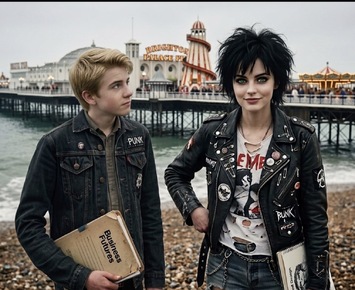
I was Terry Rogers, seventeen years old, though my slight frame and boyish face usually conspired to make me look like a schoolboy who’d wandered onto the wrong set. My blond hair was unevenly cropped, a hacking job I’d performed in front of a cracked mirror in a desperate attempt to mirror the punk aesthetic. It framed a quiet demeanor that didn’t quite fit the noise of the era.
While my peers were busy tearing things down, I was obsessed with how things were built. At Brighton’s School of Art and Technology, I didn’t study sculpture or film; I studied Business Futures. I was drawn to the cold, clean order of spreadsheets and market projections—logical tethers in a world that felt like it was spinning off its axis. My dreams were stubbornly practical: scholarships, professional stability, a life mapped out in ink.
But then there was Amanda Thompson.
She had been a fixture in my life since the fourth grade, ever since a weary teacher had sat her beside me to see if my stillness might rub off on her. Back then, she was a mousy-haired girl with a quick wit and a habit of chewing her pencils to splinters. Now, she was a force of nature. Tall and fine-boned, she possessed emerald eyes so piercing they could stop a stranger mid-sentence. Her hair, once a nondescript brown, had been brutally hacked into black spikes with kitchen scissors. Her face was a constant canvas of thick mascara and deliberate defiance, a perfect mask for her Art and Design major. She wasn't just a fan of the movement; she was a revolution in motion. Every gesture, every sharp laugh, was a challenge to a world that expected her to be quiet.
Amanda claimed it was my brain she admired—my love for books and my habit of listening until the room went silent. “You’re clever, Terry,” she’d say, her voice a teasing, husky warmth that made my practical heart skip beats. Next to her fire, I felt like a shadow, but I was a shadow that lived to chase her light.
Our weekends were sacred rituals. We spent them scouring Woolworths for vinyl singles, swapping band badges like currency, and sitting on the floor of her bedroom stitching safety pins into our denim. We scrawled slogans across our backs in permanent marker—words of protest we only half-understood but felt in our bones.
Overseeing our duo was Wendy, sixteen going on thirty. She was Amanda’s best friend and our self-appointed mother hen. Wendy was the bridge between my rigid order and Amanda’s volatility. While we were dreaming or debating the merits of The Clash, Wendy was the one checking the bus schedules or making sure we’d actually eaten. She was bossy, protective, and possessed a pragmatic streak that kept Amanda’s wilder impulses from steering us off a cliff.
But the balance shifted when Wendy’s family moved to Croydon for her father’s promotion at Debenhams. Without Wendy’s grounding presence, Amanda began to lean on me with a heavy, frantic intensity. School was becoming a battlefield for her. The teachers, blinded by her spiked hair and ripped tights, harped on her slipping grades. I remember the cold afternoon a guidance counselor muttered that she’d end up “pregnant or in prison” before her eighteenth birthday. Amanda had laughed it off, her lashes flicking with green-eyed defiance, but I had seen the flicker of genuine hurt behind the mascara. It was the first time I realized her defensive armor was porous.
That summer, Brighton’s streets buzzed with the hum of scooters and the sharp tang of the tide. The promise of something bigger—something dangerous—hung in the air. Amanda always walked a few paces ahead of me, her heavy boots thumping against the pavement, those jagged black spikes catching the afternoon sun. I followed behind, my notebook of business projections tucked under my arm, watching the girl I loved dance along the edge of a void.
I knew then that she was pulling me into her orbit of chaos, and despite every spreadsheet in my head telling me to stay grounded, I was already beginning to lift off the floor.
The Cafeteria Fight
Late June brought sticky, oppressive heat to the Brighton campus. The cafeteria was a humid soup of smells—vinegar, cheap tobacco, and industrial floor cleaner—underpinned by the rhythmic clatter of plastic trays and the dull roar of teenage ego. I was navigating the minefield of tables, balancing a tray of greasy chips and a sandwich that looked as tired as I felt, my mind busy projecting the interest rates on a hypothetical loan.
The impact was sudden and calculated. A heavy shoulder slammed into mine, sending me stumbling. My tray hit the linoleum with a sound like a gunshot. Chips scattered like shrapnel, and my drink pooled into a dark, mocking lake at my feet.
Dean Edwards loomed over me, blocking out the fluorescent light. Dean was the school’s self-proclaimed hard man, a relic of secondary school grudges who wore his narrow-mindedness like a badge of honor. He hated the punk scene—hated the noise, the safety pins, and the way it made him feel obsolete. But for reasons my spreadsheets couldn’t calculate, he hated me most of all. Perhaps it was the "clever boy" label, or perhaps he just sensed that I was the one thing keeping Amanda Thompson within reach of the status quo.
“Watch where you’re going, Rogers,” he sneered, his voice thick with the practiced malice of a bully who knew he had the physical advantage.
I scrambled up, my hands shaking. I wasn’t a fighter; I was a boy who looked for the exit strategy in every equation. “I didn’t—it was you who hit me,” I managed, though my voice lacked the weight of my convictions.
Dean didn’t bother with words. His hand shot out, a meaty palm slamming into my chest and sending me back against a table. My heart thundered against my ribs. He outweighed me by two stone and held a lifetime of unearned confidence. I knew how this ended: I’d be a bruise on the floor, and he’d be the king of the canteen.
But then the room exploded.
“Oi!”
The scream didn’t just slice through the chatter; it silenced the room. Before Dean could pull back his fist for a second shove, a whirlwind erupted from the periphery. It was Amanda. She didn't just intervene; she launched herself like a jagged piece of glass thrown into a machine.
She was a blur of black spikes and pure, unadulterated fury. Her fingernails raked across Dean’s cheek, leaving three vivid red tracks in their wake. When he tried to shove her off, she didn’t recoil—she leaned in, her teeth sinking into the cartilage of his ear with the desperation of a cornered animal.
Dean let out a high-pitched howl, stumbling back and clutching his head, his eyes wide with the shock of a predator who had just realized the prey had claws.
I stood frozen, caught in a paralyzing mixture of awe and terror. Amanda moved like chaos incarnate—fluid, fearless, and utterly indifferent to the consequences. By the time the heavy-treaded campus security arrived, Dean was a crumpled heap of tears and blood, his tough persona evaporating into the humid air.
Amanda was pulled back, her chest heaving, her black spikes mussed and her mascara smeared across her cheekbones like war paint. But her emerald eyes were blazing with a terrifying, beautiful triumph.
“Are you okay?” I asked, my own voice sounding thin and brittle in the aftermath.
She wiped a smudge of Dean’s blood from her lip and offered a jagged, adrenaline-fueled grin. “I’m fine. You, okay? The prick will think twice before he touches you again.”
I wanted to tell her she was reckless. I wanted to tell her that violence was a variable that rarely balanced an equation. But the words died in my throat. Her fearlessness was a mesmerizing dance with danger that I knew, deep down, I could never replicate.
Later, as we walked home and the sun cast a long, golden glow over the Brighton pebbles, I finally found my voice. “That was… incredible, Amanda. Terrifying, but incredible.”
She elbowed me, her laughter bright and sharp against the salt air. “Terrifying? Me? Don’t be soft, Terry. I just don’t let people hurt what’s mine.”
Her words warmed me, settling into my chest with a weight that felt like a promise. But as I watched her thump her boots against the pavement, I realized it wasn't just about protecting a friend. Amanda thrived on the defiance itself. She needed friction.
I was supposed to be the grounded one, but I was already being dragged across the seabed, caught in the gravity of a girl who was destined to burn bright and fast. I followed her toward the pier, my notebook held tight, knowing that from this moment on, there was no spreadsheet that could predict where she would take me next.
The Croydon Adventure
The train from Brighton to London rattled north with a rhythmic clatter that felt like a ticking clock. Outside, the coastline blurred into a hypnotic patchwork of golden sand and sun-bleached rooftops, eventually giving way to the gray, concrete sprawl of the city.
Amanda sat opposite me, her long legs folded up, knees tucked under her chin. Her sketchbook was a permanent fixture on her lap, and her pencil danced across the page with a frantic, jagged energy. Her black spikes caught the flickering light of the carriage like obsidian, and her emerald eyes were wide, scanning the passing world.
“You know,” she said, glancing up with a grin that made my pulse stutter, “London is where the heart beats now. Croydon might be the suburbs, but it’s close enough to the edge. We’re going to dive into the chaos, Terry. We’re going to taste it.”
I smiled, my hand instinctively tightening on the notebook tucked under my arm. To me, London was a data set—a hub of commerce and Business Futures. To her, it was a fuse waiting to be lit. “I’m sure it’ll be… lively,” I replied, trying to sound as steady as a spreadsheet.
The carriage was alive with the hum of ordinary travelers—families with packed lunches and businessmen buried in the Financial Times. But then, a ripple of electricity moved through the section ahead. Whispers spread like a virus. A man sauntered into the buffet car with a signature sneer that seemed to challenge the very air he breathed.
It was John Lydon. Johnny Rotten himself.
He moved with a casual defiance, followed by a nervous-looking agent who hovered like a gray shadow. Amanda froze mid-sketch. I saw the air leave her lungs. “Is that…?”
“It is,” I whispered. I leaned closer to her, my shoulder brushing hers. The proximity ignited a warmth in me that felt far more intoxicating than the celebrity sighting.
Johnny ordered a beer with a look of pure boredom. Amanda’s cheeks flushed a deep, frantic crimson. She grabbed her diary—the one filled with her private sketches and the scrawled dreams of a girl who felt invisible—and rose on shaky legs.
“Could… could you sign this?” she stammered. It was the only time I’d ever seen her look small.
Rotten glanced down, his trademark smirk curling his lip. He took the pen and scribbled with a flourish that looked like a scar on the page: “Only the fakes survive x Johnny Rotten.”
Amanda clutched the diary to her chest as if it were a sacred relic. When she sat back down, her thigh pressed against mine, and she didn't move away. The contact was electric. “Terry, did you see that? He touched it. He actually touched it.”
“I saw,” I grinned, my hand lingering on her knee to steady her. The air between us was charged, a high-voltage current of punk rebellion and something far more intimate.
By the time the train groaned into the station, our spirits were soaring. Croydon unfolded before us—a gritty, transitional landscape of Victorian brick and raw, brutalist construction. Wendy’s new home was a towering four-story Victorian, ivy snaking up its walls like veins. Under Wendy’s reign, it was a fortress of the underground.
Wendy flung open the door, her hair now a shocking, neon pink. At sixteen, she already carried herself like the matriarch of the scene—pragmatic, bossy, and utterly vibrant. “Finally! You two look like you’ve been up to no good,” she teased, pulling Amanda into a fierce hug before giving me a knowing wink. “Terry, attic’s yours. Amanda, you’re with me—though I suspect I’ll be seeing less of you than I’d like.”
As evening descended, the house transformed. Thirty people crammed into the living room, a sea of leather jackets and safety-pinned denim. The bass from a Sex Pistols track thrummed through the floorboards, vibrating in my very marrow. Cigarette smoke curled like fog, mingling with the sharp, cheap tang of spilled beer.
Wendy held court in the kitchen, mixing potent, questionable cocktails. “Loosen up, clever boy!” she yelled at me over the din, yanking me into the mosh pit forming in the hallway. “Punk’s about feeling alive, not calculating the cost!”
Amanda moved through the crowd like a siren. She was buzzing—from the music, the uppers Wendy had scored, and the sheer heat of the room. She found me in the fray, her hips swaying to the jagged beat, her green eyes locking onto mine with a promise that made my blood run hot.
“Drink!” she shouted, thrusting a vodka-and-coke into my hand. Her fingers brushed mine with deliberate slowness. She leaned in, her breath warm against my ear. “Don’t tell me you’re scared of me, Terry?”
I downed the drink in one fiery gulp, the burn a welcome distraction from the way my head was spinning. She clapped my shoulder, her touch sliding down my arm. “There! That’s my clever boy.”
Eventually, the energy became too heavy, too loud. Amanda grabbed my hand, her grip urgent. “Need air,” she murmured, pulling me through the tight knot of sweaty shoulders toward the back exit.
We slipped out onto the balcony, and the sudden shift was breathtaking. The sticky, beer-soaked heat of the living room vanished, replaced by a deep indigo London night. The distant roar of traffic sounded like far-off surf. I leaned against the railing, wrapping an arm around her waist to shield her from the autumn nip. I pointed upward into the clear dark. “See that? Orion. It’s the only thing that stays in place.”
She tilted her head against my shoulder, her breathing slowing down to match mine. “You always know the coordinates, don’t you? How do you see the world so differently?”
Then, with a mischievous glint, she stepped back into the moonlight. She shrugged off her T-shirt with a fluid, unhurried motion. In the pale light, her skin seemed to glow, a stark contrast to the dark silhouette of the suburban rooftops behind her. She began to dance for me—slow, sensual, entirely unbothered by the cold or the noise thrumming through the glass doors behind us. She was pure, radiant energy, and I was entirely paralyzed by the raw, unapologetic beauty of her.
When she finally took my hand and led me up the narrow stairs to the attic, dodging Wendy’s knowing grin, the world of spreadsheets and logic ceased to exist. The space was tight, the slanted ceilings forcing us close, the smell of dust and old timber hanging in the air. We moved together in a rush of heat and urgency, a collision of my caution and her chaos. It was our first time—raw, exhilarating, and utterly desperate. In the haze of that Croydon night, I made a silent projection: I would follow this girl to the end of the world.
I didn't realize then that "the end of the world" was a place Amanda was already heading toward.
Departure
The summer’s heat clung to Brighton like a fever dream, wrapping the town in a haze of sun-drenched days and music-fueled nights. For a few glorious weeks, the world felt static. Amanda and I had lost ourselves in the rhythm of the tide—cycling along the rugged coast, swimming in the chilly, salt-heavy waves, and collapsing onto hidden beaches where her fingers would trace lazy, nonsensical patterns on my skin. We were a closed loop, an equation that finally balanced.
Then, one ordinary Tuesday afternoon, the envelope arrived.
It was crisp, heavy, and official, my name typed in the kind of stark black letters that don't allow for sentiment. I read it alone in my room, the paper trembling. I had won it: the full scholarship to study Business Futures in Manhattan. It was the once-in-a-lifetime jump from a seaside town to the skyscrapers of the world’s financial heart. It promised everything I’d told myself I wanted: lectures from industry giants, stability, a path out.
But as the excitement flickered, a cold, leaden dread followed. To go meant to let go of my anchor.
Amanda appeared at my door an hour later, unannounced as always. Her black spikes were mussed by the wind, and her emerald eyes were wide with a question she hadn't yet asked. “What is it, Terry? You look like a ghost.”
I swallowed hard, the scholarship letter feeling like a confession of a crime. “I won it, Amanda. Manhattan. It’s for a year. Maybe more.”
The light in her eyes shifted instantly. For a second, a flicker of raw uncertainty crossed her face—the look of someone watching their only safety net being folded up. But then, a mask of deliberate indifference slid back into place. She forced a wild, unpredictable smile.
“Manhattan?” she repeated, her voice testing the weight of the word. “The center of the universe? You have to go, Terry. This is your future. Don't you dare let it slip away because of some punk girl in Brighton.”
“I don’t want to leave you,” I whispered, pulling her into a hug. I breathed in the scent of her—salt, faint cigarette smoke, and the heat of her skin.
“It’s only a year,” she said into my chest, though her arms tightened around me with a desperate, crushing strength. “We’ll write. We’ll call. We’re the fakes that survive, remember?”
The day of departure arrived with brutal swiftness. At the station, the air was thick with the smell of diesel and finality. Amanda pressed her well-worn diary into my hands—the one Johnny Rotten had signed. “Write me,” she said, her voice steady but her eyes glistening like wet glass. “Every day. Tell me about the chaos.”
But as I boarded the plane and felt the engines roar, I felt the first pang of what would become a lifetime of survivor’s guilt. I was being catapulted toward a future; she was being left in a town that had already decided she had none.
Manhattan hit me like a physical blow. The city was a relentless grind of towering glass and concrete, a place where Business Futures wasn't a degree—it was a religion. My days blurred into a marathon of finance lectures and library basements. I became a suit in training, my notebook filling with equations instead of her sketches. I tried to bridge the gap, but the transatlantic static was a bad omen. My letters started as long, heartfelt manifestos, but as the pressure of the program mounted, they shortened into apologies scrawled in the margins of my life.
Back in Brighton, the silence I’ve left behind began to fill with shadows.
Without me to ground her, and with Wendy away in Croydon, Amanda’s fire began to seek a different kind of fuel. Her letters, once vibrant with art, became sporadic and stained. She sought solace in the rougher corners of the scene, the dark clubs where the "no future" mantra wasn't just a lyric, but a lifestyle.
It started with uppers to keep the energy going, but as my absence grew into a void, the lures deepened. A new crowd—older, harder punks—introduced her to the quick fix for the ache she couldn't name. Almost overnight, the heroin slithered in. It turned her revolution into a desperate flicker.
She started borrowing money, then begging on street corners, her emerald eyes pleading with strangers. Each time I managed a call, her voice was different—distracted, slurred, and increasingly distant. She was vanishing into a haze of addiction, and I was three thousand miles away, analyzing market trends while the person I loved was becoming a ghost.
I sat in my sparse Manhattan apartment, clutching that old diary. I didn't know then that the vibrant girl who had danced for me under the stars was being pulled under by a tide I couldn't swim against. I only knew that the distance between us wasn't measured in miles anymore—it was measured in the things we were no longer saying.
Rock Bottom
Returning to Brighton after my first year in Manhattan felt like stepping into a faded photograph that had been left in the sun. The salt breeze still carried the same sting, and the seagulls still screamed their territorial war cries over the pier, but the colors were all wrong. I had changed—hardened by the high-pressure environment of New York, my mind now a ledger of risk management and calculated outcomes.
But no spreadsheet could have prepared me for the deficit I found at home.
I had one purpose: to find Amanda. Her letters had stopped entirely, and my calls to her mother had become increasingly panicked. Mrs. Thompson, once a woman of quiet, Victorian dignity, was now the weary witness to a slow-motion tragedy. When I stood in her hallway, she looked at me with eyes red from sleeplessness, her hands trembling as she smoothed her apron.
“She’s not here, Terry,” she whispered, her voice a fragile thread. “She’s… she’s gone to the shadows. They say she’s staying in the old industrial blocks by the marsh.”
The lead came from Carl Watson. His brother, a police cadet, had seen a girl matching Amanda’s description in a derelict warehouse—a notorious shooting gallery for the lost souls of the movement.
The building loomed at the edge of town, a skeletal relic of Brighton’s industrial past. The windows were shattered eyes, and the air around it tasted of damp rot and chemical waste. I climbed through a broken pane, my expensive leather shoes—a symbol of my Manhattan success—crunching on jagged glass.
Inside was a vision of hell. The stench hit me first—a nauseating cocktail of unwashed bodies, stagnant water, and the metallic tang of old blood. Tattered mattresses were strewn like graves across the floor. This was the void Amanda had fallen into.
I found her in a corner, huddled under a blanket that was more holes than fabric. Amanda Thompson was now a spectral shadow. Her black spikes were gone, replaced by matted, greasy clumps of hair. Her skin was a map of scabs and bruises, pulled tight over bone. But when she looked up, those emerald eyes—though dulled by a heavy, narcotic fog—were still hers.
“What are you doing here, suit?” she rasped. Her voice was a brittle echo of the girl who had raked her nails across Dean Edwards’ face to protect me. “Go back to your skyscrapers. You don’t belong in the dirt.”
I knelt beside her, ignoring the filth staining my trousers. My heart felt like it was being squeezed by a cold hand. “I’m here to take you home, Amanda. This isn’t you. This isn’t the revolution.”
She gave a bitter, crooked smile. “The revolution is over, Terry. Only the fakes survive, right? That’s what Johnny said.” She reached out a trembling, skeletal hand, her eyes glazing with a desperate, heartbreaking calculation. “Have you got any money? I could… I could make it worth your while. For a fix.”
The offer shattered me. The girl who had danced naked under the stars for me was now offering herself for the price of a needle. I pulled her into my arms, her body alarmingly light, cold as marble.
“No,” I choked out, tears finally breaking through my professional veneer. “You’re worth everything. I’m not letting you go.”
A rare flicker of clarity pierced through her. She clutched my shirt, her fingers like claws. “Am I going to die here, Terry? Tell Mum… tell her I’m sorry.”
“You’re not dying,” I said with a ferocity I didn't know I possessed.
I lifted her onto my shoulders, a reversal of the day she had carried the weight of my fear in the cafeteria. As I carried her out into the blinding Brighton sunlight, she felt like a ghost I was trying to tether to the earth. An ambulance was waiting—I had called it before I entered, always planning for the worst-case scenario.
As the paramedics took her, she looked at me one last time before the doors closed. In that moment, I knew my Business Future was irrelevant. My only future was ensuring she had one.
Recovery
The rehabilitation clinic was a fortress of sterile calm, a stark, white-walled contrast to the rot of the warehouse. It smelled of industrial lavender and floor wax—scents designed to convince the mind that the world was clean again. But for Amanda, it was a cage. Because it was a secure unit, the doors clicked shut with a finality that felt like a sentence, and the windows were reinforced with mesh that sliced the sunlight into tiny, manageable squares.
For the first fortnight, I wasn't allowed to see her. Dr. Philip McGregor, the lead psychiatrist, was a man who moved with a quiet, unshakeable gravity. He wore wire-rimmed spectacles and carried a folder that contained the shattered pieces of Amanda’s psyche. He was patient and analytical, the only person who didn't look at Amanda and see a tragic muse or a lost cause. He saw a biological puzzle that needed reassembling.
“She’s in the crucible now, Mr. Rogers,” he told me in the hallway, his voice calm but firm. “The heroin is leaving, but the vacuum it leaves behind is the real danger. We have to make sure she doesn't collapse into the emptiness.”
When I was finally allowed in, the sight of her was a physical blow. She sat in a vinyl armchair in the common room, her knees drawn up to her chin. Her skin was sallow, and her eyes—those emeralds—looked like they had been extinguished. She didn't look like a punk; she looked like a child who had been aged a hundred years in a single night.
“I’m empty, Terry,” she whispered when I took my seat beside her. She didn't reach for my hand. She didn't even look at me. “There’s nothing left inside. No music. No art. Just a gray noise.”
“That’s okay,” I said, leaning in. “Emptiness is a starting point. It’s a clean spreadsheet, Amanda. We can build on it.”
I visited every day. I brought her things that offered a sense of grounding—books on architecture, quiet stories, and news of the world that had nothing to do with the "no future" philosophy. I watched as McGregor worked his alchemy. He was patient, pushing her to find words for the pain, forcing her to confront the void she had tried to fill with a needle.
“Why did you do it, Amanda?” McGregor asked during a session I was permitted to observe.
“Because the world was too loud,” she rasped, her fingers picking at the hem of her hospital gown. “And then Terry left, and the silence was even louder. I just wanted to turn the volume down.”
Recovery wasn't a linear climb; it was a jagged, ugly struggle. There were nights when she screamed for the quick fix, her body wracked with tremors that made her bones look like they might snap. There were days when she refused to eat, staring at the white walls with a terrifying blankness.
But slowly, the fire began to flicker. It started when I brought her a fresh sketchbook and a set of charcoal pencils. For three days, they sat untouched on her bedside table. On the fourth day, I arrived to find a single, jagged line drawn across the first page. It wasn't a masterpiece; it was a scar. But it was a sign of life.
Wendy visited as often as she could, traveling down from Croydon with a frantic energy that even the clinic’s sedatives couldn't dampen. She brought gossip, contraband sweets, and a fierce, protective love that demanded Amanda get better.
“You’re not staying in here, Thompson,” Wendy would snap, though her eyes were wet. “I’ve got a couch with your name on it, and I’m not letting some doctor keep you from the next Clash tour.”
By the third month, the scabs had healed. Her hair was growing back—not in black spikes, but in a soft, natural brown that made her look like the girl I’d sat next to in the fourth grade. She began to walk in the clinic’s small, enclosed garden.
“I thought I’d never see the sky without a needle in my arm again,” she said one afternoon, her hand finally finding mine. Her grip was weak, but she was there. Present.
“The sky didn't go anywhere,” I told her. “It was just waiting for you to look up.”
She looked at me then, a spark of the old defiance returning to her gaze. “You’re still a clever boy, Terry. Always have a line ready.”
I smiled, but the Business Futures student in me was already calculating the risk. She was getting better, but I knew the distance was coming again. Manhattan was calling, and the old guilt was already sharpening its teeth.
Distance
The summons from Manhattan arrived like a polite eviction notice. My program directors were patient but firm: the sabbatical was over. One more semester abroad and the fellowship — my carefully plotted escape into “Business Futures” — would evaporate.
I told Amanda on a grey October afternoon in the clinic garden. She was sketching again, quick charcoal studies of the iron railings that caged the flowerbeds. Her hand paused when I spoke.
“I have to go back,” I said. “If I don’t finish, everything I built there collapses.”
She nodded once, the pencil hovering. The old fire didn’t flare; it simply retreated, banked deep.
“I know,” she answered quietly. “You’ve already given more time than you owed. Go build your world, Terry. I’m still learning how to stand up without… props.”
I promised letters, calls, visits. She smiled the small, careful smile she’d learned in group therapy.
“Don’t promise things the clever boy can’t deliver,” she said, resting her head on my shoulder for one long moment. “Just remember why you ever cared about the girl with the safety pins.”
The flight back felt heavier than the first. In New York I buried myself in spreadsheets and risk models, becoming the calm center of chaos while my own center frayed. At first we wrote faithfully — my typed reports of Wall Street, her charcoal sketches of the pier at dawn. But distance is patient poison. A year stretched to two, two to five. Career pulled me upward into boardrooms; she rebuilt slowly in Brighton, returning to art school, supported by her mother and Wendy’s fierce oversight.
Our calls grew shorter, the transatlantic line a wall of static. Eventually she told me, voice steady across the ocean: “I’ve met someone, Terry. A potter. Quiet. He knows the woman in the studio, not the girl from the squat.”
I stared at the glittering Manhattan skyline. “Is he good to you?”
“He’s safe,” she said.
After that the letters dwindled. Christmas cards arrived for a few more years — photos of her looking calm, hair long and streaked with grey, standing beside clay pots. Then silence settled, complete and final.
I married Elena, a sharp corporate lawyer who understood derivatives but never asked about the faded Johnny Rotten signature in my desk drawer. We had Sarah. I climbed until I reached the top floor of a Tribeca tower, only to discover the view was hollow.
Every green ticker on a trading screen still carried the ghost of her eyes. Three decades passed like compounded interest — steady, relentless, and quietly devastating.
The Geometry of Silence
By the autumn of 2008, I was the man the eighteen-year-old Terry would have envied and the seventeen-year-old would have despised: polished suit, silent elevators, algorithms moving billions while the market outside threatened to tear itself apart.
Elena and I were a power couple on paper, balanced and efficient, though our own architecture had already quietly crumbled into divorce. Sarah was in university now, navigating a world of hyper-connectivity I barely understood. Every morning I stood at the window facing east, watching the nervous twitch of the financial district, and wondered whether the salt air in Brighton still carried the same restless bite.
One Tuesday in Chelsea I walked into a small gallery on autopilot, killing time before a restructuring meeting. The walls held a series of charcoal drawings — jagged piers, waves like shattered glass, a portrait of a young man clutching a notebook, half his face swallowed by shadow.
The placard read: “The Anchor and the Void” by A. Thompson.
I stood there until the gallerist asked if I was alright. I bought the portrait. Hung it in my study, the only room that felt honest.
I didn't contact her immediately. How do you telephone someone after more than twenty years of nothing? “Hello, it’s the suit you once loved. I’m successful and empty. How’s the pottery?”
Instead, I searched quietly. The gallery gave me the name of her agent. The agent — polite, wary — confirmed Amanda exhibited sparingly, lived quietly near the coast, worked mostly in private commissions. No social media. No drama.
I waited another year. Another solo show was announced in a converted warehouse in Hackney — small, low-key, invitation only. I flew over without telling anyone why, leaving a collapsing Wall Street behind me.
The opening was half-full: serious buyers, a few old art-school faces, the faint smell of damp brick and white wine. She sat on a folding chair near the back, looking tired, silver threading through her practical bob. She wore reading glasses now. When she glanced up and saw me across the room, her hand froze on the catalogue.
I approached slowly, like someone walking onto thin ice.
“Amanda.”
She removed her glasses, studied me for a long moment. Recognition arrived in stages — first the eyes widening, then the small, indrawn breath.
“Terry.”
No embrace. No tears. Just two middle-aged strangers who had once known each other better than anyone.
We spoke for perhaps ten minutes. Halting. Careful. She asked about Sarah. I asked about her work. We both avoided the warehouse, the clinic, the years.
When the crowd thinned she said, “I need to close up. But… there’s a café round the corner. Tomorrow? Eleven?”
I nodded. “I’ll be there.”
She gave a small, wry smile — the ghost of the girl who once raked nails across a bully’s face. “Don’t be late, clever boy.”
I walked back to my hotel feeling nothing so dramatic as hope — only the faint, terrifying possibility that the past wasn’t entirely sealed.
The Small Hours
The café was ordinary — Formica tables, steamed windows, the smell of burnt toast and instant coffee. I arrived early; she arrived precisely on time.
We ordered tea. She took hers black, no sugar. I still took mine with milk.
We talked for two hours. Not about love—about facts. She had stayed sober twenty-nine years. The potter had lasted eight; they parted friends. She had a small house near the marshes, a studio in the garden shed, occasional teaching gigs. Wendy lived nearby, still bossy, still pink-haired, now a grandmother.
I told her about Elena, the finality of the divorce, Sarah’s degree in environmental science. About the tower I lived in and the silence inside it while the subprime markets melted down.
There were long pauses. Neither of us pretended the years hadn’t happened or that the damage was cosmetic.
At one point she said, “I kept your letters. The early ones. The ones that got shorter. I reread them when things were bad. They reminded me someone once thought I was worth saving.”
“I never stopped thinking that,” I said.
She looked at her cup. “You saved me once. But you couldn't stay. And I couldn't follow. We both did what we had to.”
We walked out into weak November sun. She buttoned her coat against the wind.
“I’m not the girl who danced on balconies,” she said. “And you’re not the boy with the notebook.”
“No,” I agreed. “But maybe we’re someone else now. Someone who could… have coffee again.”
She considered it. “Maybe. No promises. No rushing.”
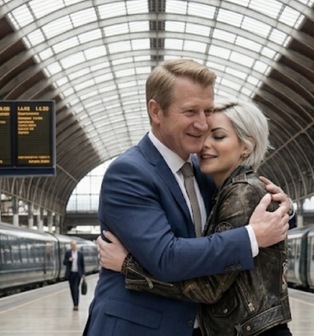
We exchanged numbers. She hugged me — brief, careful, the hug of someone who has learned the cost of holding on too tight.
As she walked away toward the tube, I watched the familiar angle of her shoulders, the way she still moved with quiet defiance.
I flew back to New York the next day. The portrait still waited in my study. The number in my phone felt like a fragile thread — not a rope to pull us back together, but a possibility.
For the first time in decades, the future wasn’t a spreadsheet. It was a question mark.
And that, I realized, was enough.