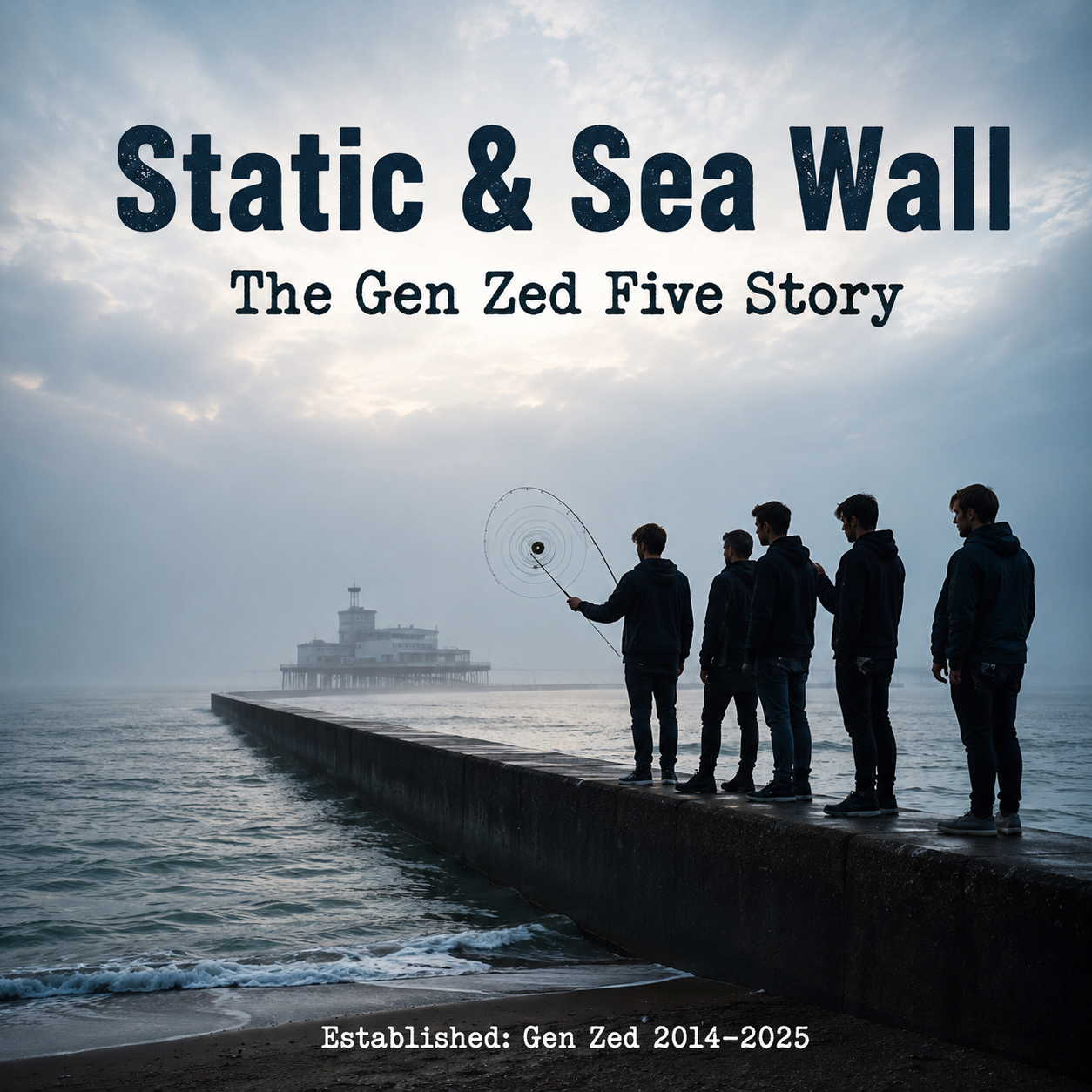
Static And Sea Wall
The Story of the Gen Zed Five – Westcliff-on-Sea, 2016–2025
Chapter 1: First Days and First Glitches (September 2016)
It was September 2016 when the new school year began at Westcliff High. The air outside carried the crisp salt smell of the Thames Estuary, mixed with the faint sweet scent of someone secretly vaping around the corner. Inside the building, however, the atmosphere felt heavy.
The corridors smelled of scuffed shoe polish, burnt toast from the staff kitchen, and the quiet nervousness of thirty‑one Year 11 students. Everyone felt like they were being watched, convinced that one bad exam result or one embarrassing moment online could ruin everything they had planned.
Among them was Joshua, who always chose the same seat: the back row, left corner, right next to the window that never opened wide enough to let fresh air in. He kept his hood up almost all the time, pulling his sleeves down over his knuckles like a protective layer of soft armour. He didn’t talk much on that first day; instead, he just listened. He could hear the fluorescent lights buzzing at exactly 60 hertz, the squeak of chairs moving on linoleum, and thirty-two different voices talking at once—all mixing together like badly tuned radios. The world pressed in on him until his thoughts felt like a scratched CD, skipping and repeating without stopping.
Across the room, Abigail was already at work. She held her phone low, filming under her elbow as if she were making a documentary. When she noticed Joshua counting the seams on his jumper cuff for the fourth time, she leaned over and whispered:
“Iconic first-day suffering, Josh. You’re looking like a tortured poet in a bad British sitcom.”
Joshua didn’t look up, but he held onto the words.
Nearby, Efrain stood by the window holding a half-eaten Greggs sausage roll, gesturing like an orchestra conductor. “Tyler, mate, you’re stressing over your new Nikes getting Essex rain on them,” he said. “Look at the real issue here—the school firewall has blocked literally everything. I can’t even open BBC News without three dodgy VPNs crashing.”
Tyler, balancing carefully on the dry edge of a puddle near the doorway, didn’t look up from his trainers. “Bruv,” he laughed, “if these get even one drop of mud, my mum will actually finish me off. Forget privacy—my creps are on life support right now.”
Sitting quietly near the radiator, Olivia clutched her plastic Costa cup like a shield. “Can we at least survive double History first?” she asked softly. “Then we can start the revolution.”
The first real test came during the blazer inspection. The Deputy Head walked down the line with his clipboard, checking every collar: “Top button, Fisher. Top button, Johnson. Top button—”
When he reached Joshua, the command was the same. Joshua’s hand lifted automatically, but the stiff wool collar pressed tight against his throat, and the tag on the back of his neck scratched like a fingernail. Suddenly, the chatter in the hall amplified, his chest tightened, and his fingers froze. Breathing became something he had to manually think about.
Olivia saw it happen. Without a word, she stepped out of line, reached into her bag, and pulled out an oversized black hoodie—soft, worn, with the tags already cut out. She pressed it directly into Joshua's hands
The Deputy Head frowned. “That’s not uniform, Olivia.”
“He’s unwell, sir,” she said smoothly, not backing down an inch. “Unless you’d rather explain to his parents why he passed out in corridor line-up.”
Joshua pulled the hoodie over his head immediately. The heavy tightness vanished, and the roaring noise dropped to a manageable hum. For the first time in ninety seconds, he could breathe.
Later that day, behind the science block, Abigail set up a broken tripod she had pinched from drama class. The salt wind whipped around the brick corners, bringing the distant clang of a train arriving at Westcliff Station
“We should make something,” Abigail said, looking around the circle. “Film how everything feels like it’s too much and not enough at the exact same time. Show what it’s actually like being here.”
Joshua looked out towards the grey water of the Estuary. “I just want somewhere where the noise stops,” he said quietly
Tyler bounced a tennis ball once against the brick, caught it cleanly, and smiled. “Then we’ll be that place for each other.”
No one voted, and no one argued over a title. From that afternoon on, they simply existed for one another: The Emotional Support Circus.
Chapter 2: The Years of Beautiful Nonsense (2016–2017)
The months after that first day flowed by quickly, and 2016 turned into 2017 in a blur of small, funny, and unforgettable moments that became their shared history.
One of the most famous events was the Mannequin Challenge on Western Esplanade. They lined up perfectly still, trying to look like statues, while people walked past them. But then a group of BMX riders rode straight through the middle of the scene, breaking the silence completely. In the chaos, Tyler lost his balance and fell spectacularly into the thick mud of the seafront—dragging Joshua down with him. Everyone laughed, but instead of being upset, Abigail screamed happily: “You ruined the aesthetic!” That moment was captured on a short video, which later gained 53 likes, two funny bot comments, and even one accidental like from Abigail’s mum.
A little while later, they made their first attempt at being “creative content creators” with the Southend Pier Deep-Fried Chips Video. They filmed each other eating hot chips by the sea, and someone left a comment that simply said: “Mood.” That single comment made them feel like they had connected with someone else, and they celebrated by sharing one large portion of chips between all five of them, passing a wooden fork around as if it were a sacred object.
They even tried their hand at a funny “business move” with the Star Kebab Sponsorship Pitch. They went to the local kebab shop and made a silly presentation saying they would promote the shop to all their friends if they got free food. The owner, Mustafa, laughed but agreed—giving them a bag of chips and drinks for free. From that day on, he always treated them well and never charged them full price again.
During PSHE week, they had a lesson that involved bananas and condoms, which created a lot of chaos and laughter. Joshua named his banana Hamlet and treated it like a character in a story. Efrain, who always thought deeply about everything, argued seriously about the colonial implications of having tropical fruit in a British sex education lesson. Abigail asked lots of practical questions about lighting and presentation, wanting to make the lesson look “less clinical.” Olivia, meanwhile, just waited patiently for lunchtime so they could all go and eat together.
Through every moment—whether it was funny, serious, or stressful—the unspoken agreement between them stayed strong:
• When Joshua felt overwhelmed or “glitchy,” someone always noticed and stepped in.
• When the school speakers came on and dismissed people’s differences as “just excuses,” Efrain stood up and spoke for them all, explaining their experiences clearly to the whole year group. Then they would all walk out together and sit behind the bike sheds until Joshua’s shoulders finally dropped down from his ears.
• When the corridors felt too crowded and loud, Tyler would simply say “outside” and lead the way to somewhere quieter.
• Olivia was always the one who carried the things they needed: spare hoodies, warm beanies, and later, a pair of high-quality noise-cancelling headphones she saved three months of lunch money to buy, just so Joshua could have them.
They never called what they did “support” or “care.” They just did it naturally, without needing to say a word.
Chapter 3: Results, The Career Fair, and The Great Protest (2017)
By August 2017, the time came for GCSE results day. Envelopes arrived, and everyone opened them with mixed feelings:
• Tyler celebrated his C grades as if he had just won the Premier League.
• Efrain looked at his History result and immediately decided to appeal it, arguing that the marking didn’t match what he had actually learned and understood.
• Abigail posted her results online with a sparkly filter over the photo.
• Olivia got exactly what she needed to go on to study architecture, which was her dream.
• Joshua sat on a concrete bollard outside the Cliffs Pavilion for three hours before he felt ready to open his envelope. He passed, but he knew it wasn’t the “perfect path” everyone talked about—just enough to keep going.
No one said “you’ll be fine” or tried to fix it. Instead, they all walked together to City Beach, dipped their feet in the cool fountain water, and let Joshua be quiet while they sat together in the peace.
Later that same year, they went to the school’s annual Careers Fair. They walked around the sports hall and met the “future” that was being presented to them: big insurance companies, industrial bearing manufacturers, and advice that felt like it belonged to a completely different era—strict, boring, and not made for young people like them.
Efrain looked at all the stands and asked seriously: “How do you plan for the future when the planet is already moving in slow motion? How can we follow these paths when they don’t feel real to us?”
Joshua, who felt most comfortable creating things, drew a picture of a “toaster with legs” and wrote underneath: This is my career goal.
Tyler joked that he wanted to be a “professional vibe generator” for people who felt tired.
Olivia quietly understood that the “real world” everyone talked about wasn’t what they had been promised.
A few months after that, they decided to do something small but meaningful: they organised their Chalkwell Park Protest. It wasn’t about war or big politics. It was simply against the council’s plan to replace the old, rusted Victorian railings along the seafront with shiny, new, and very plain steel fences.
Efrain called it: “The erasure of our childhood.”
Abigail filmed the whole thing, turning it into “Social Justice Aesthetic” with soft music and careful shots.
Tyler entertained everyone by doing the Floss dance in front of confused dog walkers passing by.
Joshua focused on filming small details—like a ladybird crawling on the old rusty metal—and captioned that part: “Even nature hates the new fence.”
The video they made only got 12 views in total, but it didn’t matter at all. They had stood together for something they believed in, and that was enough.
Chapter 4: Scattered Paths & The Silence of 2020
As time went on, the world began to pull them apart. Life moved forward, and each of them took their own separate path:
• Olivia went to university, then moved to London for an internship designing large glass towers—buildings she knew she would never be able to afford to live in.
• Efrain studied politics and sociology at university, and started using big words like “intersectionality” to explain everything from McFlurry flavours to parking permit rules.
• Abigail built a small but loyal following online, making videos about “corporate burnout” and the feeling of being stuck in a system that didn’t fit.
• Tyler became passionate about fitness and helping others feel strong, even though he went through a short, chaotic phase of getting involved in crypto investments.
• Joshua took a job working night shifts in a warehouse, where it was quiet and steady, and spent his free time editing videos in bedrooms that kept getting smaller and smaller.
But even when they were far apart, the Emotional Support Circus group chat never died. They checked in on each other, shared jokes, and reminded everyone that they were still connected.
Then came March 2020. The world suddenly stopped. The pandemic arrived, and everything changed. For Joshua, this was the hardest time of all. The silence that came with lockdown felt heavier than the noise he was used to. The textures of things—clothes, walls, objects—felt sharp and uncomfortable. His usual routine vanished completely, and he spent days feeling isolated and “glitching” alone in his room.
One evening, the doorbell rang. Standing outside, keeping exactly two metres apart, were:
• Tyler, bouncing his tennis ball to keep calm.
• Abigail, holding her camera and filming the moment.
• Olivia, carrying a small package that she had prepared carefully.
Inside the box were high-quality industrial-grade noise-cancelling headphones, and a short note written in neat handwriting:
“The world is loud. This is the off switch. Give the silence a rhythm. We are still here.”
Joshua put them on, and for the first time in months, the pressure faded away. He opened his computer and started creating again—editing clips of empty streets, the pier without crowds, and the old sea wall that still stood firm, holding back the grey water.
Chapter 5: The Weight of the Frame & Home Again (Autumn 2025)
By autumn 2025, life had taken another difficult turn. An eviction notice was sellotaped to the door of Joshua’s family flat. They had lost their home and had to move into a small, damp old terrace house on the edge of Westcliff. The walls felt much closer together, and the television in the living room was always left turned up too loud.
Joshua felt like the world had become even heavier. But instead of feeling overwhelmed, he picked up Abigail’s old broken tripod that he still had from school days. He set it up in the tiny back bedroom, right next to the window that looked out over the sea wall.
Every day, he filmed the same view: the concrete wall, the changing sky, and the grey Estuary water moving slowly. The camera frame wobbled sometimes, but the sea wall itself stood perfectly firm, no matter what the weather did.
One day, he typed just one line into the group chat:
“Sea wall’s still there.”
Within twenty minutes, they had all arrived.
• Tyler came with his tennis ball.
• Abigail brought her camera to film again.
• Efrain brought his notebook to write down what they felt.
• Olivia brought hot tea and warm snacks, ready to look after everyone.
They spent the whole day together in the small house, filming and talking. They captured the house as it really was: Nan’s steady hands pouring tea, the garden fence that was starting to sag, and the wide horizon that the sea wall tried to hold back. Joshua held the tripod carefully—its leg still shook a little, but it stayed standing.
That day, they understood that the sea wall wasn’t just concrete and stone. It had become a symbol for them: something that stayed strong and steady, even when everything else around you changed, moved, or felt unstable.
Chapter 6: The Scenic Route – Growing Up Together (2024–2025)
By 2024 and 2025, they were no longer teenagers. They had grown into young adults, and their lives had changed completely—but the connection between them stayed exactly the same.
Each of them had found their own path:
• Abigail (23): She worked as a small-time content creator, making honest videos about burnout, growing up, and feeling like you don’t fit in. Sometimes her videos earned enough to pay the rent, but she never chased fame.
• Olivia (25): She worked as a junior architect, designing buildings that were kind to people and places. Even though she knew she would never be able to afford to live in the big towers she designed, she found peace in creating something useful and beautiful.
• Efrain (24): He studied and worked as an activist and researcher, still fighting for change, but now using official emails and clear arguments instead of megaphones. He still asked big questions about how the world works.
• Tyler (23): He became a personal trainer, helping people feel strong and comfortable in their own bodies. He still used words like “bet” and “rizz” in a warm, genuine way that made everyone smile.
• Joshua (24): He worked as a freelance video editor, slowly saving up to buy a proper camera of his own. He still looked at the world through a lens, turning feelings into moving pictures.
They met often, sitting together on the sea wall or in quiet cafes in nearby Leigh-on-Sea. They laughed about the crazy days of school, complained about the difficulties of being an adult, and shared the quiet truth that they had learned: We are surviving, not because we are perfect or special, but because we have each other.
One afternoon, they stood together against the grey Essex sky. The wind blew gently, and the sea wall stood firm behind them.
“If I stop moving for even a moment,” Joshua said quietly, “the thoughts get too loud and heavy.”
Olivia reached out and tucked the scratchy label from the inside of his coat out of sight. “Check the levels, Josh,” she said softly. “You’re doing fine. You’re peaking.”
Tyler bounced his tennis ball once and caught it. “We got you,” he said simply.
Abigail lifted her phone and held it up. “One last fit check,” she said. “Let’s take a photo. Look like you’ve accepted that everything changes, but you still showed up anyway.”
The shutter clicked. The photo was sent to the group chat. No caption was needed.
They never became famous. They never changed the whole world. But they learned the most important thing of all: when the static in your head gets too loud, you just need someone who will be your sea wall. Steady, strong, and always there.
And under the same clouds that never quite decide if they will rain or shine, that was more than enough.