.
The Crossing
1. The Collision
The damp morning air at Portsmouth Ferry Terminal carried the sharp bite of salt and diesel, edged with the quiet tension of travellers already calculating delays. A dense queue of idling engines stretched toward the ferry’s yawning belly, exhaust fumes blurring the grey light into a hazy fog.
Toby Wainwright wove his bicycle carefully between a towering articulated lorry and a mud‑splattered caravan. He was hard to miss, yet somehow easily overlooked: tall, lanky, and hopelessly uncoordinated beneath the staggering weight of an oversized, overstuffed hiking rucksack strapped to his back. His shaggy hair damp from the drizzle, he was a picture of fresh‑faced innocence, hurtling headfirst into the unknown with a gleaming touring bike and a pocketful of nervous optimism.
Ahead, the lane cleared briefly. Toby pedalled harder, eager to escape the suffocating exhaust. Suddenly, a sleek silver Mercedes convertible cut hard across his path, turning blindly toward the boarding lanes.
Screech.
The luxury car’s anti‑lock brakes shrieked, stopping mere inches from Toby’s spinning back tyre. The sudden shift threw him off balance. He slammed both feet onto the tarmac, skidding sideways and nearly tipping the heavy bike — and himself — into a heap of rain‑slicked metal.
For a heartbeat, the world stopped. The terminal’s ambient roar faded into a heavy, suffocating silence.
The driver’s window hummed down instantly. Vanessa Nutman leaned out, gripping the wheel so tightly her knuckles blanched. Polished, composed, and impeccably groomed, she looked every bit in command — except for the fierce, erratic pulse hammering visibly at the base of her throat. Her carefully controlled exterior cracked, revealing someone stretched tight to the breaking point.
“Oh my goodness — I am so sorry,” Vanessa breathed, her voice cutting sharply through the humid air, equal parts genuine alarm and jolted adrenaline. “I didn’t see you at all. Are you alright?”
Toby blinked, his heart hammering against his ribs like a trapped bird. He planted one boot firmly on the ground, hoisted his heavy pack higher, and offered a breathless, lopsided grin to ease the tension.
“No harm done,” he said, his voice cracking slightly before settling. “Still in one piece, anyway.”
Vanessa let out a sharp exhale, her shoulders dropping a fraction as she took him in. For one fleeting moment their gazes locked — two strangers pulled into the same orbit by a fraction of a second. It had been a careless, near‑fatal accident born of haste and distraction. And, unbeknownst to either of them, it was the quiet beginning of something neither had foreseen.
Inside the terminal, the waiting area hummed with announcements, shuffling trays, and the sharp tang of cheap espresso mixed with the scent of pasties and hot food. Row upon row of bolted‑down plastic chairs held tired travellers eating or drinking, their eyes fixed on departure boards.
Vanessa sat in a quiet corner overlooking the loading ramps, nursing a black coffee she barely tasted. Guilt pricked at her. Glancing across the room, she spotted the same young man she had nearly struck down, struggling to shrug free of an impossibly large rucksack. He looked entirely out of place, squinting under fluorescent glare like someone stepping from a dark room.
On an impulse utterly foreign to her measured routine, Vanessa stood and walked over.
“Hey,” she said. “You look lost.”
Toby looked up, startled, a flush rising quickly to his cheeks. “Oh. Hello again.”
Vanessa smiled — the practiced, easy warmth she usually reserved for important clients slipping naturally into place. “Let me buy you a coffee to make up for nearly running you over? Call it a peace offering. I promise I’m safer on foot than behind the wheel.”
A soft, genuine laugh broke through his shyness. He accepted the cup with a grateful nod. “Only if you promise not to test those brakes again. Deal?”
They sat together, the awkwardness of the near‑miss dissolving over hot drinks. Conversation unfolded easily. Vanessa loosened her scarf, leaning back as she spoke of her work — sourcing fine wines and managing shipments between vineyards and distributors across Europe. She spoke with crisp precision, yet beneath her poise lay a quiet weariness.
Toby listened with obvious interest, then spoke of his own journey: a deferred university place, conflicting advice from friends, and the weight of expectations at home — and finally, the real reason he was travelling: to meet a father he barely knew, and a French stepmother still entirely unknown to him.
His candour softened something inside her. Listening to his unguarded sincerity, a knot she had carried for years began to loosen. The sharp edges of her carefully ordered life felt less rigid. In that impersonal terminal, surrounded by strangers, they talked with surprising ease. For two people heading the same way, the journey had truly begun.
2. The Bar
By nine that evening, the ferry had carved a steady path into the dark Channel. Outside, sunset had faded to inky black; salt spray misted across the viewing deck windows.
Inside, the ship’s bar was warm and lively, a world away from the terminal’s chill. Amber lighting and soft neon cast a gentle glow; the room swayed in time with the swell. At the far end, an acoustic duo played while the cruise director’s voice boomed through the pub quiz. The air carried the scent of perfume, spilled ale, and rich aromas drifting from the neighbouring restaurant.
Vanessa sat alone in a leather booth, nursing a gin and tonic, watching a group of tourists argue fiercely over 1990s trivia. She let the noise wash over her, grateful for the distraction.
Then she spotted Toby, heading toward the upper deck balcony. He clutched a bottle of cola, moving through the room as though half‑convinced he didn’t belong there at all.
Vanessa raised her hand and gestured to the empty seat across from her, leaning in so he could hear above the music.
“Hello you — join me?” she invited gently. “Sit down and keep me company. Save me from this acoustic assault by the stage.”
Toby grinned in relief and slid into the booth. “Thanks. I wasn’t actually sure I was allowed up here — my cabin’s down on the lower decks.”
“Only rule up here is you have to know your capital cities and ancient history,” Vanessa teased.
As they talked, he admitted he had always liked rum. She caught the bartender’s eye and ordered two dark rum and cokes — rich, smooth, and far better than anything he would have chosen himself. Hours slipped by. The quiz finished to polite applause; the band shifted into softer melodies. The noise receded. Boundaries blurred. And slowly, they found themselves in a quiet bubble of their own making.
Warmed by the drink, the music, and her easy attention, Toby’s reserve fell away. He spoke of his gap year not as adventure, but as a search for direction. His voice grew quieter as he confessed his fear: arriving in Saint‑Malo to meet a father he scarcely recalled, stepping into a life built entirely without him.
“It feels like walking onto a stage for a play I’ve never rehearsed,” he said, staring into his glass. “I’m terrified I’ll say the wrong thing — that I’ll never fit into the family they made without me.”
Vanessa listened deeply. His honesty touched something raw in her. Slowly, she lowered her guard too. She spoke of the endless demands of her business, the constant pressure to be capable, polished, in control — and the quiet, heavy silence of her home across the water: beautiful, hers entirely, and empty.
“Sometimes,” she said quietly, “you spend so long building a life that looks perfect from the outside, you forget to ask if it feels like home.”
By midnight the music had ended. The air between them felt warm and close. No longer strangers, no longer making polite conversation — they shared truths rarely spoken aloud. Cut off from everything familiar, they drew together, pulled by a quiet, undeniable gravity neither had expected.
3. The Cabin
Midnight. The ferry hummed steadily through dark water — a suspended place between worlds, where rules loosened and reality felt soft at the edges. The alcohol had lowered her defences; beneath her composure lay a hunger she normally kept locked away.
“Would you like to come back to my cabin?” Vanessa asked — quiet, deliberate, certain he would say yes.
It was Commodore Class: spacious, elegantly furnished, far finer than anything he had imagined. A chilled bottle of champagne and two flutes waited on the dresser beside a small dish of chocolates. Soft lighting warmed every surface. As she stepped inside, her mind brushed against her real home — high ceilings, a grand piano, comfortable sofas, a parrot by the window — beautiful things, all hers, and all so quiet. That same stillness lingered here too. Tonight she meant to fill it.
Toby followed — awkward, earnest, carrying no hidden agenda. Simply there: open, unjaded, expecting nothing. Exactly what had drawn her to him.
She led the way. There was no hesitation. She knew exactly what she was doing, what she wanted. Yet beneath that calm resolve lay something fragile: a fear of fading, of becoming invisible; years of independence hardening slowly into loneliness. In his uncomplicated regard she found something she had craved so long: warmth without condition.
They kissed slowly at first, then deeper, eagerness rising between them. She framed his face in her hands and drew him gently to her, and he came willingly-no doubt, only pure wanting. They made love until exhaustion overtook them, then slept tangled together, undisturbed until dawn.
For Toby it felt like magic — the beginning of everything he had dared to hope for. For Vanessa it was a sweet, deliberate escape: one night to feel young, seen, and wanted again — a temporary reprieve from the solitude she carried everywhere.
4. The Cold Morning
Dawn seeped pale grey around the curtains, casting a harsh, clinical light across the cabin. Outside, the ship’s horn sounded low and resonant, announcing the approach to France.
Toby stirred, blinking awake. Warmth and hope surged through him as memory returned — whispered confessions, shared laughter, quiet intimacy tangled in the sheets. It felt like the start of something real. He reached out sleepily — and touched only cold, empty mattress.
He sat up sharply, rubbing his eyes. Vanessa stood fully dressed by the dresser, tailored trousers and wool coat perfectly in place. Empty champagne flutes remained on the wood. She held a glass of water, her back turned rigidly to him.
Every trace of warmth had vanished. In its place stood an unmistakable wall of ice.
“Morning,” he said, voice thick with sleep, swinging his legs from the bed. “I didn’t think you’d be up quite so early.”
Vanessa did not turn. She sipped slowly, shoulders squared, every line of her locked tight. Her polished armour was back on.
Sensing the brutal shift, Toby stepped toward her, heart beginning to race. “Vanessa… are you alright? About last night — I thought —”
She flinched as though burned, spinning around. Her eyes were cool, flat, emptied of every warmth they had shared just hours before.
“Don’t,” Vanessa said quietly. Her voice was measured, precise.
Toby froze. “What’s wrong? Have I done something —”
“We were on a ferry, Toby. People get carried away in places like this,” she replied, tone controlled rather than harsh — which made the boundary all the more absolute. “We’re adults. We had a lovely evening. But it stays here. It doesn’t mean anything beyond last night.”
“Nothing?” The word tasted of ash. “That is not how it felt —”
“Last night is over, Toby. Let it go.”
Vanessa glanced at her watch — more to avoid his eyes than to check the time. She picked up her briefcase, her face carefully composed, though a flicker of genuine fatigue crossed her features before vanishing behind her familiar mask.
“Please,” she said, her voice softer now, nearly pleading beneath its restraint. “Don’t make this harder than it needs to be.”
With a quiet click, the door closed.
Toby stood alone, heat rising in a humiliating flush up his neck. The air felt suddenly too tight to breathe. He dressed in a daze, snatched his rucksack, and hurried out — intending to retreat to his own cabin. Instead, chest burning and breath coming short, he pushed through a heavy metal door and stepped onto open deck.
The damp French air struck hard — salt, steel, diesel. He gripped the rail, watching the grey coastline emerge through mist. Dark water churned far below. He shivered in the wind, replaying her words, stinging and uncomprehending. How could everything shared have meant nothing? He needed to understand what had changed.
He returned to the upper decks — and there she was.
Vanessa walked steadily ahead, coat swinging, head high, moving with practiced efficiency through the crowd.
“Vanessa!”
She did not stop, though her shoulders tightened visibly.
Toby caught up beside her near the exit ramp. “Wait — please. Can we talk?”
She turned her head just enough to meet his gaze with cool, unhurried detachment. No anger — something far worse: quiet, immovable exhaustion.
“Don’t make a scene, Toby,” she murmured, voice low. Her eyes flickered away almost instantly.
“I’m just trying to understand —”
“There’s nothing to understand,” she replied, steady and unyielding. When he stepped before her, she moved aside smoothly.
“Look around us. We’re here,” she said, simply matter‑of‑fact. “It was an escape. For one night. Let it go.”
Humiliation rooted him to the spot. Passengers streamed past, oblivious.
Vanessa walked on without a backward glance — swallowed smoothly into the crowd — leaving him standing alone as the great steel doors swung open onto France.
5. Arrival
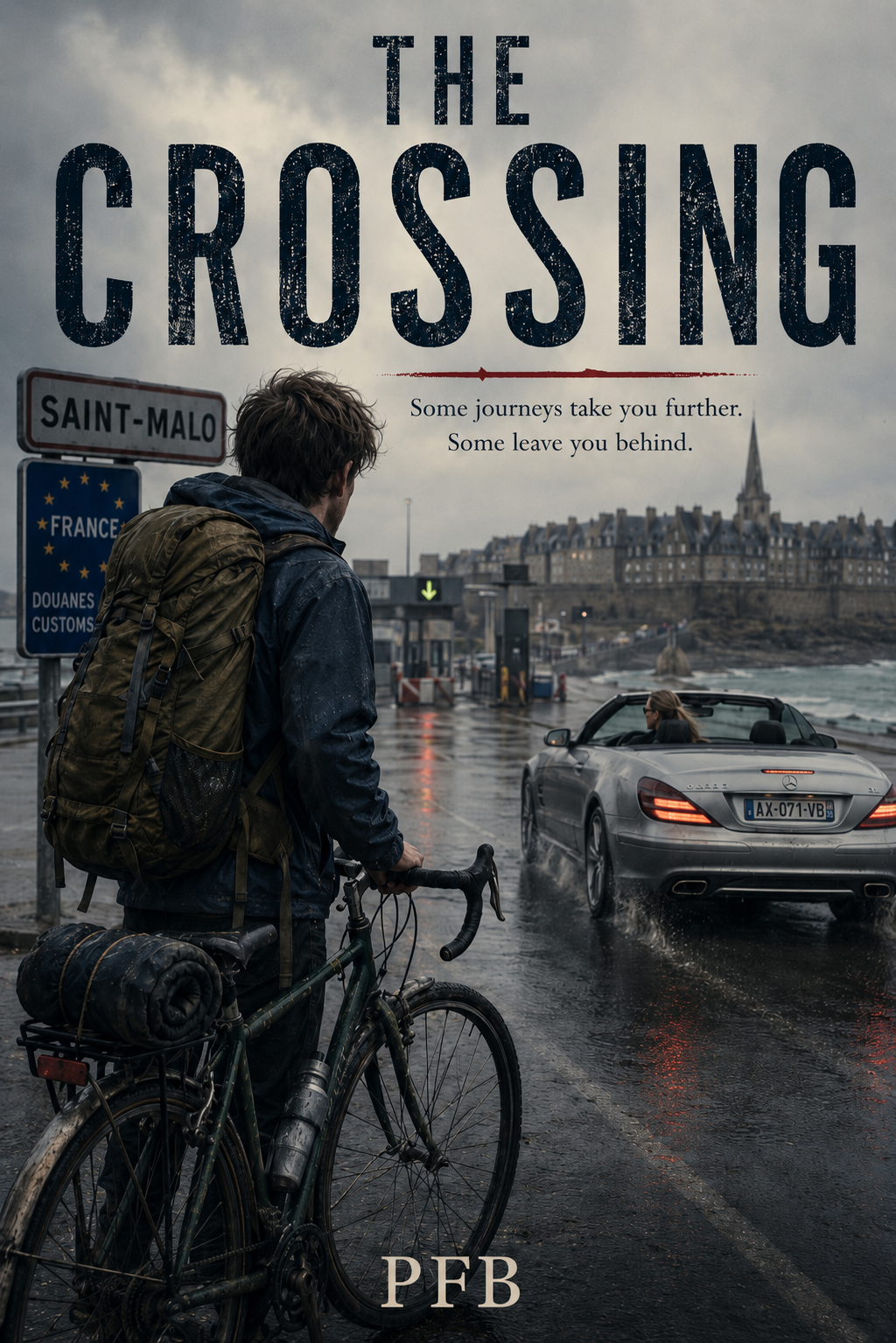
Fine grey rain clung to Saint‑Malo’s port asphalt, sharp with salt and damp tobacco. Toby leaned into his pedals, his rucksack shifting awkwardly with every stroke. His legs felt hollow; the adrenaline of rejection had burned away, leaving only a dull, heavy ache deep in his chest.
Travellers and vehicles filtered slowly toward customs. Cold coastal air bit at his face, but he barely noticed.
Ahead, a sleek silver Mercedes idled, boxed between a transporter and a family estate car. Through the rear window he could just make out the crown of her head — posture straight, rigid, as unyielding as the vehicle itself.
He slowed, coasting behind a couple in matching jackets, keeping her just in sight.
Then the truth settled, cold and absolute. Between them lay a chasm wider than the Channel they had crossed. To him, that night had been revelation — a collision of two lonely worlds that had rewritten everything. To her, it had been neatly sealed away: a momentary escape, wiped clean before the engine even fell silent.
He looked at the car’s polished lines, her effortless composure, the ease with which she had cast him aside. This was the adult world: guarded, transactional, where intimacy could be a thing borrowed in the dark and returned without emotion at dawn.
An official waved the Mercedes forward. It pulled away, brake lights flaring once, then vanished through the gates into rain‑glistening streets.
Toby reached the checkpoint, fingers stiff and clumsy as he found his passport. He did not chase her. He simply watched the empty road, swallowed hard, and pedalled on — alone into the unknown.
The barrier clacked open. Iron gates swung wide to the coast road.
He wheeled across the white line, boots feeling heavy as lead on wet tarmac, and pulled onto the kerb to catch his breath, shoulders hunched beneath his pack.
Then a low, familiar purr cut through the rain.
He looked up just as the silver convertible swept past — top down, wind whipping strands of hair across her shoulders. She wore dark, opaque sunglasses, her eyes completely hidden. Hands steady at the wheel, she accelerated smoothly, never turning her head. Not once.
Seconds later the car rounded the bend and was gone — swallowed by the grey road winding inland toward vineyards and the life she was returning to.
Toby stood motionless on the kerb, staring at empty space. Utterly, completely undone.
The warmth of the night before now felt like a beautiful, cruel illusion — a spark that had burned bright in the dark only to be extinguished by daylight. Hope, connection, longing, loss — all knotted tight inside him. He grieved something that, to her, had never truly existed at all.
He clipped his helmet into place, took one last look toward the road where the car had vanished, and rode on into France — carrying far more than the weight on his back. Older. Wiser. And no longer innocent.