The Heat of The Moment
A Memoir
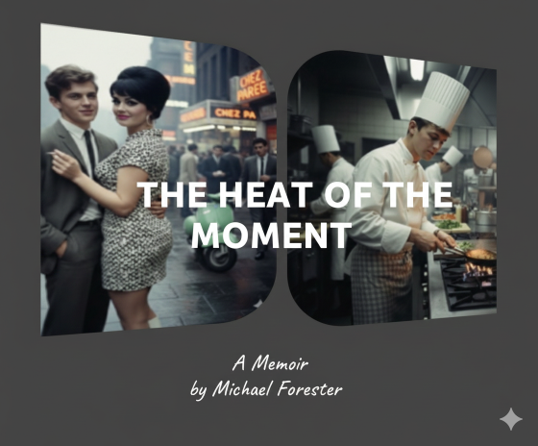
From the adrenaline-soaked kitchens of 1960s Soho to the gilded heights of Michelin-starred Paris, Michael Forester learned that the hottest fires are not on the stove—they burn in the lives we leave behind.
In 1961, a young man from the manicured lawns of Kent turned his back on a respectable future to chase the raw, blistering thrill of professional cooking. At L’Escargot in Soho he reinvented himself as “Jack the lad”—a rising star who lived for the roar of service, the camaraderie of the brigade, and the hazy nights of jazz clubs and potent grass. Then he met Brenda Edwards: fierce, independent, unforgettable. For one electric summer she was the brightest flame in his world.
But when fatherhood loomed, Michael ran. A coveted post at Paris’s legendary Café de la Paix became his escape hatch. Behind its relentless ranges he climbed to sous-chef, earned three stars, and fed presidents and princes—yet every flawless sauce tasted of ash. Success became exile; brilliance became hollow performance.
Years later, a single letter from London shattered the illusion. Forced to confront the daughter he abandoned and the woman he betrayed, Michael’s carefully cauterised wounds reopened. What followed was a long, painful unraveling: the collapse of a career built on avoidance, the stripping away of ego, and the slow, humbling rediscovery of what the fire is truly for.
The Heat of the Moment is a searingly honest memoir of ambition, cowardice, and redemption. It reveals the brutal cost of chasing “potential” and the quiet grace of returning—not as a celebrated chef who feeds the ego, but as a man who finally learns to tend the hearth that warms a family.
The Heat of The Moment
A Memoir
Chapter 1: The First Flame
The shift from the damp, silent boxwoods of Kent to the fog-shrouded, steam-laden depths of Soho was a personal wake-up call, but I liked it. It was a jagged transition, leaving behind the "respectable" Michael Forester—the one destined for a partner’s desk and an eternity of chargeable hours—and finding someone else in the fierce heat of a professional stove.
I can still see the day I told my parents. My father’s face was a map of pure disappointment; my mother simply leaned into her tears. To them, the kitchen wasn't a career; it was a descent. But it was my life. If I was going to ruin it, I wanted it to be on my own terms.
I came from a long line of British middle-class academics where "work" was something done with the mind, never the hands. My father practiced law, specializing in the cold intricacies of finance. My mother taught French and Modern History—not because she had to, but because it was the proper thing to do. They lived in a world of footnotes and quiet rooms. I wanted something I could actually feel.
My father’s face when I told him wasn't red with rage; it was grey with a weary, intellectual defeat. He looked at me as if I were a balance sheet that simply wouldn't add up.
"A cook, Michael?" he’d asked, the word sounding like something he’d found on the bottom of his shoe. "We gave you a private education so you could command men, not sweat amongst them."
My mother, ever the romantic academic, wept for the loss of my "potential" even as she unknowingly fueled my fire. She taught French; I wanted to taste it. She spoke of the Enlightenment; I wanted the literal light of the burner.
"It’s my life," I’d snapped, fueled by that toxic, beautiful brand of eighteen-year-old arrogance. "I’m not interested in your precedents and torts. I want to build things people actually enjoy."
The Soho Crucible
The County Hotel in Canterbury had been my sandbox, but by 1961, I was ready for the coliseum. Through a connection with the maître d', I landed a spot at L’Escargot in Soho.
Soho in the early sixties was a fever dream of neon, jazz, and the smell of roasting coffee clashing with open sewers. I was a Commis Chef, the lowest form of life in a hierarchy that made the army look like a liberal arts college. I was green, anonymous, and hungry for the chaos.
I lived for the rush. The camaraderie was a drug—the shared cigarettes in the alleyway, the frantic, wordless communication of a service in full swing, and the sheer, brutal honesty of a well-executed plate. Away from the kitchen, I was a "Jack the lad." I spent my meager wages on gambling at the dog tracks and pints of bitter in pubs where the air was thick enough to chew. I was a boy playing at being a man, intoxicated by the sudden, sharp edges of city life.
The Collision
Then came the afternoon that changed the trajectory of my life. It was a Tuesday, the light over Greek Street a dusty, pale gold. I was swaggering out of a coffee bar, my head still ringing with the adrenaline of a heavy lunch service, when I literally "bumped into" her.
She was a vision of 1960s glamour that made the world around her look like a black-and-white film.
"Watch it, darling, I'm in a hurry," she snapped, though her blue eyes danced with more amusement than anger. She had hair as black as a raven's wing and lips painted a defiant, electric pink.
This was Brenda Edwards. She moved in the fringe circles of the Soho night—dancers, models, and girls who knew exactly which parties were worth attending. She was fiercely independent and entirely unimpressed by my middle-class charm.
"I’m Michael," I said, recovering my bravado and flashing the cheeky smile that usually got me out of trouble. "And I think I owe you a drink for the assault."
"You owe me more than a drink, Michael," she purred, her London accent sharp and musical.
She didn't stay long—she was a blur of perfume and sharp wit, disappearing into the crowd before I could even ask for her surname. But the impact was total. I stood on the pavement of Greek Street, watching her go, feeling a pull that was stronger than any ambition I’d ever felt.
I didn't know then that Brenda was the fire I couldn't control. For now, there was just the heat of the kitchen and the sudden, searing thought of her, and I was arrogant enough to think I could handle both
Chapter 2: The Symphony and the Smoke
The kitchen at L’Escargot was a battlefield where the weapons were carbon steel and the casualties were measured in burnt fingers and bruised egos. I was assigned to the vegetable station under Anton, a stocky, reliable man only a few years my senior who navigated the chaos with the calm of a seasoned sergeant.
Our day began at 7:00 AM, a brutal ritual of hauling heavy crates of produce from Covent Garden Market down three flights of narrow, treacherous stairs. By 8:00 AM, I was a man possessed by potatoes. I spent hours peeling and shaping Pommes Frites and Pommes Chateau with obsessive precision until my thumbs were numb and my mind was blank.
The discipline was military, dictated by a hierarchy that demanded total submission. When the Maître Chef de Cuisine, Jean-Claude, entered the room, the very air seemed to crystallize. He was a mountain of a man with a curling grey moustache and eyes that could spot a bruised shallot from across a crowded room. In his presence, the English language ceased to exist. Everything was a sharp, “Yes, Chef,” or “No, Chef.”
The Midday Dance
At 12:00 PM, the bell would ring—the signal for the dance to begin. Jean-Claude would stand at the pass, his voice cutting through the steam as he barked orders in rapid-fire French:
“Sur commande deux terrines, une sole, deux côtelettes d'agneau!”
The kitchen would explode. To an outsider, it looked like a riot; to us, it was a symphony. Between the blistering heat of the ranges and the crushing pressure of the clock, I felt a sense of belonging I’d never known back in the manicured suburbs of Kent. We were a tribe, forged in fire. By 11:00 PM, after the final scrub-down, I would collapse into my box room in the basement, the scent of garlic and bleach seeping into my dreams.
The adrenaline of the kitchen demanded an equal and opposite reaction. On my first day off, the other side of Soho beckoned. Outside Ronnie Scott’s on Frith Street, I met Tajo Goldberg, a dapper kitchen porter who introduced me to "the charge."
"Want to try some charge, man?" he asked with a grin, rolling a massive joint.
Determined to maintain my "Jack the lad" bravado, I took a shallow, cautious drag. Tajo laughed, his eyes crinkling. "Not like that. Take it down, deep down." I followed suit, and the euphoria was instant—a dizzy, relaxed haze that transformed the Afro-jazz in his Bayswater bedsit into the music of the spheres.
The Blowback
Two weeks later, destiny struck again. I bumped into Brenda—literally, once more—at the corner of Broadwick and Wardour. I caught her just before she hit the pavement, pulling her into a brief, impulsive hug. Looking into those piercing blue eyes, I decided right then that I wouldn't let her vanish into the Soho fog again.
The next day, I tracked down her bedsit. When she opened the door, her face flickered with genuine horror. "What the bloody hell are you doing here?"
"I thought I'd pop round for a cup of tea," I said, my heart hammering against my ribs like a trapped bird.
She nearly slammed the door, but something in my persistence—or perhaps my sheer nerves—made her relent. "Okay," she sighed. "Just a cup of tea, mind."
The afternoon melted into a blur of conversation. We talked as if we had years of lost time to retrieve, the distance between us shrinking with every word. Eventually, she rolled a joint, inhaled deeply, and leaned in until her face was inches from mine.
"Open your mouth," she whispered.
She gave me a "blowback," her warm, smoky breath filling my lungs and making the world tilt. As the smoke cleared, our lips brushed. Emboldened by the haze, I tried to kiss her properly, but she recoiled as if stung.
"What the fuck are you doing? If you’re going to start that nonsense, you can fuck off!"
I spent the next hour apologizing, terrified I’d ruined the only thing that mattered. We eventually calmed down, smoking another joint until we fell asleep curled together, as innocent as children. I woke the next morning to the sound of Poetry in Motion on the radio and the sight of her silhouette through the bathroom steam. I was hopelessly, desperately in love.
The Brush-Off
The high didn't last. When I returned two nights later, the welcome had curdled. Brenda didn’t bother hiding; she simply stood in the doorway, blocking my path with a look of bored exhaustion.
"Michael, go home," she said, her voice flat. "The other night was a one-off. I’m not looking for a relationship, and I'm definitely not looking for a boyfriend."
"I thought... after what happened..." I stammered. The rejection stung worse than any kitchen burn.
"You thought wrong," she snapped, her eyes turning to ice. "Don't make this pathetic. Just stay away, yeah?"
I spent the next few months buckling down at work and losing myself in the high of the kitchen. I spotted Brenda a few times, but we never spoke. During a visit home, I confessed to my father that I was in love but it was going nowhere. He gave a short, dry laugh and did something rare—he put his arm around me.
"If it’s going to happen, son, it’ll happen," he said. "You’re young. You need to play the field."
I tried to take his advice, but I couldn't shake her. Even in the heat of the line, surrounded by the roar of the fire and the clatter of pans, she was the only thing I could still taste
Chapter 3: The Spark Ignites
By the spring of 1962, Soho was no longer a maze; it was my kingdom. I had survived a winter of peeling sacks of muddy Maris Pipers and had been promoted to the fish station. I was eighteen, earning a pittance, but I felt like a titan. More importantly, I had Brenda back—thanks to Tajo Goldberg.
Tajo had found me moping over a crate of lemons and staged a "diplomatic intervention." He’d cornered Brenda at a jazz cellar, worked his effortless charm, and convinced her that I’d learned my lesson about the boundaries she’d set. He brought her to the kitchen door one Tuesday night. She was leaning against the damp brick of the alleyway—no explanations, just that electric pink smile and a sharp, "Hurry up, Forester, I’m freezing."
Our summer was a fever of jazz and sweat. We’d finish our shifts—me smelling of lemon and sea bass, her of Chanel No. 5 and Benson & Hedges—and disappear into the basement clubs of Wardour Street. We were the "it" couple of our own tiny, smoke-filled world.
The Heavy Air
Then came the August humidity, thick enough to stall the breath in your lungs. We were in her bedsit, the window propped open with a book of French poetry. Brenda wasn't smoking; she hadn't touched the "charge" for a week.
"Michael," she said. Her voice was flat, stripped of its usual musical lilt. She sat on the edge of the bed, her raven hair shielding her face like a curtain.
"Yeah, darling?" I was counting my dog-track winnings, distracted by the flash of a few extra quid in my palm.
"I’m late. Two months late."
The air in the room didn't just still; it vanished. I looked at her, and for the first time, I didn't see a vision. I saw a cage. I saw the mahogany desk my father had earmarked for me, the mounting bills, the crying, and the sudden death of the "Jack the lad" who could do whatever he pleased.
"Are you sure?" I asked, the cowardice already curdling in my gut.
"I’m sure." She looked up, her blue eyes searching mine for a flicker of the man I’d pretended to be. "What are we going to do?"
The Escape Hatch
I didn’t answer. Not that night, and not the next. I felt a tectonic shift in my soul. I realized then that I loved the idea of myself more than I loved her—I was in love with the chef, the traveler, the free spirit. The reality of a father was a person I wasn't ready to become.
Two days later, a letter arrived at the restaurant from a contact of Jean-Claude’s in Paris. A position at the legendary Café de la Paix. It wasn't just a promotion; it was an escape hatch.
I didn't go back to the bedsit. I didn't send a note or stand in that doorway to offer a polished lie about building a future. I simply stopped existing in her world. I packed my life into a single heavy suitcase while the city slept, moving like a thief in the night.
I boarded the boat train at Victoria Station with the silence of my departure ringing in my ears. As the English coast faded into the grey mist, I didn't have to face her clarity or her scorn. I only had the roar of the engine to drown out the memory of those blue eyes waiting for an answer I was too small to give.
I was still just a little boy in a big man’s apron, and I was finally running
Chapter 4: Exile in Paris
Paris didn’t ask questions. It simply swallowed me whole.
I stepped off the boat train at Gare du Nord with one suitcase, a roll of knives, and a stomach knotted so tight I hadn’t eaten in two days. The air tasted of diesel, Gauloises, and rain on hot stone. No one waited for me. No one knew my name. That was exactly what I wanted.
The Café de la Paix was everything London wasn’t: vast, gilded, merciless. Tourists drank champagne under painted ceilings upstairs while, three floors below, thirty men screamed at one another in a brick-lined dungeon lit by naked bulbs. The heat rose in waves from the ranges; the floor was slick with duck fat and desperation. On my first day Chef Pierre Louise-Rue looked me over like a bad cut of meat.
“You are English,” he said, not a question. “If you drop one scallop, Forester, you go back to your island on the next tide. Compris?”
I didn’t drop the scallop.
The work was savage. We started at six, hauling crates up from the cellars, breaking down whole tuna on marble slabs while the radio played Edith Piaf turned low enough to ignore. By nine the brigade was in full voice—copper pans clashing, knives flashing, orders barked in a patois so fast it felt like being punched in the ears. I was stationed on entrées, then sauces, then—when half the team walked out during a July heatwave—poisson. I learned to sear a sole meunière in thirty seconds flat, to finish it with beurre noisette that foamed but never broke. My forearms were a map of small white scars. My French improved the way a drowning man learns to swim.
Some nights, after a service that ran until two in the morning, the brigade would spill out onto the boulevard still in our checked trousers, drinking cheap cognac from the bottle. I would stand apart, watching the lights of the Opéra flicker across the wet street, and feel—for a moment—clean. The exhaustion was so complete there was no room for anything else.
But Paris is a city of ghosts if you let it be.
One afternoon in the market at Les Halles I caught the scent of tarragon crushed underfoot and was suddenly back in Brenda’s bedsit, watching her chop herbs while humming along to the radio. I stopped dead in the aisle, a crate of langoustines digging into my shoulder, until a porter shoved past me cursing. Another time, walking home along the Seine at dawn, I saw a little girl in a red coat chasing pigeons and felt something crack open in my chest—sharp, physical, like a rib giving way. I lit a cigarette with shaking fingers and kept walking.
I told myself the work left no bandwidth for memory. That was half true. The other half was cowardice wearing a taller hat.
Eighteen months after I arrived, Pierre called me into the tiny office that smelled of Gitanes and veal stock. He poured two inches of Armagnac into a coffee cup and slid it across the desk.
“You cook like an Englishman who is angry at the world,” he said. “It works. From tonight you are sous-chef.”
I should have felt triumph. Instead I felt the same hollow click I’d known the morning I boarded the train at Victoria. I thanked him, drank the Armagnac in one swallow, and went back to the pass. That night we served two hundred and forty covers without a single complaint. When the last ticket was cleared I stood alone in the silent kitchen, steam still rising from the ranges, and realised I could not remember what Brenda’s laugh sounded like.
Somewhere across the Channel a child with my blood was learning to walk, to speak, to ask questions I would never hear. I had traded her for the right to stand at the head of a brigade and shout “Oui, Chef” in perfect Parisian French.
Exile, I discovered, is not a place. It is a temperature you learn to live at—high enough to cauterise the wound, low enough that you can still feel it throb when the wind changes.
I stayed at that temperature for years.
Chapter 5: Suzanna
By 1967, the city had sanded away most of my English edges. I spoke French like a native who’d grown up in the gutters of Belleville, swore in the same rapid patois as the rest of the brigade, and could taste when a sauce needed one more drop of vinegar before anyone else in the room. Egon Ronay awarded us three stars—rare for a Parisian house then—and the critics wrote that the Café de la Paix had found a new golden age. I was twenty-five, sous-chef, and untouchable.
I moved out of the damp garret near Montmartre and into a narrow attic apartment on the Avenue des Champs-Élysées. The landlord, Gabriel Dupont, was old money—quiet, courteous, always away on business in Geneva or Lyon. His wife, Suzanna, was thirty-two: tall, poised, with the kind of effortless elegance that came from a lifetime of never having to chase anything. She had sharp green eyes that missed nothing, a voice like smoked honey, and a restlessness that simmered just beneath her polished surface.
The Reduction
It began slowly, the way a good stock reduces. It started with a shared cigarette on the communal balcony while the city shimmered below us in the summer heat. She would lean against the railing in a simple Chanel suit, exhaling smoke toward the distant Eiffel Tower, and talk about the boredom of charity galas or the latest exhibition at the Galerie Maeght.
“You Englishmen,” she said one evening, her lips curving in a half-smile. “You hide your fire so well. But I can smell it on you—the kitchen, the ambition. It’s intoxicating.”
Then came a conversation about loneliness that lasted longer than it should have. One afternoon, she handed me my post and let her fingers linger against mine for half a second too long. “Careful,” she murmured, her eyes locking on mine. “Some burns leave marks.”
I felt it like a brand.
Gabriel left for Geneva on a Thursday. That night, Suzanna knocked on my door carrying a bottle of Sancerre and wearing a black silk dress so thin the hallway light showed straight through it. Pearls at her throat; nothing else.
“Gabriel won’t be back until Monday,” she said, stepping inside without waiting for an invitation. “I thought you might be hungry.” Her tone was light, teasing, but her gaze was direct. “Or perhaps thirsty. You work so hard, Michael. All that heat, all that precision. Don’t you ever want to… lose control?”
The High-Wire Act
The affair was a high-wire act performed in stolen hours. Suzanna was no passive flame; she orchestrated the romance with the same calculated grace she brought to her social life. She would leave notes slipped under my door—witty, provocative lines quoting Baudelaire or simply: “Come at three. The light is perfect.” She mocked my guilt gently, tracing the scars on my forearms from the kitchen and whispering, “You conquer fire every day, yet you fear a little domestic blaze?”
I hated the way Gabriel’s monogrammed towels hung in her bathroom. I hated drinking his wine while he was away earning it. I hated even more that I didn’t stop—and that she knew it. Suzanna burned bright and careless, but with purpose; she told herself that she deserved at least one passion her marriage couldn’t provide.
“I don’t want your promises,” she said one night, lying tangled in my sheets, a Gauloise glowing between her fingers. “I want your hunger. The rest is just noise.”
She said it lightly, but later—when the room had cooled and the city had gone quiet—I felt her shift beside me. Not toward me, but away.
“Promise me something else,” she said, her voice suddenly small. “That if this ever stops being amusing for you… you will leave cleanly. No explanations. No apologies. I have had enough men who stayed out of habit.”
It was the only time she ever admitted fear—and she disguised it as a demand.
The Hollow Star
The night the stars were announced, Pierre closed the kitchen early and marched the entire brigade up to the roof terrace overlooking the Opéra.
Tables were dragged out, crates of champagne were cracked open, and the city was laid out below us like a glittering sauce we had finally perfected. Pierre raised a glass to me—to the "angry Englishman" who had dragged the house into greatness. The brigade cheered. Someone started singing La Vie en Rose off-key. I stood at the railing with champagne fizzing in my hand and looked down at the lights of Paris moving like beurre noisette in a hot pan.
I felt nothing.
Not pride. Not relief. Just the same hollow click I’d known the morning I left Victoria Station.
Later, back in the attic alone, I couldn’t sleep. I lit the single burner on my tiny stove and made a sauce Choron—rich béarnaise laced with tomato purée, fresh tarragon, a perfect reduction—until it coated the back of a spoon exactly at nappe.
The kitchen was silent except for the soft hiss of gas. I tasted it. Flawless. Textbook. And it meant nothing.
I stood there in the blue flame’s glow and realized the truth I had been running from since Soho: I had become brilliant at surviving heat, but I no longer knew what the fire was for.
Across the Channel, a little girl with my eyes was turning six. Somewhere, Brenda was teaching her to tie her shoes, to read, to ask why the man in the photograph never came back. I had traded them for stars on a page, for the right to wear taller whites, and for nights in another man’s bed with a woman who saw my flames but never asked me to tend a hearth.
I turned the gas off. The sauce cooled and skinned over, glossy and useless. The glass ceiling wasn’t above me. It was inside
Chapter 6: The Peak and the Past
By 1967, I was living in a state of high-octane delusion. I had become a master of the "double life"—a three-star Sous-chef at the Café de la Paix by day, and a hedonistic ghost haunting the jazz clubs and the penthouse of the Champs-Élysées by night.
The kitchen was my fortress. We were at the absolute summit of French cuisine, having just secured our third star. Inside those white-tiled walls, life was a symphony of military precision. Chef Pierre Louise-Rue was at his most formidable, his mustache bristling as he barked orders for our signature slow-cooked pigeon with foie gras. We worked fourteen-hour shifts in a furnace of steam and ego, stepping over fallen comrades and ignoring the blood of kitchen accidents.
When the final "Oui, Chef!" echoed at midnight, the adrenaline didn't just vanish; it demanded more. We would spill out into the Paris dawn, fueled by cognac and "the charge," convinced we were untouchable. I was the king of my attic room, looking out over the oak-lined boulevards, hiding the emptiness of my soul behind a wall of truffles and 60/40 butter-to-potato pommes purée.
Then, the wall cracked.
The letter was waiting for me on a Tuesday morning, tucked under my door like a splinter. The envelope was cheap, the postmark unmistakably London. I knew the handwriting before I even touched the paper—it was the jagged, defiant script of Brenda Edwards.
I sat on the edge of my bed, the sounds of the bustling Avenue de la Grande Armée fading into a dull hum as I read:
Chapter 7: The blast from the past
The letter hadn’t been an invitation; it was a subpoena.
I lied to Pierre, told him my mother was dying, and caught the ferry. Standing in a South London park in 1968, I felt like a vibrant, technicolor lie. My shoes were Italian calfskin, polished to a mirror shine that felt offensive against the cracked pavement and the smell of damp soot.
Brenda was leaning against a rusted swing set. She looked older, her face tightened by a decade of making ends meet, but her eyes were still that piercing, unforgiving blue.
A few yards away, a little girl in a scuffed red coat was trying to climb a slide. She had my heavy brow and a way of settting her jaw that made my stomach lurch.
"She looks like you," Brenda said. Her voice wasn't the jazz-club purr I’d replayed in my head for years. It was thin. Tired.
"Brenda, I—"
"Don't start a sentence you can't finish, Michael." She didn't look at me. She watched the girl. "You look well. Expensive. Paris suits you."
"The kitchen... it’s been demanding. We just got the third star. I’ve been working twenty-hour shifts, trying to build something—"
"You’re babbling," she cut in. She finally turned her head, and the coldness in her gaze was sharper than any paring knife I owned. "You didn't build anything. You ran. You heard a heartbeat and you ran until you hit the Channel."
I reached for my silver cigarette case, a nervous habit from the Café. The click of the metal sounded deafening in the park’s silence.
"I have money now," I said, fumbling with the lighter. "I can set things right. A flat in a better area, clothes for Carol, whatever you—"
"Money?" She let out a short, dry sound that wasn't a laugh. "You think five years of silence has a price tag? I spent 1963 scrubbing vomit out of boarding house carpets with a baby strapped to my back while you were whisking butter. I don't want your French gold, Michael. I wanted a man who didn't look at a pregnant woman like she was a death sentence."
She walked toward the slide, picking up the girl—my daughter—who looked at me with a stranger’s curiosity.
"She asks about the man in the photo," Brenda said, her voice dropping to a jagged whisper. "I tell her he's a ghost. Because ghosts don't have to explain why they aren't there when the fever spikes at 3:00 AM. Ghosts don't have to pay the rent."
"I'm here now," I insisted, but even to my ears, it sounded pathetic.
"No, you’re visiting," she snapped. "You’re looking at us like a critic looks at a plate of food. You’re checking for flaws, deciding if it’s worth the 'charge.' Then you’ll go back to your steam and your tall hats and your girls on the Champs-Élysées."
She adjusted the girl on her hip and began to walk away.
"Wait," I called out.
She stopped, but didn't turn around. "If you go back to Paris, stay there. Don't come back here and try to be a hero for an afternoon. It’s messy here, Michael. There are no dishwashers to clean up after you."
She walked into the grey London mist, the red coat a fading spark. I stood there, a three-star chef in a zero-star park, realizing that my knives were useless against a wound this deep
Chapter 8: The Collapse
I returned to the Café de la Paix, but the discipline was gone. The image of the red coat haunted every service—the small figure on the slide, the stranger’s curiosity in eyes that were unmistakably mine. To drown the guilt, I leaned harder into the “double life.” I arrived at the kitchen with cognac on my breath and “the charge” clouding my vision. My work became sloppy; my sauces were either broken or bitter, over-reduced with anger I could no longer hide.
My affair with Suzanna Dupont turned from a distraction into a desperate, toxic addiction. She sensed the change in me—the tremor in my hands, the way I clung to her like a man drowning. “You’re unraveling, chéri,” she would say, tracing my scars with a fingertip while a Gauloise burned between her lips. “But I like you wild. It makes the boredom bearable.” She pushed harder, leaving bolder notes, demanding afternoons when Gabriel was supposed to be away. I hated Gabriel for the stability he represented—the quiet wealth, the unshakeable poise—even as I lived under his roof and slept with his wife. I hated myself more for needing her flame when my own was guttering.
The end came sooner than I expected, without a scream, but with the quiet finality of a closing door.
It was a Tuesday evening, rain lashing the windows of my narrow attic bedsit. I had stumbled up the stairs after a brutal service, reeking of scorched roux and regret, when the door to the main apartment opened. Gabriel stood there, briefcase in hand, his face composed but his eyes holding a disgust deeper than anger—as if he’d found a cockroach in a five-star dining room.
Suzanna was behind him, already in her coat, pearls gleaming at her throat. She met my gaze for a fleeting second, her green eyes cool and unreadable. No plea, no regret—just a faint, almost imperceptible shrug, as if to say, It was amusing while it lasted.
“I have known for some time, Monsieur Forester,” Gabriel said, his voice as cold as a marble slab. “The scents on my towels, the late-night footsteps, the little notes you thought were hidden. I tolerated it because Suzanna has her… diversions, and I have my peace. But you have become careless. Sloppy. Unpleasant. It ends now.”
Suzanna didn’t argue. She simply smoothed her silk skirt, picked up her small valise, and walked past me down the stairs without a word—returning to the safety of her husband’s status, or perhaps to the next diversion. The door clicked shut behind them.
“You are a talented cook, Forester,” Gabriel added, not unkindly but with finality. “But you are a small, hollow man. Your things will be packed and left in the concierge by morning. You have until dawn to vacate. After that, the lock changes.”
He turned away, leaving me alone in the dim hallway of what was no longer my home.
The next night, the kitchen became my executioner. During a frantic dinner rush, my hands—once steady as stone—shook as I tried to mount a velouté. It broke, separating into greasy curds. When a young commis reached to help, pity in his eyes, I erupted, shattering a stack of plates against the wall.
Chef Pierre didn’t yell. He walked down the line, picked up a heavy copper pot, and hurled it at my feet. The ring of metal on tile echoed like a funeral bell.
“Get out,” Pierre whispered. “You are no longer a chef. You are a ghost.”
I didn’t argue. I untied my apron, laid it on the stainless steel, and walked out into the Parisian rain—homeless now, bridges burned behind me. As I boarded the night ferry back to England, suitcase heavy with knives I no longer deserved, I finally realized the fire wasn’t behind me anymore. It was everywhere, and it had consumed all I had left.
Chapter 9: The Broken Emulsion
The kitchen didn’t feel like a symphony anymore. It felt like a cockpit in a tailspin.
The heat was no longer a tool; it was an animal. It sat on my chest, thick with the smell of scorched flour and the metallic tang of thirty men sweating under the Grand Gala pressure. I had "prepared" in the walk-in fridge, the cognac burning a hole in my stomach while the "charge" I’d smoked turned the fluorescent lights into jagged, buzzing needles.
"Table 12. Six covers. Pigeon en Croûte," Pierre barked.
The ticket sounded like a gunshot. This was the dish that gave us the stars. It required the hands of a surgeon. I reached for my Sabatier, but the handle felt slick, like it was covered in someone else's blood. My fingers weren't my own; they were vibrating, a low-frequency hum that made the blade chatter against the cutting board.
I tried to slice the pastry. Zip. The steel caught on a knot of mushroom duxelles. I didn't slice it; I butchered it. The puff pastry tore, exposing the raw, pink heart of the pigeon like an open wound.
"Forester! Focus!" Pierre’s voice came from miles away, muffled by the roar of the extractors.
I ignored him and reached for the reduction. The Sauce Périgourdine. The mirror of the soul. I threw the butter in—not cubes, but chunks, my movements jerky and frantic. I began to whisk.
Clack-clack-clack-clack.
The rhythm was wrong. I was chasing the emulsion, trying to force the fat to marry the wine, but they were divorcing in front of my eyes. The sauce didn't gloss. It curdled. It turned into a grey, grainy soup, a slick of yellow oil rising to the surface like scum on a pond.
"The sauce is breaking, Michael," Jean, the commis, whispered. He moved in, his young face tight with pity. He reached for my whisk. "Let me—"
The pity was the spark. I didn't see a boy helping; I saw a witness to my fraud. The air in the kitchen suddenly vanished, replaced by the smell of that South London park—damp soot and the ghost of a red coat. I wasn't in Paris. I was nowhere.
I didn't think. I swung the sauté pan.
The heavy copper hit the prep table with a sound like a car crash. The broken sauce erupted, a hot, greasy spray that painted Jean’s white jacket in a streak of failure. The kitchen went dead. Not quiet—dead. The only sound was the rhythmic hiss of a dripping tap and the erratic thud of my heart against my ribs.
Pierre didn't scream. He walked over, his eyes scanning the broken pastry, the oily sauce, and finally, my face. He looked at me the way my father had—like a balance sheet that would never add up.
He picked up a finished plate of sole from the pass and let it go.
It didn't just break; it detonated on the tiles.
"Get out," he said. The words were quiet, but they carried the weight of the three stars we had worked for. "You aren't a chef, Michael. You’re just a man burning down a room so he doesn't have to stand in the dark."
I didn't take my knives. I didn't even take my coat. I walked out the back door, and the cold Parisian rain hit me like a physical assault.
Standing in the alleyway, the white linen of my uniform felt like a shroud. I looked at my hands—the hands that had fed presidents and titans—and all I could see was the grease of a broken sauce. I had run for seven years, and I had finally run out of room.
I started walking toward the Gare du Nord. I didn't need a map. I just followed the smell of the rain, heading toward a doorstep I didn't deserve to stand on
Chapter 10: The Weight of Silence
The Priory didn’t smell of the world. It smelled of floor wax, industrial lavender, and the low, humming anxiety of people who had been stripped of their armor. For fifteen years, my skin had been seasoned by woodsmoke, duck fat, and the metallic tang of blood; here, the air was filtered and sterile, a vacuum that seemed to suck the very breath from my lungs.
I sat in a plastic chair in Dr. Vance’s office, my hands tucked tightly under my armpits. I was trying to hide the fact that they were vibrating like plucked wires.
"You’re hiding them again, Michael," Vance said. He didn’t look up from his clipboard.
"It’s cold in here," I snapped. My voice sounded like gravel rattling in a tin can. "A professional kitchen is a hundred degrees. This place is a morgue."
"It’s sixty-eight degrees. Your body is just lonely for the adrenaline." Vance finally looked at me, his eyes clinical but not unkind. "Tell me about the Sabatier. The orderly said you tried to bribe him with a gold watch just to keep the ten-inch blade in your locker."
I let out a harsh, dry laugh that turned into a cough. "It’s not a weapon, Vance. It’s a limb. I’ve spent my entire adult life with three pounds of carbon steel balanced against my right hip. Do you have any idea what it’s like to suddenly be lopsided? I don't know how to stand up straight without the weight of it."
"Maybe you’ve been leaning on the steel so you didn’t have to stand on your own two feet," he countered. He leaned forward, gesturing to my chest. "The hands, Michael. Show me."
Reluctantly, I pulled them out. They shook with a violent, rhythmic tremor—the physical manifestation of a nervous system screaming for 'the charge' and the frantic, 110-decibel roar of the extractor fans. In the silence of the clinic, the ticking of the wall clock felt like a hammer hitting an anvil. Tick. Tick. Tick. Each second was a ticket I couldn't fire, an order I couldn't fill.
"I was a three-star Sous-chef," I whispered, watching my fingers dance uncontrollably. "I’ve fed presidents. I’ve executed five-hundred-cover galas in a July heatwave without dropping a single grain of salt. I was a titan."
"And yet," Vance’s voice dropped to a soft, lethal pitch, "you couldn't feed your own daughter. You fed the fire instead. You used the roar of the burners to drown out the sound of your own cowardice. You didn't stay in Paris to cook, Michael. You stayed because as long as you were 'Chef,' you didn't have to be 'Father.' Isn't that right?"
I surged out of the chair, my face inches from his. The old 'Jack the lad' was screaming inside my head, wanting to swing, to shatter, to burn the room down just to feel the heat again. "You don't know the line! You don't know what it takes to survive that heat!"
Vance didn't flinch. He didn't even blink. "I know that a man who respects the fire doesn't let it burn his house down. You didn't love the craft, Michael. You loved the hiding place. You loved the steam because it meant no one could see your face. Now, the steam has cleared. What’s left?"
I looked down at my hands. For the first time, I didn't see the tools of a titan. I saw the scarred, nicotine-stained hands of a man who had run away until there was nowhere left to go. The adrenaline—the Great Delusion—finally drained out of me, leaving nothing but a vast, terrifying hollow.
I sank back into the chair. The silence of the Priory finally rushed in, heavy and absolute. I didn't just weep; I broke. It was a silent, racking collapse, the sound of a thirty-year-old ego finally hitting the floor.
"I don't know how to make a sauce that isn't angry," I choked out through the tears.
Vance set his clipboard aside. "Then we start with something else. We start with the water. Just learn how to boil the water, Michael. Without trying to conquer it."
Chapter 11: The Hearth and the Harvest
The two years following the Priory were a slow reduction. I didn’t return to the world with a fanfare; I returned with a Tupperware container. Standing on that South London doorstep in the rain, the smell of diesel replaced the scent of truffles, and the weight of the shepherd’s pie in my hands felt heavier than any three-star galantine.
“You’re late, Michael,” Brenda said when she opened the door. There was no venom in her voice—just the flat, tired observation of a woman who had spent fifteen years checking the clock.
“I know,” I said, my voice finally stripped of its Parisian affectation. “I made something. For Carol.”
Brenda glanced at the container, then back at the new lines on my face—the ones that didn’t come from a bottle or a pipe.
“She’s seventeen, Michael. She doesn’t want fancy French sauces. She wants a father who stays for more than a weekend.”
“It’s not fancy,” I said quickly. “It’s just shepherd’s pie. But I peeled every potato myself. I didn’t rush the onions. I stayed in the kitchen until it was right.”
She studied me for a moment, then stepped aside. Not as an invitation—more an allowance.
The house didn’t smell like ozone or burnt sugar; it smelled like laundry and the quiet, lived-in reality of people who had learned how to keep going without applause. When Carol appeared at the top of the stairs, she looked like a memory I hadn’t earned. She had my brow, but her mother’s guarded, intelligent eyes.
“Who’s at the door, Mum?” she asked.
Then she saw me.
She didn’t run down. She didn’t scream. She simply watched the man from the photographs.
“I’m Michael,” I said, the title finally discarded. “I was wondering if I could make you some tea. I promise I won’t break the sauce.”
She came down slowly, her eyes never leaving mine.
“You’re the one who likes the butter, right? The sixty-forty man?”
A ghost of a smile crossed my face—the first real one in a decade.
“Sixty-forty. Though your mum tells me I need to cut back.”
“Keep the butter,” Carol said. Then, after a pause, “Just… don’t leave the stove this time.”
Brenda didn’t look at me. But she didn’t contradict her either.
⸻
The Present Day
That was decades ago.
Today, the Sunday sun hits the copper pots in my own kitchen, turning them into miniature, glowing suns. I move with the slow, deliberate grace of a man who no longer has anything to prove to someone in a tall white hat.
“Grandad! Is it smooth yet? Can I see?”
My grandson, Leo, is perched on a stool, watching me with the same wide-eyed curiosity I once had back in 1961. I lift the wooden spoon, showing him the velvet trail the potatoes leave behind.
“Almost, Leo,” I say. “See how it holds the shape? That’s the butter talking to the starch. If you rush it, they fight. If you’re patient, they dance.”
“Michael, don’t fill the boy’s head with kitchen philosophy,” Brenda says from the table, laughing.
Her raven hair has turned a soft, elegant silver. The sharpness has gone from her smile, replaced by something warmer—settled. What we share now isn’t romance or regret. It’s history, and the quiet trust of two people who survived the same fire and learned how not to reignite it.
Carol sits beside her, pouring wine. She looks at me—not as a ghost or a legend, but as the man who showed up every Sunday for the last twenty years.
“Let him talk, Mum,” she says. “He’s finally learned the difference between a chef and a cook.”
“And what’s that?” I ask, wiping my hands on my apron.
“A chef feeds the ego,” Carol says, reaching for Leo’s hand. “A cook feeds the family.”
I plate the pommes purée in the centre of the table. It isn’t under the surgical glare of service lights; it’s bathed in the amber glow of a home. I take my seat—not at the head, but among them.
For years, I thought potential was a destination—a mountain of accolades I had to climb. I know now I misread the map. Potential wasn’t about the fire that burns; it was about the hearth that warms.
I look at the faces around me—the people who weathered my storms and stayed for the clear days. The fire didn’t consume me. It refined me, down to the things that mattered.
“All right,” I say, lifting my fork. “Let’s eat before it gets cold.”
No one rushes. I’m not going anywhere. I’m staying right here.