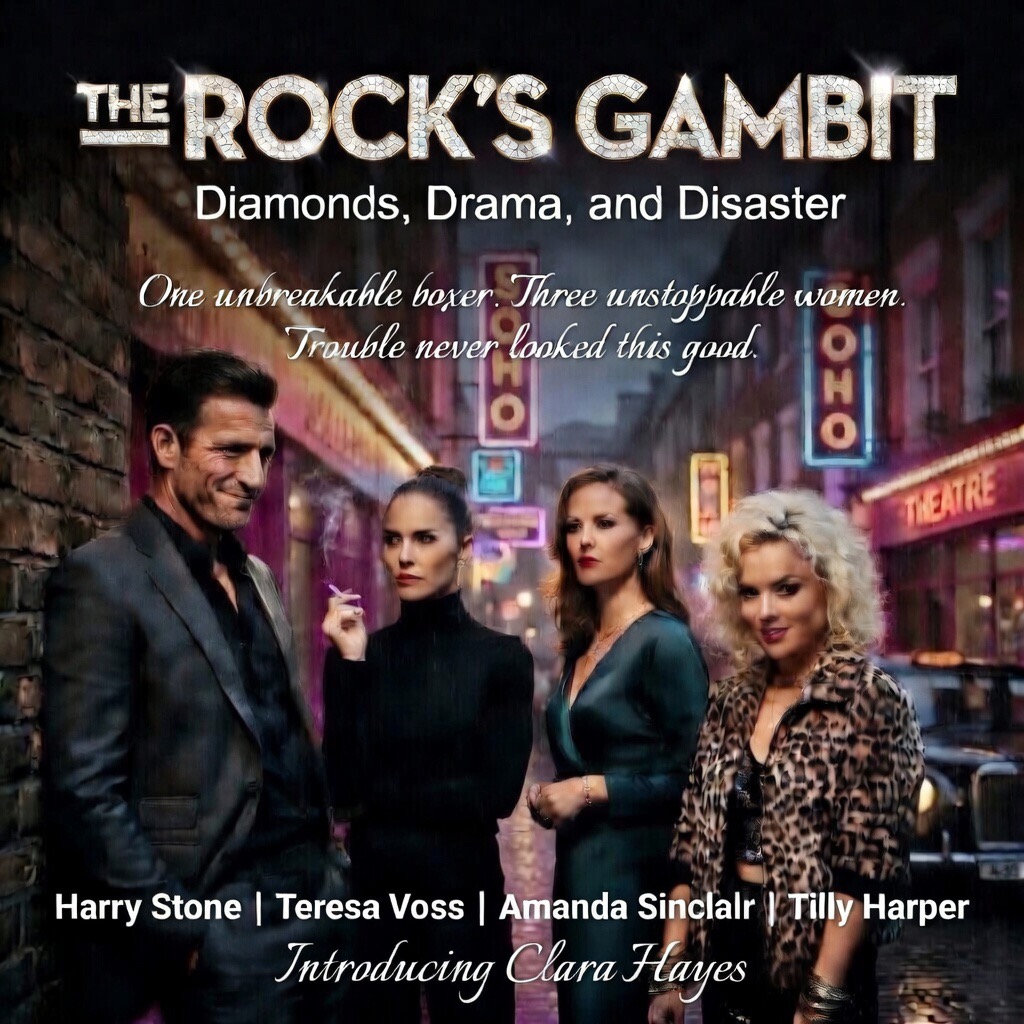

The Rock's Gambit
London, 1985. The city is rigged. Fortunes shift overnight, and the game is always stacked against those who don’t hold the cards.
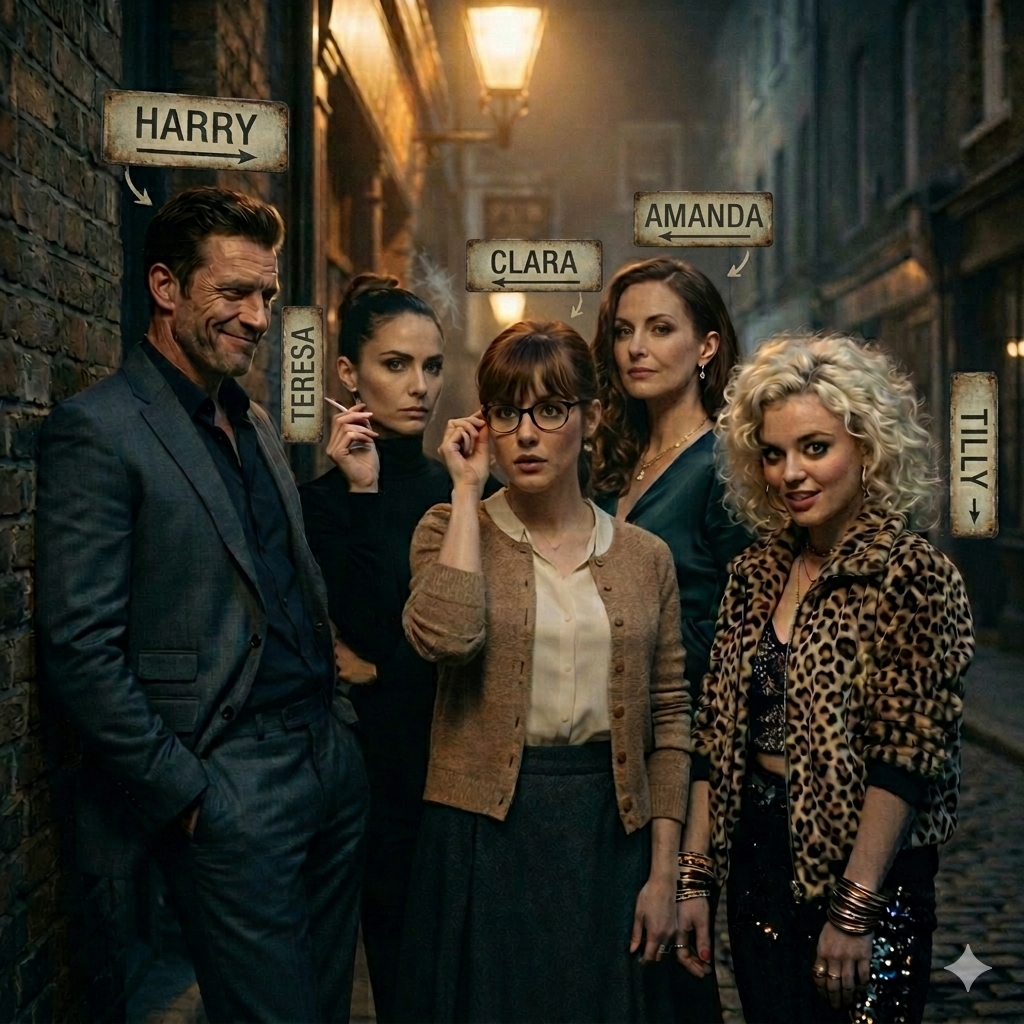
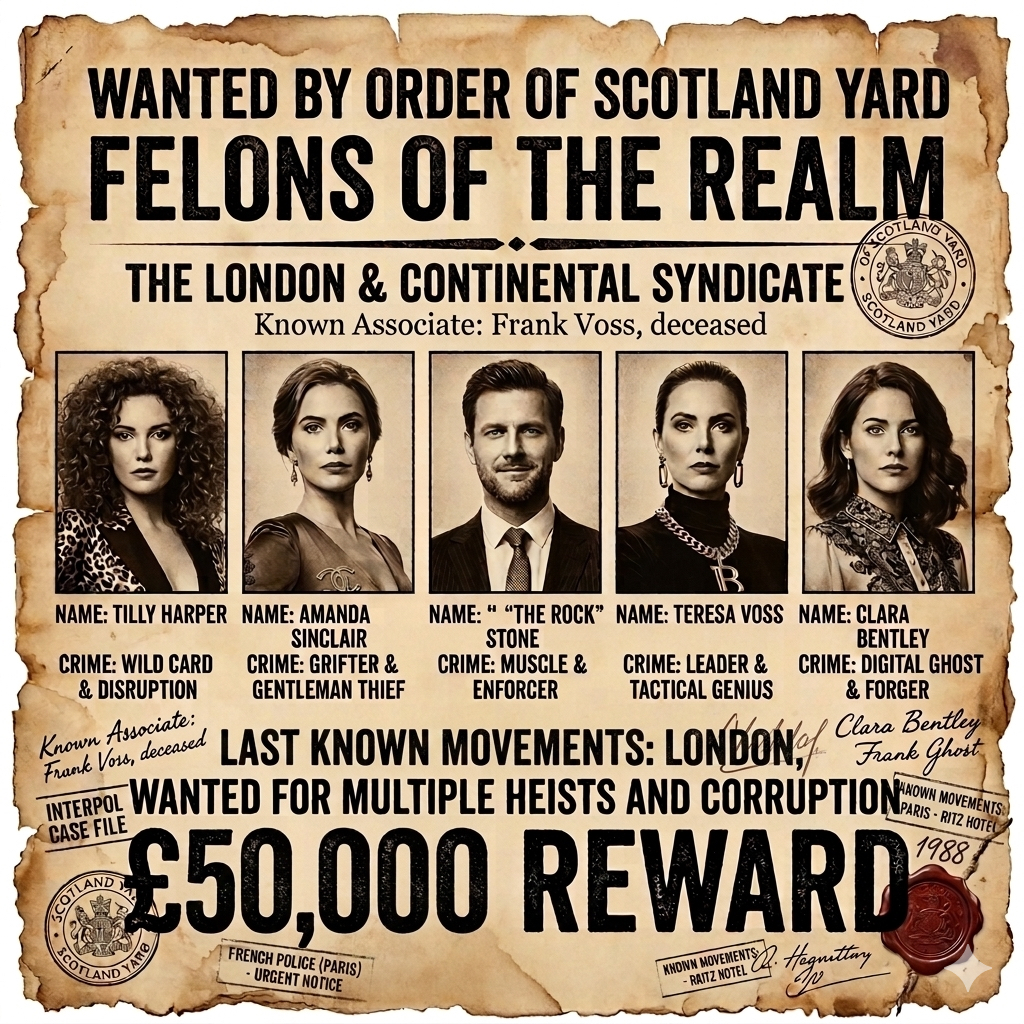
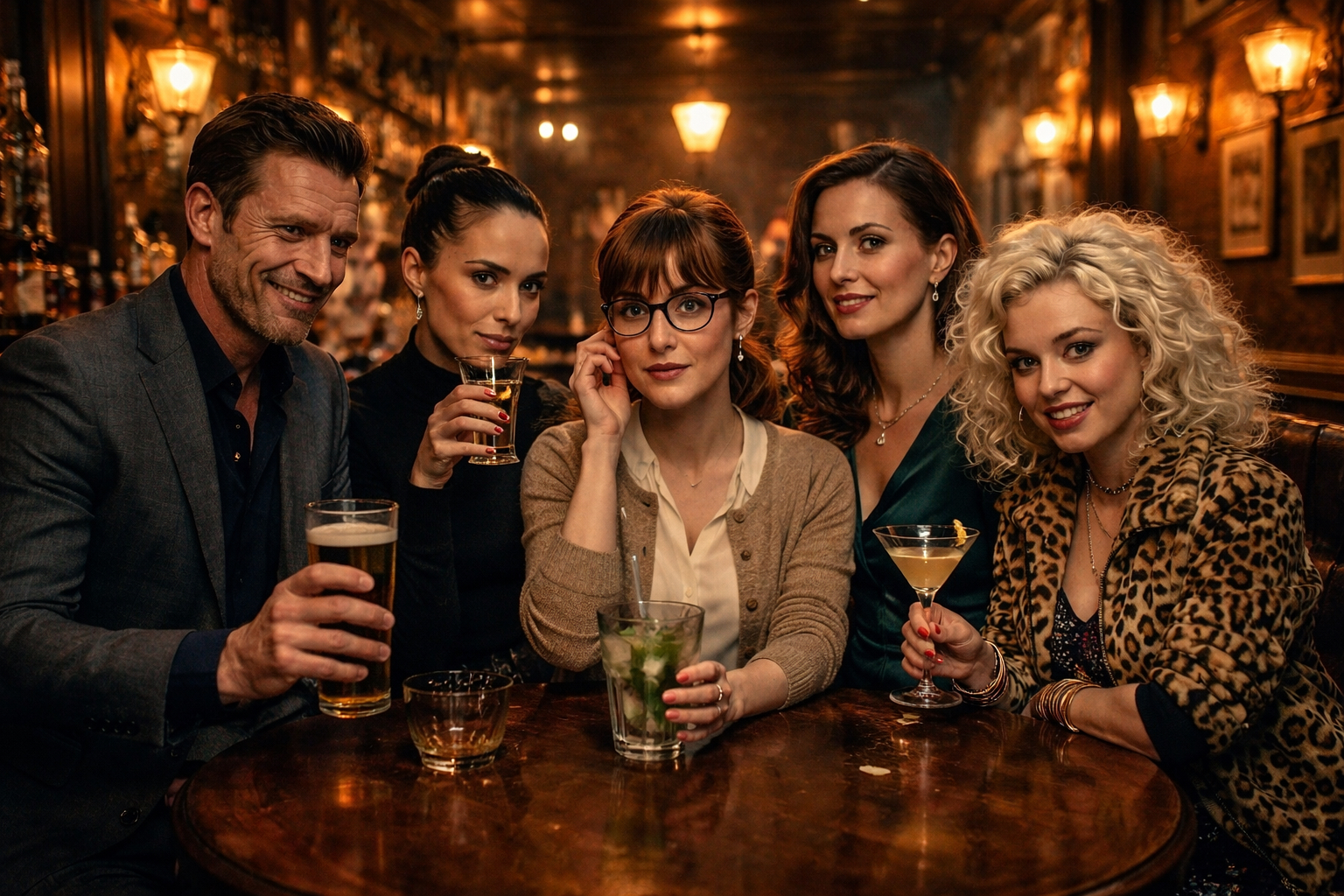
Teresa Voss is the mastermind: sharp, unflinching, always three moves ahead. Amanda Sinclair is her quick-eyed confidante, sharp-witted and cool under fire. Tilly Harper is their wild card: bold, chaotic, and the spark that never lets them take themselves too seriously. Together, they found Harry “The Rock” Stone—a gifted thief with a steady hand and a dangerous hunger for the tables—and invited him into their fold.
Four very different people, bound by loyalty and grit. Together they pull off the jobs no one else dares—until a swap at Windsor Castle drags them into something far bigger: a web of corruption stretching from Hatton Garden to the Vatican Bank, run by corrupt officer George Marlow. When Harry’s old habit puts everything at risk and Marlow closes in fast, the four must stand as one.
From rain-slicked Soho alleys to Monte Carlo’s glittering rooms, Zurich’s quiet streets, and deep beneath the Vatican itself—they chase the truth, outrun the law, and fight for the freedom they have earned.
This is their story: of mistakes forgiven, bonds forged in fire, and the greatest prize of all—not gold or glory, but the family you choose to build.
Chapter 1: The Rock & Three Kinds of Trouble
London, 1985.
The city felt rigged.
Yuppies in red braces clinked champagne glasses in Soho while dole queues stretched through the rain, headlines bled of strikes that refused to end. Neon smeared itself across puddles. Synth-pop thumped from basement clubs. Every street corner felt like a bet someone else had already priced in. The trick was working out who ran the house.
Harry “The Rock” Stone sat in a corner booth of a greasy spoon off Wardour Street, air thick with yesterday’s fry-ups and tomorrow’s regrets. Before him, a double espresso had long gone cold, a thin skin crusted over it like oil on still water.
Beneath the chipped Formica, his fingers moved restlessly, folding and unfolding torn Kempton Park betting slips into sharp little triangles that never quite held their shape.
At thirty-two, he still carried a boxer’s frame: six foot one, broad-shouldered, hands that knew exactly where to land. A boxer’s body—softened just enough to say he’d stopped caring somewhere along the way. Right about when the bell went quiet.
His eyes hadn’t softened at all. Hazel, sharp, restless—the kind that didn’t trust a room, and trusted themselves even less. Across the café, a man laughed too loud. Harry’s gaze flicked there automatically. Not because it mattered. Because everything might.
The worst part wasn’t the debt. It was that moment just before loss—the flicker in his chest, the quiet insistence that this time would hold. That this time the cards would fall right. They never did. Still he believed it anyway. Always did.
Outside, a white-and-blue Rover police car drifted past steam-fogged glass, wipers marking a slow, steady rhythm—slower than it needed.
Harry didn’t look directly. Amateurs made that mistake. Instead he watched its reflection in the chrome napkin dispenser on his table. Shape. Movement. Intent.
Red taillights flared at the junction, lingered a beat too long, then slipped into mist and vanished.
Probably nothing.
Still, Harry folded the last slip in half and slid it deep into his pocket—like evidence he hadn’t yet decided to burn.
The brass bell above the door jangled, sharp and metallic. Three women stepped in out of Soho drizzle.
Conversation faltered.
Amanda Sinclair led. She wore emerald silk that looked almost obscene against fried bread and Formica. Auburn hair pinned back with a diamond clip that caught the buzzing fluorescent. Her smile wasn’t warm—it was positioned, Chelsea breeding sharpened for darker streets. She didn’t walk so much as claim the floor beneath her heels.
Right behind her: Tilly Harper, detonating colour into the room. Heavy leopard-print coat hung off her shoulders like it survived three decades of bad calls; arms stacked with plastic bangles that chimed with every step. Rain-soaked curls fought gravity and won, framing a face too bright, too loud, and entirely unconcerned with polite society.
Teresa Voss came last.
Plain black wool coat, buttoned to the throat. Dark hair pulled back into a severe, surgical bun that left no room for vanity. A cigarette ember burned between her fingers, trailing thin smoke like an official warning no one had cleared. She didn’t scan the room.
She didn’t need to.
She already knew where the exits were. Where the counter boy kept the bread knife. How many seconds to reach Harry’s booth.
A lorry driver paused mid-bite, sausage roll suspended halfway. The lad behind the counter slowed without noticing, rag hanging useless. Something shifted in the room—subtle, unmissable.
Harry didn’t stand.
He leaned slowly back into cracked vinyl, broad hands flat on the table, masking the sudden jolt of adrenaline hammering his ribs.
They slid into the booth without asking.
Amanda took the seat opposite, silk rustling against cheap vinyl. Tilly squeezed in beside her, knocking bangles against the sugar bowl. Teresa lingered half a beat, grey eyes locking onto Harry’s with cold, clinical focus, then took the inside seat beside him.
“Harry Stone?” Amanda asked softly.
Harry gave his crooked grin—the one he used when entirely out of chips.
“Depends who’s asking, darlings. You here to arrest me, charm me, or rob a bank with me?”
Tilly grinned back, white teeth bright behind red lipstick. Reached over and pinched a chip from a nearby table before the bloke noticed.
“Bit of all three, if there’s time, love. You look like you’ve been surviving on tap water and prayer. You need stimulation.”
Teresa didn’t smile.
She slipped a small leather notebook from her coat and slid it across Formica. Stopped exactly three inches from Harry’s left hand.
He didn’t touch it at once. Habit—older than his boxing license—held him still. Eyes flicked the room again. Door. Window. Two new faces by the cigarette machine. The air outside felt arranged, like a stage before curtain-up.
Then he opened it.
Tight, ruthless notation filled every page. Floor plans. Patrol timings down to the second. Camera arcs marked in overlapping red lines—entry points, blind spots, structural weaknesses mapped with obsessive precision.
The Victoria and Albert Museum. Knightsbridge Gala.
And at the heart of the display hall, marked with a small pencilled star—
The diamonds.
Something old and clean woke in Harry’s gut.
Not the hot, dirty itch of the betting table. Something colder. Clearer. More honest.
More dangerous.
Amanda leaned forward, expensive French perfume cutting clean through grease and smoke. Rested chin in hand, emerald eyes bright.
“It doesn’t hurt the arithmetic,” she said lightly, “that George Marlow still speaks your name whenever his ulcer flares. He tells people you owe him for ’74.”
The name landed like a body blow.
Quiet. Heavy. Final.
And with it rose another voice—Frank Voss, years ago in a smoke-hazed billiard hall:
Watch the quiet ones, kid. The loud ones are fireworks. The quiet ones move the board.
Harry closed the notebook with a soft snap.
Looked straight at Teresa now, ignoring the others.
“You’re playing at something bigger than a few carats of ice,” he said. “This isn’t a robbery. It’s an ambush.”
Silence settled over the table.
Teresa lit another Benson & Hedges with a silver Dunhill that clicked like a cocked pistol.
“Maybe,” she said, and exhaled.
Tilly clapped once, bangles rattling like dry bones.
“Oh, don’t overthink it, Harry! Diamonds. Big shiny highly illegal diamonds in a room full of people with far too much money. Don’t overcomplicate it—it ruins the complexion.”
Amanda smiled faintly, fingers brushing the table’s edge.
“Let him overthink it, Tilly. It’s the only way men like Harry ever feel like they’re driving.”
Harry glanced between them: Amanda—sharp, controlled; Tilly—already slipping the café’s silver sugar bowl into her coat like it belonged there; Teresa—cold, watchful, waiting for the bell.
Three kinds of trouble. One kind of chance.
Beneath the debt, beneath the dread, that stupid familiar flicker rose again. This is the one, Harry. This changes everything.
He knew it was a lie. The house always held the edge. But knowledge and belief had never lived in the same chest inside Harry Stone.
Tapped the leather notebook once with a thick finger, voice settling low and steady—the sound of a man stepping back through the ropes.
“All right. Let’s go steal some diamonds.”
Chapter 2 — Knightsbridge Chaos
The Victoria and Albert Museum did not merely display wealth.
It curated it.
Crystal chandeliers scattered warm light across marble floors polished to mirror-sheen. Champagne circulated quietly on silver trays. Laughter stayed measured, never quite loud enough to offend the room. Even conversation felt rehearsed — voices calibrated so nothing urgent ever seemed to happen.
Outside, rain turned Cromwell Road to black glass. The great red-brick façade rose above it all like a Victorian fortress, arches and domes washed in theatrical white. Within, the Knightsbridge Gala unfolded in a slow shimmer of silk, black tie, and carefully disguised excess.
The truly wealthy had long since learned to pretend brilliance no longer impressed them.
The diamond display sat at the gallery’s centre beneath low ambient light — and defied every attempt at indifference. Light bent toward it and shattered, spilling thin icy shards of blue and white across velvet and glass, alive and shifting.
Harry Stone moved through the room like a counterfeit note passed among experts.
The dinner jacket was not his. It pinched beneath the arms, sat wrong at the collar. He carried himself too solidly, too deliberately — out of step with men who had inherited posture along with their property.
“Stop staring at the glass like you mean to punch it, Harry,” Amanda murmured beside him.
She did not turn her head. Her attention rested lightly on the display, her reflection floating in the pane. Crimson dress drew notice with surgical precision — nothing wasted, nothing accidental. A museum clerk lingered nearby, already half-drawn into her orbit.
“Do they polish them each dawn?” she asked softly. “Or do they simply wake this way?”
Harry’s gaze had already shifted.
“That guard by the archway — neck too thick. Private firm. Marlow’s, I’d wager.”
“Then fortunate he is not watching you,” Amanda replied, letting fall a faint, practiced laugh. “Tilly’s in position. Teresa has cut the secondary feed. We have four minutes.”
Harry exhaled slow and tight.
“I’d rather face a boxing ring,” he muttered. “At least there you see the blow coming.”
Across the gallery, Tilly Harper ensured no one saw what mattered.
She had arrived as a minor European baroness, wearing a plume of feathers that looked ready to take flight at any moment. Her laughter cut bright and deliberate through the hum.
“Oh, but Darcy,” she insisted to a bewildered silver-haired lord, “you simply must tell me more about agricultural reform. It sounds dreadfully thrilling.”
The collision came exactly on cue.
Bangles struck mahogany. Balance fled theatrically. A waiter lunged — too late.
A tray tilted —
— and the room erupted in glass, smoked salmon, and high-society panic.
Gasps rippled outward. Heads turned.
The archway guard pivoted sharply, his attention torn clean away.
“Go,” Amanda breathed, already withdrawing.
Harry did not run.
He moved with measured calm, three silent strides covering the distance. Pulse slowed, settling into a heavy steady rhythm.
Hand slipped into pocket, closed around the replica — perfectly weighted, cold as truth.
The display loomed.
Pressure-sensitive. Three grams tolerance.
No margin for error.
Teresa appeared as though she had always stood there.
Black waistcoat. Silver tray. Invisible.
She glided behind the velvet drape, one motion — quick, precise.
The lights died.
The room vanished into black.
A collective intake of breath replaced sight. Silk rustled. Feet shifted.
Harry counted.
One.
Fingers found the seam. Suction cup pressed, lifted — just enough.
Two.
First diamond free. Replica seated.
Three.
Second — perfect.
Hand hovered over the third —
— and something tightened.
Not seen.
Felt.
The air drew thin.
The camera had rotated back too soon.
“Harry,” Teresa said, low and sharp.
He froze.
Lowered the glass.
Carefully.
Not carefully enough.
A soft click carried through the returning glow.
A guard turned.
Harry moved instantly.
Stepped back — then up, planted one foot on a chair edge, raised his glass with easy, careless confidence.
“To museums,” he announced, voice cutting clean through the hum. “The only place in London you may drink champagne while staring at things you will never afford.”
A beat of silence.
Then laughter — spreading, relieving the tension.
Harry leaned into it, grinning.
“And frankly — if they trusted me with this much jewellery, I’d rob the place myself.”
More laughter followed.
Amanda caught the tone, shaped it.
“Naturally,” she added lightly to those nearby, words carrying just far enough. “With insurance premiums what they are, I suspect they’re half-hoping someone does.”
Mood shifted instantly — amused, knowing. Eyes turned away from the display, away from danger.
Exactly as she intended.
Even the guard smiled.
Teresa did not.
She watched something else.
A second guard by the east corridor — hand pressed to earpiece. Listening. Unconvinced.
Amanda saw it too.
No glance exchanged. None needed.
Move.
Now.
Tilly obliged.
Another stumble — this time into a bronze statue that lurched dangerously on its pedestal. A woman cried out as it tipped —
caught —
slammed back into place with a heavy, ringing thud.
Every eye snapped toward the noise.
Teresa moved first, peeling from the case. Amanda slipped ahead, edging just into the line of sight as they reached the corridor.
A security supervisor waited there.
Radio raised.
Eyes sharp.
Amanda adjusted her cuff with cool irritation, stepping squarely into his view.
“We have been redirected twice already,” she said, crisp and commanding. “If this is further incompetence, I shall speak personally to whoever organised this shambles.”
Perfect tone — entitled, controlled, unassailable.
The man hesitated.
Just long enough.
Teresa walked past him without a glance.
Amanda followed.
Tilly swept through last, muttering audibly about hopeless staffing.
Harry brought up the rear.
As he passed, the supervisor looked up — recognition arriving too late.
“Hold —”
Harry slammed the door hard back into its frame.
Metal met flesh.
A shout rose.
“Terribly sorry!” Harry called, bright and breezy.
Then they were through.
Rain hit them instantly.
Cold. Sharp. Real.
The alley reeked of wet brick and diesel. London again — raw and unpolished.
For a heartbeat no one spoke.
Then Tilly laughed.
“Oh, did you see his face —”
Amanda wrenched off a heel. “You nearly toppled a Renaissance bronze.”
“I saved it from falling!” Tilly retorted.
Teresa ignored them both.
Behind the door, voices were rising.
Drawing closer.
Harry slipped a hand inside his jacket. Fingers closed around the diamond.
Perfect.
Flawless.
Too easy.
He turned it once in his palm — stared too long.
“Something wrong?” Amanda asked quietly.
He pocketed it. “Nothing.”
She did not press. But her gaze lingered — measuring, weighing.
“Good,” she said, smoothing rain from her dress. “Because everything proceeding without a hitch is usually when the trap snaps shut.”
The door burst open.
“Stop!”
“Run,” Teresa snapped.
No elegance now. No performance. Only speed.
Slipping on wet cobbles, breath tearing, rain slashing sideways.
A whistle shrilled behind them — far too close.
Teresa veered into a narrow passage. Harry glanced back — two guards gaining fast.
He seized a heavy steel skip and heaved it across the mouth of the alley. It screeched across concrete seconds before pursuit crashed into it.
Bought them breath. Barely.
They spilled onto the main road just as a black cab slowed at the lights.
Teresa wrenched the door open. “In.”
They tumbled aboard.
“Drive.”
“Where to?”
“Anywhere but here.”
The cab pulled away. London blurred into streaks of rain and lamplight.
Amanda leaned back, one shoe discarded, watching Harry through the window reflection rather than face-on.
“Try not to enjoy it too much,” she said softly. “That is usually when the price comes due.”
Harry said nothing.
He watched the museum recede, its lights burning steady gold against the dark.
That feeling clung to him — not fear.
Recognition.
The sensation of holding a perfect hand at cards that you know you were never meant to be dealt.
Sooner or later —
someone will call the bluff.
He settled back. The diamond pressed cold and hard against his ribs.
And smiled.
Because men like him never folded.
Not even once the house began watching back.
Chapter 3 — Parisian Exchange
Rain tapped softly against chapel windows while the priest spoke of duty, family, and the quiet dignity of age.
Teresa Voss listened politely.
She had arranged everything: lilies, service, hymns, wake. Every detail set exactly as her great-aunt would have wished. No fuss, no spectacle, no excess feeling. Order, even in death. Grief, in Teresa’s world, was private — something folded neatly away, where it could not cloud decisions that mattered.
Beside her sat Clara Hayes.
No hand reached for hers. No soft words, no practiced platitudes. Clara simply stayed — steady, present, exactly as she had been all morning.
Years ago they met at the Tate. Clara restored damaged paintings with microscopic patience, working in silence for hours. Teresa, during unexplained lunch breaks, had learned to see things: camera angles, alarm layouts, structural weakness. They recognised in each other at once the same thing: discipline. And no unnecessary noise.
As the congregation rose for the final hymn, Teresa checked her watch. Not impatience — habit. She would not be in Paris. Funerals create witnesses: names in registers, faces recalled, timelines pieced together when questions come. For forty-eight hours, Teresa Voss remained firmly in London — tied to sympathy, paperwork, signatures. Exactly where she needed to be.
More importantly: the buyer would never meet the full crew. Arranged long before lilies were ordered. A Monaco contact — old money, quiet appetite, discretion above all. Terms clear: no overlap between acquisition and sale, no full introductions, no extra risk.
Teresa set the price. Chose the meeting. Chose who went. She always chose.
The coffin vanished behind the curtain. Teresa did not look back. By the time the chapel doors opened onto grey London light, her briefcase was closed.
“Pack light,” she told Clara as they walked to the car. “And wear dark clothes.”
Clara frowned. “For stealth?”
Teresa clicked the latch shut. “For funerals.”
By the time London mourners reached thin tea and stale sandwiches, Harry had upgraded three tickets at Heathrow — inventing a dying aunt in Marseille whose condition worsened dramatically with every retelling.
Twenty minutes later he had acquired a fedora from a sleeping businessman near Gate Six, and was halfway through an impromptu soft-shoe shuffle when a small crowd applauded. Harry bowed. Naturally. A security officer watched from across the terminal, grew steadily more suspicious, glanced toward passport control — and decided whatever Harry Stone was doing simply wasn’t worth the paperwork.
Amanda Sinclair observed the performance with the practiced patience of someone who had seen it far too often to expect improvement. Beside her, Tilly Harper documented every moment on a Polaroid, like a tourist who had wandered accidentally into organised crime.
“Harry,” she called through laughter. “Do the spin again.”
“I do not repeat encores,” Harry replied, grand and grave.
“You did repeat prison twice,” Amanda murmured.
Harry pointed at her, solemn conviction intact. “Character development.”
Paris in October still belonged to the living.
Cafés along Saint-Germain spilled cigarette smoke, cheap philosophy, and Piaf into cooling air. On the Seine, card games ran with surgical calm — letting tourists lose slowly enough to believe they almost won. Surface soft: limestone, golden light, easy laughter. Edge sharp underneath. Even the criminals, Harry noted, had better tailors.
Walking the river, Harry slowed automatically as a street operator shuffled three cards on a crate. Fingers twitched in his coat; mind mapped the sleight instantly. Amanda did not turn — her hand closed firm around his forearm, grip tight enough to bruise through wool.
“Don’t even think it, Stone,” she said, pulling him into the crowd. “That’s a fool’s game — and you’re supposed to be the artist.”
Their Le Marais bolthole leaned slightly, as though time had dragged it downward for decades. Floorboards groaned. Wallpaper peeled. Skylight angled toward rooftops like a watchful eye. Harry hated it on sight.
“No proper tea,” he complained, dropping his case onto a mattress that looked structurally uncertain. “Wine tastes like vinegar. And whatever that is smells like a well-used punchbag.”
“That,” Amanda said, drawing off her gloves with care, “is real cheese.” She glanced at him, half-amused. “No taste, love. But we keep you anyway.”
Rain brushed the glass. Amanda ignored it, laying out tonight’s identities with exact precision — dresses, wigs, scarves, gloves arranged in perfect symmetry.
“Spare pieces go in Harry’s case,” she said. “No one searches the charming one with the British passport.”
Tilly grinned over her shoulder. “Too busy staring at his teeth.”
The House of Cartier on Rue de la Paix should have been routine. But from the moment they stepped inside, the air resisted them — not openly, not loudly, but enough to fray the rhythm.
Light poured through tall windows across marble and velvet counters beneath chandeliers cut with unnerving clarity. Somewhere beneath discreet lighting and several million francs’ worth of unspoken pressure rested it: flawless, ten carats.
Amanda entered first — effortless, precise, not drawing attention so much as gently redirecting it. Staff straightened as she passed; guards recalibrated without knowing why. The room shifted softly around her.
“Bonsoir,” she said, leaning lightly over the central display.
One guard blinked too slow. Another straightened, then hesitated mid-motion toward his earpiece. Amanda marked every twitch — and the harder truth: something here refused to soften.
Five seconds later, Tilly detonated into the space. All noise, all colour, bright impossible American energy.
“Oh my heavens — are these real real? Like, actual real? How adorable!”
Heads snapped. She moved in a blur of perfume and momentum, bouncing between displays — reckless, glamorous, impossible to pin down. Then a bracelet slipped. Cracked sharp across marble.
Guards lunged — and stalled, caught between protocol and embarrassment as Tilly clutched her chest in theatrical horror.
“Goodness — I nearly swooned! Someone fetch me a gin, quickly!”
Laughter split the tension. Harry slipped clean through the gap. Unnoticed. Unremarked. Exactly as planned.
The diamond lay beneath light, perfect enough to feel temporary. His hands moved on instinct — smooth, practiced — and the stone lifted free.
For one heartbeat his reflection caught in glass. Older. Sharper. Charm still there, but frayed thin at the edges. The odds shifted — not enough to stop. Enough to matter.
“Monsieur?”
Too close. Harry finished the motion without breaking rhythm. Replica seated. Real diamond vanished into his palm. Turned at exactly the right pace — not hurried, not slow — and met the salesman’s gaze with easy, uncomplicated warmth.
The man hesitated. Studied him. Something nearly formed behind his eyes. Then faded. “Pardon.” He stepped away.
Passed — but not cleanly. Across the room Amanda shifted half a step, neatly breaking a guard’s line of sight to the case. Tilly turned up the volume — shattering glass, fraying nerves, holding attention anchored entirely to herself. Balance restored. Illusion reset. And Harry walked out without looking back.
Outside, Paris continued indifferent. Traffic hummed. Tyres whispered on damp stone. Harry leaned against a kiosk, relaxed on show, watching everything through shop reflections — never directly. Old habit. Kept him alive longer than luck ever did.
A police car rolled slow past the curb. Too slow.
Something tightened beneath his ribs. Not fear. Instinct. He did not move. Did not flinch. Let cigarette smoke curl untouched. Let posture say the world bored him. The car turned the corner and vanished.
Gone. Not forgotten.
Amanda and Tilly joined him moments later, stepping back into the crowd as though they had never left it. Tilly still hummed with energy, laughter tugging at her mouth. Amanda composed, reset, precise.
Harry tilted his hand. Diamond caught the last pale light. Burned cold. Sharp. Flawless. And wrong — in a way he could not name.
“Ladies,” he said, grin returning easy now the prize was safe, “that wasn’t a robbery. That was art.”
“You hesitated,” Amanda said. Light. Exact.
“I did not,” Harry answered — too fast.
Tilly linked his arm without asking, tugging him forward into the flow. “We are rich and sparkling, love. That is the only math that matters.”
Amanda did not argue. Did not smile. Just watched him — careful, measuring — as if that hesitation mattered more than any of them would say aloud.
Charles de Gaulle: elegant chaos. Queues tangled. Announcements echoed half-heard. Travellers moved with the tight, worn hope of people certain they are nearly free of inconvenience.
The shift happened near security. Casual. Seamless. Identical cases. Timing perfect. Harry, glancing at a headline he barely read, picked up the heavier one without question.
Three minutes later: the tap.
“Monsieur. Vous. S’il vous plaît.”
Harry froze. Closed his eyes. Breathed out — somewhere between resignation and quiet curse. “Ah. Bollocks.”
The room smelled of stale coffee and bureaucracy. Pockets emptied. Passport studied twice. Case onto metal table, opened one sharp efficient motion. Contents spilled: scarlet silk, shattered jasmine perfume soaking through lace — all delicate, feminine, entirely damning.
Harry stared at the explosion of elegance.
“Ce n’est pas à moi,” he said, with all the dignity available under the circumstances.
The younger officer allowed himself a smile. “Very bold, monsieur. The fit looks… ambitious.”
Harry said nothing. Nothing worth saying.
Fifteen minutes later he stepped back into the terminal — smelling faintly of expensive jasmine, wearing a look of carefully guarded dignity. Held it just long enough to be out of earshot.
“Which one of you —”
Tilly stepped into his path, grinning. A velvet pouch dangled between her fingers. She shook it once. Diamond flashed, sharp and bright, under harsh fluorescent light.
“Calm down, hero.”
Amanda was already walking toward the gate, not glancing back. “We have the real case. You were the diversion.”
Harry watched her go. Something sat wrong. The timing. The certainty. How neatly it had all unfolded.
Over the channel, order returned.
Champagne arrived — standard issue above French airspace. Tilly slept within minutes, head to the window, bangles finally still. Amanda sat beside him, magazine open, eyes scanning a page she had not turned in ten minutes.
Harry played his part. Smiled when spoken to. Laughed on cue. Drank too much gin. Let the familiar rhythm of escape wrap around him like a well-worn story. But beneath it all, the question stayed. Quiet. Persistent.
How did they know exactly which case to open?
Replayed it once. Twice. The approach. The timing. The absolute certainty. Across the aisle, Amanda’s reflection caught briefly in darkened glass. She did not turn. But she saw him working it out — turning angles, timing, odds — behind his eyes.
A faint, private smile touched her mouth against the dark pane.
She had swapped the cases herself at the kiosk. Knew Harry’s easy, unhurried charm would buy Tilly exactly thirty seconds of bureaucratic distraction. Enough to walk clean through security with the bonds.
Flawless. Perfect.
But watching him piece it together, she realised something else: he was finally starting to see the board the way she did.
And he would spend the whole journey home working out exactly who was playing whom.
Chapter 4 — Homecoming
The plane’s heavy wheels kissed Heathrow’s wet tarmac with a violent, hydroplaning shudder — and London welcomed them home the only way it knew how: drizzle, gridlock, and the quiet certainty that somewhere in the Square Mile, a bill waited unpaid.
A city rendered in charcoal. Grey skies hung low enough to brush double-decker rooftops; grey streets coiled between soot-stained brick; grey faces moved beneath a sea of black umbrellas like tired ghosts marching toward a judgment that never came.
To Harry, it was beautiful.
A perfect, miserable canvas.
By the time their cab rattled into Soho, rain had blurred into fine airborne mist, smearing neon across watercolour streets. Brake lights streaked puddles like fresh ink; tyres hissed over wet tarmac with the soft tear of silk.
London looked exhausted.
Damp.
Fiercely alive.
The King’s Head breathed warm when they pushed through the stained-glass door.
Heat hit first — thick, wrapping round them like wool. Then the smell: tobacco smoke hanging blue and heavy, stale beer, damp coats, decades of bad decisions soaked deep into the carpet. Windows glowed amber against the dark; Bowie drifted soft and low from a battered jukebox beside the fruit machine.
A few heads turned.
Took in Amanda’s coat, the set of Harry’s shoulders, Tilly’s riot of colour — then looked away.
In Soho, survival means knowing when not to stare.
Teresa Voss sat at the far end, beneath a nicotine-yellowed mirror that had outlasted the Blitz. Black polo-neck cut sharp against pale skin; a Benson & Hedges burned between her fingers, thin smoke curling slow toward the glass. A pint rested by her elbow — half-finished, and yet untouched.
She looked as though she had walked in from the cold and decided the cold could wait.
Clara Hayes sat beside her, white wine held carefully. Posture still carried the discipline of gallery halls and chapel pews; eyes quiet, alert, missing nothing.
Teresa had never invited Clara into this world.
She had simply never told her to leave.
And in Teresa’s world, that counted as trust.
“Well?” Teresa said as they drew near. Her gaze flicked across them — precise, clinical, counting, measuring, checking for damage no one else would see. “Diamond or disaster?”
Tilly answered by dropping her holdall onto the bar hard enough to rattle glasses.
Heads turned.
Tilly beamed at the nearest patron.
He looked away at once.
Smart man.
With deliberate ceremony she unzipped the bag, reached in, and tipped a velvet pouch onto worn wood.
The diamond rolled once beneath amber light — then flared.
Sharp.
Cold.
Unapologetic.
It seemed to drain colour from the room. Voices faltered. Even the landlord paused mid-wipe, rag suspended motionless.
For a heartbeat, the pub held its breath.
Then Teresa smiled.
Rare. Genuine enough to soften every line of her face.
She lifted her glass.
“To absent friends,” she said quietly. “And present geniuses.”
Glasses chimed — ale, Rioja, cider, Guinness, and Clara’s wine a half-beat behind.
Clara watched.
Always watching.
Harry slid onto a stool, faint jasmine still clinging to him like evidence.
“I thought we’d lost the lot at Charles de Gaulle,” he muttered, pulling a long draught of Guinness. “Fifteen minutes of pure humiliation while two gendarmes argued whether I was a smuggler or a variety act.”
Tilly laughed bright and loud.
“Don’t undersell it, love — you were magnificent.”
She launched into instant reenactment: broad French accent, hand pressed theatrically to chest, red napkin draped like scandalous lace.
The corner of the pub warmed. Laughter rippled. A man at the dartboard nearly choked on his pint. Even the landlord grinned.
And Teresa — unexpectedly — laughed.
Quiet. Dry. Real.
Clara noticed.
Stored it away, careful and precise.
Amanda leaned closer, perfume cutting clean through smoke and beer.
“Admit it, Harry,” she murmured. “You thrive on the drama.”
He turned, that familiar crooked grin settling easy.
“I thrive on winning. Drama simply follows me.”
She held his gaze a beat too long.
Then looked back to her wine.
By then the diamond was gone.
Teresa’s satchel rested at her feet, her hand draped light across the top. Casual.
Intentional.
Harry turned his glass slow, watching dark liquid settle.
“I still don’t understand,” he said, quiet enough only they heard. “Why me? Plenty faster. Younger. Less… weathered.”
Teresa crushed her cigarette out slow.
“My father trusted you.”
The name hung in the air, heavy and sudden.
“Hatton Garden. Nineteen seventy-four,” she said. “He watched you lift three trays under the Flying Squad’s noses — and walk out smiling.”
Harry studied his reflection in black stout.
“Frank said many things when the whisky was in him.”
“He also said loyalty matters more than talent,” Teresa replied. “And these days? Loyalty is rarer than diamonds.”
Amanda’s fingers brushed his cuff — barely a touch, but deliberate.
“The Rock still carries weight, Harry,” she said soft. “Clean jobs. No noise. That is what we needed.”
He did not look at her.
But he heard.
“Also!” Tilly chimed in, sloshing cider dangerously close to Clara’s sleeve. “You handle catastrophe with excellent style. Vital team qualification.”
Laughter came easier this time.
Warmer.
Something inside Harry loosened — an old knot he had not realised he still carried.
Frank’s voice, clear as memory: Loyalty’s your edge, kid.
He lifted his pint.
“To Frank.”
A pause.
“And to us,” he added, grinning. “Thieves, dreamers… future legends.”
They drank.
Outside Soho glistened wet beneath neon and rain. Inside the King’s Head burned low and gold. The diamond rested heavy beneath Teresa’s hand.
Clara’s eyes flicked once toward the satchel.
Then away.
Careful.
Measured.
For one breath —
everything felt right.
Then the door swung open.
Cold air knifed through warmth, swirling smoke, guttering candlelight.
A man stepped in.
Rain sheened his coat; broad shoulders beneath heavy wool. He paused just past the threshold, scanning the room with quiet, predatory calm.
Not police.
Something worse.
Harry did not notice.
Amanda did.
Her hand froze halfway to her glass.
Teresa did not turn.
But her grip tightened on the satchel, sharp and sudden.
The man crossed the room with unhurried ease and took a stool three away from theirs. Ordered whisky. Neat.
Voice low. Polite. Unmemorable.
He did not look at them.
He did not need to.
The moment passed — or pretended to.
Harry laughed louder, settling into warmth, drink, the dangerous sweet illusion of safety. For the first time in years, he could almost believe he was ahead.
That the game had finally tilted his way.
But three stools down, the stranger lifted his glass.
He did not drink.
Instead his gaze settled on the mirror behind the bar — watching them through reflection, steady, patient.
A man who did not need to rush.
Because he already knew how this ended.
Chapter 5 — An Inspector Calls
Rain hammered Camden with the steady fury of an old creditor settling a score. Water sheeted down soot-blackened terraces, spilled from rusted gutters, and cascaded onto the high street like heavy curtains drawn shut.
Beneath a sagging greengrocer’s awning, a couple shouted over the downpour — words swallowed whole. Toward King’s Cross, a siren rose thin and distant, then faded into tyres on wet tarmac and the city’s steady, breathless hiss.
Inside Harry’s flat, air hung thick: stale smoke, leftover curry, damp coats, and a year’s worth of small mistakes. The place looked exactly like a man caught halfway between hiding and starting over.
Dishes leaned precarious in the sink. Racing pages spread across half the kitchen table. An ashtray overflowed beside an unpaid bill, curled crisp by the radiator. Hoovering was overdue.
Harry called it character. Everyone else called it condemned with personality.
Teresa sat beneath buzzing strip light, sketching casino floor plans in sharp, precise strokes across a notebook dense with arrows, timings, camera arcs. Her cigarette burned slow; ash grew long before dropping into an empty soup bowl.
Amanda perched by the window in stocking feet, picking idly at a sandwich, attention fixed far more on her wine.
Tilly sprawled across the sofa like a glamorous accident scene, one heel dangling loose, ash drifting lazily into a chipped mug. Hair in rollers; pale face mask suggesting either grand preparation or minor surgery.
For a few minutes, it almost felt like normal.
Then came the knock.
Three strikes. Sharp. Hard. Deliberate. No hesitation. No neighbour borrowing sugar. Just weight.
Knock. Knock. Knock.
The room shifted instantly.
Tilly froze mid-stretch, leg suspended. Amanda’s eyes lifted toward the door — head motionless. Teresa’s pen stopped dead, leaving a bleeding dot of black ink.
Harry didn’t check the spyhole.
Gut already did the maths.
“Expecting company?” Tilly whispered — bright American accent gone, pure London returned.
“No,” Harry said.
Which meant trouble.
He crossed the flat slowly, floorboards creaking under his step. Rain hissed against glass while those knocks hung heavy in his head. Drew a slow breath, settled stance — old habit — and opened.
Detective Chief Inspector George Marlow filled the doorway. Rain streamed from his overcoat, dripping steadily onto lino. Mid-fifties, thick through the waist, face lined with whisky, long hours, and carefully nursed resentment. Only his eyes hadn’t softened: pale blue, sharp enough to cut wire.
“Evening, Stone.”
Voice low, rough, heavy with certainty.
He stepped inside uninvited, brushing past as though the place already belonged to him. Cold air and rain followed, slicing clean through smoke and grease.
Swept the room once — measured, professional. Amanda. Tilly. Then Teresa.
Lingered there. Not admiration. Recognition.
“Well,” Tilly murmured, “someone forgot to retire in ’74.”
Marlow ignored her completely. Crossed to Harry’s armchair — lifted years ago from a closing hotel — and sat without asking, settling in as if he meant to stay all night.
“Paris called,” he said, flicking water from his cuff. “Cartier’s missing a ten-carat trinket. Your name’s on the manifest. Along with your friends’.”
Harry leaned against the frame, face smooth. “Busy flight. Half London heads there this time of year.”
Marlow smiled — no warmth. “I thought Scrubs taught you restraint. Then again, Frank Voss always said you never listened.”
The name tightened the room. Teresa’s cigarette paused halfway to her lips. Marlow noticed. Of course he did.
“Hatton Garden. ’74,” he went on soft. “Your lot made me look a fool. Six months of paperwork. I don’t like looking foolish.”
Harry sipped Guinness. “George, eleven years is a long grudge. Think of your blood pressure.”
Marlow leaned forward, deliberate, invading space. “I’m not here to lock you up.” Beat. “I’m here to help.”
Amanda laughed — quiet, cold, sharp.
“One small favour,” Marlow continued. “You run a job for me. The Paris telex vanishes. No reports. No Interpol. No more visits.”
Silence settled heavy. Teresa spoke. “What favour?”
Marlow pulled out folded cream stationery. Hilton letterhead. “Wednesday night. Park Lane. Room five-one-two. African prince. Diplomatic immunity. Wealth like armour.” Glanced around. “He wears a signet ring. Emerald. Raw gold. Heirloom.” Thin, knowing smile. “I want it.”
Harry frowned. “You want us to rob royalty?”
“I want deniability,” Marlow corrected. “You take the ring. I handle fallout. We stay friends.” He stood.
Teresa stubbed out her cigarette. “And if we say no?”
Marlow pulled on gloves, smoothing leather slow over each finger. “Then I make a call. The French are already in London. And Brixton cells…” Pause. “…are cold this time of year.”
Amanda tilted her head. “Darling George — at least buy us dinner before prison threats.”
Flicker of amusement. “You always aimed higher than this lot.”
“Same to you,” she replied. “And the Met.”
Tilly snorted.
Harry watched him close. This wasn’t leverage. This was ownership. Marlow didn’t just want the ring. He wanted them.
And suddenly Paris made cruel sense. Too clean. Too easy. It was never luck. Marlow had been pulling strings all along.
At the door, hand resting on frame, Marlow paused. “You don’t get to walk away.”
Silence. He looked straight at Harry. “Men like you don’t retire. You just circle. Sooner or later, you come back to where the money is. I’ll be waiting.”
Heartbeat. Then that small, cold smile. “Wednesday. Don’t be late.”
Gone.
Door clicked shut — soft. Final.
Rain rushed back into the silence. Kettle clicked off. Only drip-drip from his coat onto floorboards.
Still no one spoke.
Then — “I vote we rob him instead,” Tilly said.
No one argued.
Teresa lit another cigarette. “We do the job.”
Harry stared. “You’re serious?”
“Completely. But we do it our way.”
“Marlow doesn’t do ‘our way.’”
Amanda stepped forward, glass still in hand. “He thinks he doesn’t have to.” Slow, dangerous smile spread. “We’ll correct that.”
Tilly grinned. “Finally. A proper problem worth solving.”
Harry looked at them — really looked. Teresa already calculating angles. Amanda already shifting the board. Tilly already enjoying the fight. And him — right in the thick of it.
Marlow thought he’d slipped a leash round their necks.
Harry exhaled slow. Smiled back — not kindly.
“Fine. We’ll dance.” Sharp pause. “But he doesn’t get to lead.”
Outside, Camden drowned. Storm hammered glass — wild, loud. Applause. Or warning.
Chapter 6 — Room 512 Shenanigans
The Hilton on Park Lane glittered like a chandelier someone had dropped across Mayfair and decided not to clean up.
Marble floors mirrored everything — light, faces, movement — flattening it all into something unreal. Mirrors doubled the space, doubled the wealth, doubled the quiet tension simmering beneath every polished surface. It smelled of beeswax, expensive perfume, and the faint stale anxiety of people with too much to lose who spent their lives pretending otherwise.
Harry adjusted his tie for the third time and felt it tighten again at once — as if the building itself meant to throttle him.
“Try to look house-trained, darling,” Amanda had said.
He studied his reflection. Barely recognised the man staring back. Suit fit too well. That alone made him suspicious.
This was never a job.
It was bait.
And Marlow stood somewhere out there, rod in hand, waiting for the bite.
Amanda didn’t hesitate. She moved through the lobby in sapphire silk that caught light with surgical precision — every step measured, every glance deliberate. Men turned their heads. Some openly. Some pretending not to. One forgot his own sentence mid-word and simply stopped.
Harry followed half a beat behind — solid, grounded, broad-shouldered — out of rhythm with the effortless drift of inherited wealth flowing all around him.
Then Tilly arrived and blew the whole performance apart.
She collided with a bellboy with operatic enthusiasm, sending luggage, coat hangers, and a hatbox spinning across polished marble. Champagne sloshed wildly from her glass, spattering cuffs and skirts alike.
“Oh — I am so dreadfully sorry!”
Voice carried. Heads turned. A porter rushed over. Then another. Someone shouted for a manager. A lapdog yapped furiously as its owner dragged it clear of the chaos.
For ten seconds, the entire lobby revolved around her.
Harry didn’t glance back. He drifted through the gap she’d opened as if it had been built exactly for him.
Across the room, Teresa stood motionless beside a mirrored column. Her face calm, unreadable. Her eyes did the work — tracking exits, counting guards, noting how cameras pivoted fractionally toward the noise.
Timing every second.
When the lift doors opened, Amanda stepped in first, Harry and Teresa following without a word. Doors slid shut. Noise cut clean in half.
Harry exhaled a breath he hadn’t known he held.
“It’s bait.”
“Yes,” Teresa said.
“And Marlow holds the line.”
Amanda watched their reflections in mirrored glass. Smile faint, controlled, offering no comfort.
“Then let’s ensure he catches something unpleasant.”
Lift hummed upward.
That familiar pressure settled in Harry’s chest — not fear. Awareness. Pieces already in motion long before they arrived.
Room 512 confirmed it.
Scent hit first: heavy cologne, cigar smoke, and beneath it all — insecurity dressed as confidence. Prince Monolulu sprawled across the bed in an open silk shirt, gold flashing everywhere, rings stacked on nearly every finger. Television droned horse racing in the corner, ignored entirely.
He grinned when they entered. Too wide. Too eager.
“Ladies! Now this is exactly what I call service!”
Amanda glided inside like she owned the place. Sat lightly on the bed’s edge, crossing one leg over the other — motion that held his attention without effort.
“Your Highness.”
Tilly was already at the minibar.
“Tiny whisky bottles,” she breathed, delighted, lifting two like she’d struck gold. “God bless hospitality.”
Prince laughed — loud, unguarded. His hand wandered.
Amanda shifted just enough, gently steering him back, her focus already elsewhere.
“Business first,” she murmured. “Surely a man of your stature keeps his finest treasure close?”
Her gaze brushed the ring.
Big. Bright. Impossible to miss.
“Never comes off!” He clutched it proudly.
Of course it didn’t.
Tilly moved in that same instant — a brush of shoulder, a half-step too close, a stagger that looked entirely accidental.
Ring slid free, smooth as silk.
She drifted away, holding it up to the light as though admiring her own reflection. Then froze.
Sparkle was wrong.
Too flat.
Too bright.
Glass.
Her eyes snapped to Amanda.
Amanda didn’t react — but warmth vanished from her gaze entirely.
Of course.
Marlow never meant them to steal anything.
He meant them to be caught red-handed.
Tilly bit back a curse — and then saw it.
The briefcase.
Half-hidden beside the wardrobe. Black leather worn soft at corners. Brass lock catching light. Not display. Not prop.
Real.
Her expression shifted — sharp, wordless.
Amanda saw. Decided instantly.
She leaned closer to the prince, laughing soft and low at whatever he said, drawing him in, keeping him exactly where she needed him.
Tilly crouched. Eased the case free — inch by silent inch.
No sound. No rush. Perfect timing.
Thirty seconds later they stepped back into the corridor, leaving the prince still smiling at empty air.
Harry saw the case and his gut tightened.
“Tell me that isn’t —”
“No time,” Amanda said, all softness gone. “Move.”
Behind them, corridor fractured.
Doors slammed. Voices — hard, authoritative — closing fast.
Police.
Exactly when Marlow planned them to arrive.
Only now — there was nothing here to pin on them.
Stairwell swallowed them whole. Concrete. Echoing. Honest.
Harry took the steps fast, case heavy against his forearms, breath steady but deep.
“I hate stairs,” Tilly panted.
“You hate effort,” Harry returned.
“Same thing.”
Amanda kicked off one heel, the other barely clinging on.
They hit the fire door together. Burst through under Harry’s shoulder.
Rain struck cold and hard — washing away silk, polish, performance.
The Cortina idled beneath a flickering lamp. Teresa at the wheel, hands steady, eyes sweeping mirrors.
They piled in.
“Go.”
Car surged forward, tyres biting damp tarmac. Behind them, voices spilled into the alley.
Too slow.
Always just too late.
They didn’t slacken pace until they were simply another car beneath sodium glow, swallowed by London.
Harry exhaled slow, long — tension unwinding tight in his chest.
Tilly hauled the case onto her lap, worked a hairpin free from her hair.
“Always come prepared, love.”
Lock clicked.
Lid fell open.
Money.
Stacked high. Crisp. Dense. Heavy in a way nothing else ever is.
For a heartbeat, silence.
Then Tilly laughed — bright, sharp, unburdened.
“We’re rich.”
Harry stared — then barked a laugh that startled even him.
“Marlow…”
Amanda leaned back, watching rain streak across glass.
“He planned to raid the room,” she said quiet. “Seize the cash. Keep most. Plant the rest — and us — at the scene.”
Her smile spread slow, satisfied.
“We improved the arrangement.”
Teresa met her eyes in the rear-view.
Faint nod. Brief. Genuine.
By the King’s Head, adrenaline had settled into something sharper. Momentum.
Pints poured. Ashtrays cleared. And the money — laid out in neat columns beneath amber light. Teresa counted with quiet precision, separating bundles, running totals in her head. Enough to vanish. Enough to start over.
Harry leaned back, feeling that old familiar pull rise — that flicker he knew better than to trust.
Winning.
It never meant what it felt like.
Amanda raised her glass.
“To poetic justice.”
Tilly clinked hard enough to spill cider.
“And to never trusting a bent copper with bespoke tailoring.”
Laughter came easy.
Too easy.
Harry watched rain streak the window, blurring Soho neon beyond.
Somewhere tonight, George Marlow would stand in an empty hotel room. Realise. Understand exactly how completely he’d been outplayed.
Harry smiled.
“Let him come.”
But even as the words left him, something stayed quiet. Watchful.
That same feeling.
That same warning.
Too clean.
Too perfect.
Like a winning hand dealt just a little too easily.
He lifted his pint anyway.
Because men like him never walked away from the table.
Not even once the house started playing for keeps.
Chapter 7 — Casino Follies
The Leicester Square casino felt like old money trying not to yawn itself to death.
Crimson velvet drapes sagged from high ceilings like exhausted aristocrats refusing to admit the empire had ended. Beneath them, crystal chandeliers burned with stubborn resolve over walnut walls steeped in cigar smoke, single malt, expensive perfume — and underneath, the sharper, quieter tang of men losing things they could not afford to replace.
Slot machines chattered faint and hopeful downstairs. Roulette wheels snapped and spun beneath pools of honeyed light. At the far end, an elderly pianist in a frayed cummerbund worked his way through As Time Goes By with patient brutality.
No one stopped him.
No one listened.
He might as well have played to an empty room.
Harry breathed it all in anyway. The hum, the smoke, the slow drift of money — it filled his lungs like oxygen, and something inside him settled into the rhythm instantly. A muscle long dormant remembering exactly what it had been built for.
“Now this,” he murmured, dangerous brightness sparking in his eyes, “feels like Lady Luck’s just around the corner.”
Amanda glanced across the room, unimpressed. Silver silk clung to her like poured light. “It smells like a messy divorce.”
Tilly was already drifting toward the roulette tables, laughter trailing behind her. “I adore places where rich men weep into perfectly tailored suits.”
Teresa stood apart. Still. Composed. Watching.
Her gaze moved methodically — not seeing the casino, disassembling it. Doors. Exits. Cameras set flush into ceiling moulding. Dealers’ rotation patterns. Lines of sight most people never noticed. Where someone could stand. Where someone could vanish.
To her, this was not glamour.
It was architecture.
Understood. Measured. Taken apart.
Earlier that day, she had split the Hilton cash four ways. No ceremony. No speeches. Just numbers — precise, final. Handed Harry eight thousand pounds in tight bundles and told him, clearly and without emphasis, to buy encrypted scanners — the kind that hear what police assume no one else can.
An investment.
A future.
Harry nodded. Meant it. That had been daylight, kettle humming, ordinary world still within reach.
This was not that world.
Somewhere between entrance and table, the itch returned.
At first barely a whisper — soft, reasonable. Easy to dismiss. Then it settled, grew louder, more persuasive.
One good run. One clean night where the cards finally fell right. He was owed that. Time to balance the books. This time he would walk away square. Always framed that way. Sensible. Temporary. Manageable.
By ten o’clock, he had lost nearly eighteen thousand pounds — and was reaching for Amanda’s share as if the line between theirs and his had never existed.
The table had gone cold long before.
Not gradually.
Completely.
He felt it in the rhythm — the subtle wrongness. Patterns that would not hold. Dealer hitting every hard hand. Every instinct honed over a lifetime screamed: stand, walk away, cut loss.
He stayed.
Amanda stood just behind, hand resting light on his shoulder. To any eye — casual. Affectionate.
Harry felt the pressure. Felt it tighten, steady and precise, with every hand he lost.
“Harry,” she said, smooth as silk, “if you lose my money too, I may be forced to commit very public, very unfashionable murder.”
“I’ve got this,” he said. “Under control.”
It wasn’t.
But it never felt out of control while it lasted. That was the trick. The quiet, cruel mechanism. He exhaled slow, settled deeper into the chair, fingers brushing the edge of his stack.
“Trust me,” he said, quieter now. “Next hand’s mine.”
Fingers lingered. Not hesitation. Recognition.
He had been here before — different rooms, different decades, different stakes — but always this same place. The moment where it stopped being about odds and became something else.
Something personal.
“Don’t,” Amanda said.
He heard her. Always did. But beneath her voice lay another — older, deeper, unarguable. No panic. Just certainty.
Dealer turned a king.
Loss.
Amanda closed her eyes briefly. “Remarkable. We are witnessing innovation in self-destruction.”
Harry signalled the waiter. “Double whisky. And pink champagne for the lady.” He turned back, quiet conviction intact. “Luck’s due to turn.”
“That sentence,” Amanda said, “has buried better men than heroin.”
Tilly appeared beside them, glass in hand, smile bright and merciless. “He’d bet his own funeral and take odds on the coffin.”
“I’ll turn it,” Harry muttered.
“Historically?” Amanda asked. “Or in your head?”
Then the room shifted. No announcement. No fanfare. Just air growing heavier, attention drifting.
The whale had arrived.
Everything about him spoke of effortless wealth — cut of suit, weight of watch, the way he placed chips as if outcome did not matter. Two men stood silent and motionless behind him.
He took the seat opposite Harry without a glance.
That was worse than arrogance.
Harry felt it instantly — skin tightening, instinct flaring sharp and hot. He hated him. Which meant, inevitably, he leaned forward.
And played.
Rhythm changed. Chips rose and fell faster. The whale did not react — win or lose, face remained unreadable.
That indifference pressed down like a weight.
Unbearable.
Harry pushed harder, chasing something he could no longer name.
Loss.
Raise.
Loss.
Double down.
Loss.
Room softened. Sound dulled. Table narrowed until it was the only thing real.
Just one more hand. Always one more.
At half-past eleven, three thousand remained. Everything.
Amanda saw. Of course she did.
“Don’t,” she said — soft, final.
He did not look up.
“All in.”
Chips slid forward — sound absurdly small for what rode on them.
Dealt.
Jack.
Nine.
Nineteen.
For one suspended breath, everything aligned. Not hope — something cleaner. Certainty. As though the world had paused just long enough to correct itself.
He almost smiled.
Dealer turned an ace.
Time stretched.
Then the ten.
Blackjack.
Hope did not vanish. It imploded. Collapsed inward, leaving hollow silence.
The rake moved once. Neat. Efficient.
Gone.
Harry sat motionless. Hands flat on felt, as if the game might continue beneath them if he waited long enough.
It was never the money.
It was the second before the turn.
The belief — absolute — that this time it would be different.
“Christ, Harry,” Amanda said. Edge softened despite herself. “Stay away from gambling. Or at least stay away from my money.”
Tilly leaned in, tone firm. “You have truly done it now.”
Harry said nothing. His face said it all.
Amanda looked at him. “Hopeless. Bloody hopeless. What do we do?”
Harry did not answer.
Somehow that was worse.
Then — George Marlow appeared.
Not entering. Not walking over. Simply there.
One moment the space by the mirrored column stood empty. Next — occupied. Rain-dark coat. Face worn down by patience rather than years. Eyes sharp enough to cast their own light.
He took the empty seat beside Harry.
“Right where I expected you.”
Harry did not look round. “Bad timing. I’m skint.”
“You always are,” Marlow said. “And you never know when to stop.” Pause. “Hatton Garden. Seventy-four. Exact same mistake.”
Harry’s gaze shifted.
Marlow leaned in. “The Hilton money. I want it back.”
Quiet. Certain.
“Find it. Very soon. Or I come for your liberty.”
Rain still clung to his coat.
“Your problem, Stone — you never walk away. You see fire. And you run toward it.”
Amanda moved closer — controlled, unmistakeable.
Harry sat back. “Is that what you think this is?”
Marlow held his gaze without effort. “You chase. And then you fall.”
Across the table, the whale stood and left. Untouched. Unconcerned.
Harry remained pinned beneath the light. Empty. Visible.
“I’ll wait,” Marlow said softly. “I can outwait a gambler.”
“Careful, George,” Amanda cut in. “Patience never was your strong suit.”
“It is now.”
It landed heavier than every threat.
Harry tried a smile. Failed. “Pull up a chair.”
Marlow stood. “No. I’ll collect you when you’re finished ruining yourself.” Beat. “You are never as alone as you imagine.”
Gone.
Amanda did not hesitate. Took his arm and pulled him upright. “Come on.”
He let himself be led.
Lift mirrors told the truth.
Tie crooked. Eyes red. Sheen of sweat beneath polish.
A man coming apart in expensive fragments.
Harry leaned toward her, reaching for what was familiar. “Room service?” Slurred. “Or — or we go again?”
Her grip tightened.
“You gambled everything.” Pause. “And half of mine.”
Doors slid shut.
Below, Marlow stood beneath chandeliers, watching floor numbers climb.
Patient.
Certain.
Waiting.
Harry turned from his reflection.
Because finally — he understood.
Marlow wasn’t chasing them.
He didn’t need to.
He was just waiting for them to fall.
Chapter 8 — The Windsor Castle Caper
The private auction hall at Windsor Castle glittered like a jewellery box shaken too hard. Champagne drifted on silver trays; waiters threaded between collectors, minor aristocrats, discreet diplomats, and men rich enough to confuse ownership with taste. Chandeliers burned steady above vaulted ceilings painted centuries ago by people who assumed monarchy was permanent.
Most guests still did.
Bids floated effortless through the air.
Twenty thousand.
Thirty.
Fifty.
Polite fortunes exchanged over smoked salmon.
Harry Stone adjusted a dinner jacket that cost more than his first three cars combined and resisted the urge to scratch like something half-wild.
He wasn’t here for culture.
Or prestige.
Or whatever quiet madness made people spend six figures on paintings of miserable sheep.
He was here because Dickie Johnson had asked.
That still counted for something.
Dickie “The Dodger” Johnson hovered at his shoulder, sweating gently through tailoring that never quite belonged.
“Harry, mate — tell me it’s genuine before Pettigrew-Smythe bids like he’s buying the county.”
Harry sipped whisky slow, gaze drifting across the room before gracing Dickie with attention.
“Always a pleasure, old friend.”
“You still owe me fifty quid from ’78.”
“Inflation’s a terrible thing.”
Across the room, Amanda almost smiled.
She moved easy through the crowd in emerald silk — light found her whether it was invited or not. Conversations faltered as she passed. Men mistook her poise for opportunity.
Tilly had already abandoned restraint.
“I’m just saying,” she remarked mid-canapé, “if you own fourteen castles, you don’t get to complain about taxes.”
Amanda plucked fresh champagne from a tray.
“Try not to insult them before dessert.”
“No promises.”
Near the East Gallery, Clara Hayes stood composed and slightly apart, clipboard folded to her chest. She didn’t quite belong — but understood the room well enough to move through it. When she saw Teresa, something in her shoulders softened.
“You actually came.”
“I said maybe.”
“I heard the maybe.”
“You recover quickly.”
Clara glanced past her toward the auction floor.
“Is Harry behaving?”
“No,” Teresa said calmly. “But he’s indoors.”
“That’s already an improvement.”
Dickie finally steered Harry to the painting.
The Harvest Meadow rested beneath protective glass — carefully lit, quietly important.
Harry slowed.
Then stopped.
Something wasn’t right. Not obvious. Not structural. Just… wrong. Colours leaned too bright; varnish caught light with eager shine. The countryside looked staged — painted from memory, not life.
Harry narrowed his eyes. “Bloody hell.”
Dickie froze. “What?”
“It’s shouting.”
“What’s that mean?”
“Gainsborough didn’t shout.”
Teresa stepped beside him, focus sharpening instantly.
“Pigments are wrong,” she said quiet. “Modern oils under aged varnish.” Paused. “Brushwork lacks discipline.”
Dickie’s face drained.
“You’re telling me there’s a fake — in Windsor Castle?”
Harry glanced sideways.
“Feels about right, doesn’t it?”
Teresa didn’t answer. She was already mapping the gap — the absence where the real thing should have hung.
This wasn’t just forgery.
It was a replacement.
Which meant the original hadn’t gone far.
Clara watched her realise.
“That look,” she murmured, “is rarely encouraging.”
“You’re observant.”
Clara hesitated — just long enough to register. Then slipped a laminated pass into Teresa’s hand.
“You’ve got minutes. Security rotation’s slow tonight.”
Teresa took it without looking down. “No alarms?”
“Not yet.” Pause. “If you’re going to do something stupid — do it quickly.”
Harry was already moving.
Room to corridor: noise fell away. Air cooled. Scent shifted — wax, paper, quiet preservation. Footsteps swallowed by carpet. Portraits watched from walls.
He pushed through baize-lined door into a holding space. Eyes scanned.
There.
Rolled canvas, loosely wrapped — not hidden, just waiting.
He approached slower than intended. Not caution. Recognition.
Loosened cloth just enough.
And knew.
This one didn’t demand attention. Didn’t need to. Colours settled true. Distance held. Light carried time inside it.
The real thing.
“Hello, you,” Harry murmured.
He worked fast — clean, practiced, hands gentler than most would expect.
The swap itself was simple.
Too simple.
Then he saw it.
Shelf to his right. Two ceremonial goblets. Solid gold.
He paused. Just a heartbeat.
And in that heartbeat — the voice. The same one that whispered one more hand.
Teresa’s voice, sharp and clear in memory: Don’t.
The other voice answered smooth. You’re already in.
Harry smiled faintly.
“Rude not to.”
Goblets vanished inside his jacket.
Back in the hall, everything accelerated. Voices sharpened. Bids climbed. Politeness gave way to hunger. Paddles rose fast.
Then — Tilly fell.
Spectacularly. Champagne erupted across a baroness. Chair tipped. Waiter’s crystal tray shattered with immaculate timing.
Room fractured into elegant chaos.
Perfect.
Near the rear exit, Ronnie “White-Paint” Wilkins slipped through the door, long bag slung tight, face tight with triumph. Didn’t look back.
Under chandeliers, the real painting rested beneath glass.
Unremarked.
Dickie gripped his paddle. “Eighty thousand!”
“Eighty-five!”
“Ninety!”
Hammer fell. “Sold.”
Applause — measured. Civilised. Entirely unaware.
Dickie turned to Harry, glowing. “He’ll make me a peer for this.”
Harry clapped his shoulder — steady, reassuring — masking the cold weight pressing into his ribs.
“You did all right.”
Amanda heard the shift anyway. Of course she did.
One eyebrow lifted. “Souvenirs?”
Harry summoned his most innocent face. “School loyalty.”
She studied him. Then — unexpectedly — smiled.
Small. Real. Dangerous.
Outside, air felt cleaner. Sharper.
Teresa slid the painting into a protective tube with precise, efficient movements. Tilly spun across cobblestones, laughing into rain.
Harry felt the goblets heavy against him. Solid. Certain.
Like a second heartbeat.
“White City tonight,” Teresa said.
Paused.
“We fix what was lost.”
Harry met her gaze.
The casino. The debt. The mistake.
This time — he nodded.
No joke. No bravado.
Across the car park, someone lowered binoculars.
Radio clicked. “Confirmed.”
In a waiting car, someone listened — and smiled without warmth.
And not far away, in a dim warehouse beneath flickering bulb, Ronnie White-Paint unrolled his prize.
Silence followed. Not confusion.
Fury.
Cold. Sharp. And coming straight for them.
Chapter 9 — Under the Floodlights
Floodlights blazed alive against heavy London night, dragging the crowd raw from shadow — bookies, gamblers, dreamers, and men who should have known better by now. Greyhounds snarled behind iron traps; punters leaned hard on rusted rails, clutching slips like prayer cards. Cheap beer sloshed cold concrete; cigarette smoke drifted pale and blue beneath the heat.
Harry loved places like this. Tracks, halls, back-alley casinos — anywhere hope and desperation shared the same postcode. He leaned easy against the rail, cigarette burning slow, the Windsor goblets heavy and cold inside his jacket like a private secret.
Beside him, Amanda sipped G&T from plastic, leather zipped high against autumn chill. Light silvered her hair; bookies shouted conflicting odds below.
Harry glanced sideways. “View’s not half bad from down here, is it?”
Amanda didn’t look round. “Keep dreaming, Stone.” Faint, rare smile tugged. “Some things belong behind glass.”
He grinned slow. “Now that’s a proper challenge.”
Tilly burst through the crowd in pink sequins, slip held high. “Lucky Lad, trap four! Absolute certainty. Feel it in my bones.”
“You said that about the last three,” Amanda noted.
“And one nearly came third!” Tilly peeled fresh notes and pressed them into Clara’s hesitant hands. “Go on, darling. Bet properly for once.”
Clara blinked. “Tilly, this is far too much.”
“That’s optimism, sweetie.” Tilly laughed loud.
Clara laughed anyway and headed for the bookie. Nearby, Teresa sat calm on peeling bench, coat buttoned to throat, Chablis chilling beside her — as though she’d wandered in, decided to stay out of spite.
Harry wandered over. “White wine at a dog track, Tee?”
Teresa sipped unflustered. “Pairs beautifully with poor decisions, Harry.”
First race roared. Mechanical hare whined; crowd erupted — shouting, bargaining, sudden conversion.
Harry leaned out. “Come on, Lucky Lad — move those legs…”
Dogs blurred round the bend — muscle, mud, numbers.
Then a voice cut through it all. “Stone.”
Harry closed his eyes. Breathed slow. Of course.
Ronnie “White-Paint” Wilkins shoved through — cheap leather, face set in professional grudge, tattoos crawling up his neck like unfinished sentences. “You stitched me at Windsor, you bastard.”
Harry turned, mock-wounded. “Ronnie, that hurts. I vastly prefer ‘professionally outmanoeuvred.’”
“You swapped the bloody painting!”
“You bought the wrong one, Ronnie,” Harry said gentle. “Distinct legal difference.”
Before Ronnie could answer — another voice. Calm. Measured. Infinitely worse.
“Evening, gentlemen.”
Marlow stepped from shadow. Conner Doyle loomed half a step behind — built like a brick wall that tired of people. Marlow looked worn smooth by decades of Met life — not exhausted, just emptied.
Air turned freezing.
Harry sighed. “Terrible habit you’ve got, George.”
Marlow’s gaze flicked straight to Harry’s jacket. “The goblets. Hand them over.”
Amanda appeared beside him instantly. “Learn to let things go, Inspector. Bad for the blood pressure.”
“Your lot should learn to stop stealing royal artifacts,” Marlow said flat.
“Technically,” Harry shrugged, “they were unattended.”
Marlow stepped close. “Now, Stone.”
Tilly returned with drinks — and felt the shift. “Oh. It’s the bloody Bill.”
Doyle narrowed eyes. Somewhere glass shattered; a bookie screamed odds.
Marlow lowered his voice. “Don’t make this hard.”
Harry studied him. “Know what’s tragic about trust?”
“It keeps letting you down.”
Tilly chose exactly then to stumble — lager spilling down a burly punter’s back.
He spun furious. “What the d’you think —!”
“Don’t start with me!” Tilly snapped back. “You walked straight into my glass!”
“I stood perfectly still, you mad —!”
“Hardly ambitious, is it?”
Shouting spread. Shoving. A third man intervened. Someone crashed the rail — and the crowd surged.
“GO ON, YOU BEAUTY!” Tilly shrieked.
Deafening noise. Marlow’s attention flickered half a second. Doyle stepped to break a fight.
Harry moved — smooth, invisible. Goblets passed from his coat into the deep pocket of Amanda’s holdall.
Marlow turned back. Harry’s coat hung loose and empty.
“Cute. Very cute.”
Harry spread hands. “Search away. I’m respectable.”
Marlow meant to try. Then the loudspeaker boomed: “Lucky Lad storms clear!”
The greyhound won by three lengths. Tilly screamed loud enough to rouse pigeons. “TWELVE HUNDRED QUID! WE’RE RICH!”
Clara stared at her slip. “I… I actually won.”
“Entirely welcome, darling.” Tilly beamed, hugging her.
In the chaos, Amanda drifted away. Teresa stood, collected her wine — calm as ever.
Marlow saw them go. Too late. By the time they pushed through, the crew was already descending stairs.
Harry lingered a heartbeat. Looked back. Not mocking. Just smiled.
Then vanished into rain.
An hour later — cramped back room in Soho. Damp wool, stale tobacco, rain on frosted glass. Cash piled high across scarred wood.
“I still can’t believe that worked,” Clara said.
“It usually does,” Harry said, lighting up.
Amanda snorted. “That sentence explains ninety percent of your life, Harry.”
Teresa spread a timetable flat. “Pack light.”
Harry looked up. “Meaning?”
“London’s getting too small.”
Amanda leaned forward. “Destination?”
Teresa sipped. “Zurich.”
Tilly brightened. “Switzerland! Rich people!”
“Neutral banks,” Amanda corrected.
“Better tailoring,” Harry added hopeful.
Teresa ignored them. “Tomorrow night. Boat train.”
Silence settled — not fear. Momentum.
Harry raised glass. “To legends.”
Amanda clinked. “To legends who know when to leave.”
Tilly banged hers to Clara’s. “And to Lucky bloody Lad!”
Laughter warmed the room. Outside, neon blurred in rain. London turned restless.
High above the alley, Ronnie Wilkins watched from shadow. Smoke curled into damp air.
He waited.
Europe was far.
But nowhere was far enough.
Chapter 10 — Swiss Stakes and Skint Wallets
Zurich looked incredibly expensive — even in driving rain. Clean, silent trams glided through wet, immaculate streets. Bankers in dark cashmere vanished into wood‑panelled cafés glowing gold against October chill. Everything felt polished. Ordered. Controlled.
Harry Stone distrusted it on sight.
Their boarding house in Oerlikon perched above a locksmith’s shop beside the railway line. Narrow stairs, paper‑thin walls, carpets that smelled permanently of boiled cabbage, damp wool, and stale tobacco. The landlady watched them through half‑moon spectacles, convinced at least one was morally contagious.
She was, of course, entirely right.
Teresa had taped floorplans of the Baunat diamond house flat across the wardrobe mirror, lit by dim bedside yellow. Blue smoke drifted slow; a police scanner hissed beside the wireless.
“Sixteen‑carat raw diamond necklace,” Teresa said, drawing a sharp line. “Security shifts at exactly fourteen‑seventeen. Five thousand francs to buy the watchman. Ten thousand for the pilot waiting at Dübendorf.”
Harry sat at the table, half‑listening, picking at a fingernail with a matchstick. The heavy brown envelope inside his coat seemed to swell with every breath. Fifteen thousand francs. Emergency fund. Bribes. Papers. Their lifeline. And all he could think — staring at that neat stack — was double it before breakfast.
Amanda noticed first. She always did.
“Remarkably quiet, Harry.”
“One of my better qualities, surely.”
“Not when you’re plotting something catastrophic.”
Tilly looked up from painting her nails scarlet. “Narrows it down, doesn’t it?”
Teresa didn’t turn from the map. “Stay clear of Niederdorf. Casinos there feed on rich tourists and men with no impulse control.”
Harry summoned his most innocent grin. “Thank God I’m neither.”
No one smiled. That should have been warning enough.
Twenty minutes later he pulled on his coat, envelope tucked safe inside, and stepped out into Zurich rain. A dozen bad ideas multiplying fast in his blood.
The casino stood beneath amber floodlights beside the Limmat — polished brass, smoked glass, quiet desperation disguised as sophistication.
Inside, fortunes vanished politely. No shouting. No smashed glass. Just the soft slide of cards across felt, and waitresses carrying scotch through reverent silence.
Harry loved it instantly.
Told himself: one hand. Two. Turn fifteen thousand into twenty, then thirty. Walk back with solutions instead of debts.
The chemin de fer table sat under low light — a private conversation between practiced liars. Harry took a seat, laid down his first stack — and won.
Of course he did. That was how they hooked you. Not with loss. With the taste of pure, effortless possibility.
Second win. Then a small loss. Then heavier.
Harry leaned forward, knuckles white. That old heat bloomed in his chest — familiar, dangerous, addictive.
Just one more hand. Get even.
Cards blurred into a steady, ruthless rhythm. Win. Lose. Chase. Reach deeper.
His fingers closed around the last of the envelope. The room narrowed. Nothing existed but green cloth, dealer’s hands, and the terrible, beautiful momentum pulling him under.
Chapter 11 — The Cost of Momentum
By two a.m., the casino silence no longer felt sophisticated. It felt like an interrogation.
Green felt stretched endless beneath amber light — a desert where Harry had buried all fifteen thousand francs of their lifeline. The croupier’s rake clicked rhythmic, mechanical, pulling the final stack toward a quiet German who hadn’t met Harry’s eye once all night.
Harry sat motionless. Hands flat on felt, fingers numb. Pocket light — hollow. The envelope meant for fuel, bribes, safety was nothing but scrap under the dealer’s counter.
He hadn’t just lost cash. He’d lost momentum.
“Monsieur?” Croupier paused, hand hovering over the shoe. Polite. Swiss indifference. He did not care if Harry stayed or walked into the river.
“No,” Harry said, throat thick and dry. “Finished.”
Chair creaked loud. He pushed back, boots sinking into carpet like dragging dead weight through wet cement. He didn’t see the glances. Walked out.
Cold air hit like a blow. Rain had stopped; cobblestones gleamed like coal beneath lamps. The Limmat rushed dark and swollen, mountain water foaming against stone. Harry leaned on rail, pulled out a crushed pack, ruined three matches before lighting — hands shaking with a tremor he couldn’t still.
Smoke burned through fog in his brain.
Fifteen thousand. Gone. Just like that.
He’d walked in a professional thief. Walked out a liability. Teresa was right: the old sickness didn’t care about logic, or plans, or Marlow. It only cared about the next card.
“You always had magnificent timing, Harry.”
Voice from shadow.
Amanda stepped into light, wrapped in a mink lifted from a cloakroom — ridiculous, and entirely striking. Her eyes fixed on his face. Cold. Unreadable.
“How long?”
“Long enough to watch a man realise he’s trapped us in Switzerland with nothing.” She stepped closer, heels clicking sharp. “Leave them anything? Even a scrap?”
He stared at boots. “Shoe went cold.”
“Shoe didn’t go cold, love. You did.” She caught his lapel, pulled him down. Voice quiet, dangerous, stripped of wit. “That money was Clara’s future. Tilly’s safety. The only thing keeping Marlow from locking us all away for fifteen years.”
“I’ll fix it.” Words tasted like ash.
“With what?” Grip tightened. “You’ve got nothing left. You’re skint. You’re a liability.”
She searched his face for that usual arrogance — found only grey exhaustion and bloodshot eyes. Anger held, but beneath it — something cracked. Sharp, painful disappointment. She let go. “Teresa knows.”
Stomach dropped. “You told her?”
“Didn’t need to. Tee knows a lie before you speak it. Checked your room the moment you left. Envelope gone. She’s waiting.”
Harry flicked cigarette into river. Watched red drown in black. “Let’s get it over with.”
Walk back in freezing silence. Up creaking stairs. Room thick with tobacco and coffee.
Teresa sat exactly where he’d left her — chair turned to door. Plans still taped up — but a thick black cross scored straight through the Dübendorf escape route.
Tilly sat on floor by radiator, curls wild, brightness gone. Watched a spider crawl across peeling paper. Didn’t look up.
Teresa met his gaze. No shouting. She looked like a judge who’d already written the verdict.
“Pilot called,” she said, voice dropping like stone. “Weather pushed his price up two thousand. I went to get the reserve from your coat, Harry.”
He slumped by door. “It’s gone, Tee.”
“I know.”
Silence — thick, suffocating. Static hissed from the scanner; Swiss voices droning distant news. A reminder they were strangers here. Zero margin for error.
“Twelve thousand,” Tilly whispered, voice cracking. “That was our way out. Papers. Bribes. We’re stuck.”
“I’ll fix it.” Defensiveness crept sharp. “Jewellery district by Bahnhofstrasse — I know the security firm. Hit morning delivery, clear twenty grand before noon —”
“NO.” Teresa cut through instantly, flat and absolute. “We do not do smash-and-grabs in Zurich. This is not Southwark. Police seal the whole quarter in minutes.”
She turned to window, drew curtain back an inch.
“Four hundred francs left. Three days’ food and rent.” Paused. Her eyes caught the beam of a passing train. “And George Marlow’s advance team just checked into the Central Hotel.”
Amanda froze. “Marlow? Here?”
“Senior officer. International warrants. Pride. He didn’t wait for paperwork. Flew overnight.”
Teresa looked straight at Harry. Face blank.
“Game has changed. We aren’t chasing money anymore.”
One last cold, heavy beat.
“We’re running out of city.”
Chapter 12 — The Vatican Vaults
The train south from Monaco had been silent claustrophobia. By the time Roman dusk bruised into starless black, rain found them. It slicked ancient Vatican walls, turning cobblestones into mirrors of dull amber lamps and strobing blue lights.
They waited in an unmarked Alfa Romeo, three streets from St Peter’s. Engine idled low, thrumming through floorboards into Harry’s damp boots.
Teresa sat front, face lit only by the radio’s faint green glow.
“Signals fail past the second archive tier,” she said, twisting the dial. Static hissed back. “Volcanic tufa swallows radio waves. Down there — we’re entirely blind.”
Harry adjusted his tool bag between knees, glancing at Amanda pulling on black cashmere. Static lifted her hair then settled soft.
“Remarkably calm for someone burgling the Holy See.”
Amanda smoothed her collar. “Comforting myself: if caught, the cells were probably designed by Michelangelo.”
“Reassuring,” Harry agreed.
“Don’t get light,” she said quiet. “You folded in Monte Carlo. You still owe us a miracle to wipe Zurich clean.”
Harry didn’t argue. The weight hadn’t lifted — it had hardened into purpose. No itch tonight. Just the job.
Teresa checked her watch: 22:14.
“Clara’s inside as a Munich scholar — rewriting logs. Tilly’s tracking Swiss Guard rotations at the bronze doors. Shift change gives us six minutes.”
Harry gripped the handle. “Let’s go visit a Pope.”
The Archivio Segreto looked nothing like a fortress. It looked like bureaucracy.
They slipped through a maintenance gate; guard engrossed in sports pages and lukewarm espresso. Forged pass flashed, unchallenged. Down spiral stairs that smelled of damp limestone, wax, and centuries of silence. Air dropped degree by degree. Eighty-five kilometres of shelving buried under the hill — holding secrets that redrew maps long before Harry’s ancestors learned to read.
Third tier. Clara waited by iron vault door, clipboard swapped for scanner. Pale under caged bulbs.
“The ledger’s off-index,” she whispered. “Sala dei Cento Giorni — restricted treasury annex.”
Teresa scanned the lock: antique three-bolt lever, solid brass, zero electronics.
“Harry.”
He stepped forward, picked unrolled. Hands gentle. Eyes half-closed, head tilted to listen.
Click. Scrape.
“Marlow’s racket runs deeper,” he murmured. “Vatican Bank laundering Hatton Garden gold before it hits Switzerland.”
Click. Bolt drew back — crack like a gunshot.
Amanda watched the corridor. “So he’s not just bent. He’s running an international laundry.”
“Exactly.” Harry tucked picks away. “And nobody likes their utilities cut.”
Torch beam cut through dust. Teresa traced rows, fingers brushing Latin labels: 1984… 1985… 1986. Pulled Spese Straordinarie — Extraordinary Expenses — laid it open. Truth blazed clear: shell companies, transfers, Marlow’s cipher beside a cardinal’s seal.
“We have it,” Teresa said, activating recorder. “Every crooked penny.”
Then — darkness. Absolute.
Vault door slammed shut behind them. Boom echoed endless. Electronic seals hissed locked.
Radio screamed static — then Tilly’s voice, thin and breaking:
“…trap… Marlow’s here… Doyle’s blocking exits — RUN —”
Silence. Stone swallowed the rest.
Harry flicked torch — no keyway. Sealed remotely.
Steps from the deep archway. Clack. Clack.
Second beam flared. Marlow stood framed. Charcoal suit damp. Face grim, triumphant. Doyle loomed behind, crowbar resting easy.
“Told you, Harry. Patterns never break.”
Harry shifted subtly, shielding Amanda. “Came a long way from Commercial Road to run errands for robed crooks, George.”
“This isn’t about priests.” Marlow stepped closer. “It’s about order. World doesn’t run on charm or luck. It runs on rules. You lot are just a glitch to be erased.”
Teresa held the ledger like a shield. “We logged everything. If we aren’t out by midnight — Bern federal prosecutors get the full file.”
Marlow laughed, dry as tinder. “Swiss banks care? Their whole system functions the same way. You’re out of depth, Voss. Always were.”
Signalled. Three gendarmes stepped into view. Pistols levelled.
“End of the line. Hand it over.”
Harry looked at the sealed door, then his team. Silence thick as dust — save dripping water deep in foundations.
Trap shut. And for the first time in his life — Harry Stone had no cards left to play.
Chapter 13 — The Only Winning Move
Silence pressed in — old parchment, cold iron, breath held too long. Gendarmes’ Berettas centred on Harry’s chest. Unwavering.
“The ledger, Teresa.” Marlow’s voice flattened. Performance gone. Just routine. “Don’t make Doyle take it. He respects nothing.”
Doyle shifted. Shoulders settled like iron slabs.
Harry tracked pale dust across flags. Mind clicked — cold, precise.
No comms. No backup. Two exits — both sealed from above.
“You know, George,” Harry said soft, hands rising slow, palms open. “You see everything as a crime scene. Grid lines. Evidence bags. Neat boxes.”
Marlow narrowed eyes. “Keep digging, Stone.”
“Thing about a con,” Harry took one casual step left, “mark always watches the table. Never looks at the legs.”
Ceiling blew.
Not bombs — pneumatic bolts firing through bedrock. Crack deafening. Dust billowed blinding white.
Upstairs — Tilly had found the main pressure valves.
“MOVE!” Teresa roared.
Not the door — straight into the fog. She drove the ledger into the nearest guard’s chest, swept his legs.
Harry hit Doyle before the crowbar rose. They crashed through parchment piles. Crane-strong, but Harry fought with the ferocity of a man who already lost everything. Forehead cracked into Doyle’s nose — sickening crunch — tore the bar free.
“AMANDA! THE HOIST!”
She was already there — slipping past the second guard, hauling the emergency release. Iron cage groaned, counterweights clanking, doors rattled open.
“HARRY — NOW!”
Gunfire stitched blindly through dust. Teresa scrambled in first, ledger clamped tight. Amanda followed, reaching back. Harry hurled his tool bag full into Marlow’s face just as the detective raised his revolver. Marlow went down under a cascade of steel and brass.
Harry threw himself into the cage. Boots skidded grease. Slammed the gate. Wrenched the lever hard.
Hoist dropped fast into dark drains below — leaving Marlow’s raw, furious shouts echoing uselessly up the shaft.
Chapter 14 — The Bitter Lemon – Positano
The Amalfi sun did things London never could. Air smelled of lemon blossom, salt, and wealth so thick you could tuck it in your pocket. They’d taken a cliffside villa where pastel houses clung to rock, leaning out over a sea shifting from emerald to indigo. A village spun from a painter’s dream — and for the first time in years, they felt truly awake.
They had earned this. Nearly a year had passed since Monte‑Carlo. Harry still saw it: 11:47 p.m., beneath the chandelier, a royal flush in his hands… and the cold certainty the game was rigged by Marlow. He’d folded it face‑down, tapped his cuff twice, and got everyone out seconds before Doyle burst in. Sixty‑one thousand francs salvaged. Then Teresa dropped the Vatican file on the table.
Rome followed: miles of archive under volcanic stone, cut off from the world. But they’d pulled it off. Exposed the network. Changed the rules.
Sun, Sea, and Something Real
Afternoon drifted down stone steps to the shore. Amanda slipped into a shaded workshop; craftsmen fitted sandals to her feet, slow and perfect.
A mahogany Riva waited at the pier. Harry took the wheel, linen shirt open, hands steady on the throttle — the old restless twitch long gone. He steered them out to warm water and hidden caves. Amanda leaned beside him, emerald bikini, sunglasses, pouring champagne.
“You aren’t hunting for a card game, Stone.”
He grinned. “Why play against a deck when I’ve already won the lottery just looking at you?”
Tilly, in neon kaftan and enough bangles to sink a dinghy, sat on warm sand eating gelato while teaching two bewildered deckhands a very illegal card trick.
Below deck, something shifted quiet and sure. Clara spread polaroids — wild orchids, ripening lemons, swallows over mountain springs. Teresa stood behind her, severe bun undone, hair falling loose.
“You’re missing the view,” Clara said.
Teresa’s grey eyes, once sharp, had softened entirely. She covered Clara’s hand. “I’m looking right at it.”
When she leaned in, there was no calculation. No strategy. Only longing. Polaroids slipped to the floor. For the first time, Teresa wasn’t planning three moves ahead. She was here. Now. In love — and leaving Frank Voss buried in London rain.
Midnight Silk and Golden Chips
Twilight gilded the coast. Yachts glowed in the harbour. Tilly “stumbled” near baccarat tables, scattering chips, creating glorious chaos — while Harry slipped unseen into the high‑stakes lounge.
He and Amanda played as one. She sat on his chair arm, whispered dry jokes. He played calm — no fever, no desperation. Slid a mountain of chips forward, winked, won. Didn’t glance at the payout. Pulled her close and kissed her deep under crystal light.
“Let’s go,” he murmured. “I want to see where legends danced.”
They finished at Music on the Rocks, carved straight into the cliff. Corks popped, sea thudded against stone, and for a few hours the world began again.
The Twist in the Lemon Groves
At 2 a.m. they walked back up torch‑lit steps — Harry and Amanda arm in arm, Teresa and Clara hand in hand, Tilly clutching a “liberated” bottle of limoncello. Steinbeck wrote it true: Positano bites deep. A dream place that feels unreal until you leave — and then calls you back.
Villa gates swung open. Lights already on.
A man sat in wicker, whisky in hand. Linen suit sharp. Pale eyes cold as razors.
George Marlow.
They froze. Harry stepped instantly before Amanda. Teresa’s hand tightened, expression turning to ice.
“Beautiful night,” Marlow purred — London grit cutting through Mediterranean air.
“Marlow.” Harry’s voice dropped. “Last I heard you were in Parkhurst, sharing a yard with Ronnie White‑Paint.”
Marlow laughed — dry, hollow. Stood, brushing dust. “You think files hold me forever? System has trapdoors. Pay the right people — they slide open.”
He tossed a dossier onto the table.
“I’m not here to arrest you. Italians don’t know I exist. There’s a job in Rome. Private collection. Bigger than Windsor. Bigger than Hatton Garden.”
His gaze swept them — cold, unyielding.
“You broke me. Now you make me rich. We’re a team again. Starts tomorrow.”
Epilogue: Soho — December 23, 1986
London bit deep. Stale tobacco, damp wool, coal smoke. It did not care about lemon groves or emerald seas.
Inside the King’s Head, fire gilded nicotine‑yellow walls. Jukebox spun Fairytale of New York. On the bar, in velvet, lay the Monte Carlo Star — eighty‑nine carats of yellow diamond, seeming to glow even through cloth, as if it knew every life ruined to bring it here.
Harry stood behind the pumps, pulling pints slow and easy. The tremor in his hands was gone. Shadow beneath his eyes lifted. For the first time since 1974 — perfectly steady.
Amanda lounged in the booth. Tilly, leopard coat and bangles, loudly teaching Clara to cheat at cribbage. Clara lost cheerfully, cheeks flushed pink. Teresa read the paper, hair loose, one boot hooked under the table.
Headline blazed:
MARLOW CORRUPTION PROBE EXPANDS — VATICAN BANK LINKS CONFIRMED
Teresa lowered the sheet. A small, sharp, satisfied smile. “Rome asset trail seized this morning. Ran out of trapdoors at last.”
Door opened. Winter walked in.
Wind rattled glass. George Marlow stood framed — coat frayed, face grey, eyes burning. No badge. No authority.
Silence fell. Even the fruit machine went quiet.
Harry finished pouring, scraped foam clean, slid it across.
“On the house, George. Christmas spirit. Last decent drop you’ll get before prison wine.”
Marlow ignored the glass. Voice raw. “I’ll get you. All of you.”
Teresa folded the paper neat. “With what? We mapped every account. Every penny from Hatton Garden to Zurich. We didn’t improvise this. We built it.”
Marlow slumped. “Frank Voss was a grass. And a fool.”
Harry’s face hardened. “Frank never touched a penny. You stole enough to buy a country. Now you’ll share a yard with men who hate bent coppers.”
Two officers stepped in. Snow dusted shoulders.
“Mr Marlow. Bail revoked. Come along.”
Marlow didn’t fight. Lifted the pint, drank half, set it down. Walked out into snow. Door clicked shut.
Pub breathed again.
Tilly tossed cards. “Well! Who’s buying next round?”
Harry tipped the Star onto mahogany. It blazed like captured sunlight.
“Half a million. Five ways. Not bad for a quiet life.”
Clara opened an envelope Teresa slid across. Eyes wide.
“Two tickets… back to Amalfi?”
“Just us,” Teresa said soft. “No dossiers. No Marlow.”
Amanda walked to the bar. Looked at his hands — steady, free of the old hunger.
“One last dance, Stone?”
Harry smiled — crooked, warm, entirely his. Took her hand.
“With you lot? Always.”
Outside, snow fell soft — burying old mistakes under clean white. Far away, in Parkhurst exercise yard, George Marlow stepped into thin winter sun — and saw Ronnie “White‑Paint” Wilkins waiting by the shelter.
The game was over. The house had settled its accounts.
And the crew had finally stolen their freedom back.