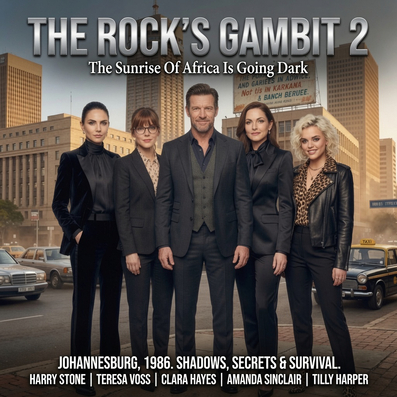
THE ROCK'S GAMBIT 2
PART 11: The Sunrise of Africa Is Going Dark
Chapter 1: One Last Job (London Setup)
The Camden flat breathed around her.
It was mid-morning, the kind of pale, washed-out daylight that London specialised in — grey at the edges, soft at the centre. Teresa Voss stood in the kitchen, kettle in hand, and for the first time in months, she didn’t have a schedule. No timeline. No threat. Just… stillness.
She filled the kettle and set it on the hob. Her movements were automatic, honed by repetition — the kind of muscle memory that meant she didn’t have to think. Thinking was dangerous. Thinking let things in.
As she waited for it to sing, her eyes drifted across the room. It had changed, subtly, over the past year. Not the decor — the scuffed floorboards, the faded rug, the bookshelf leaning slightly to one side — but the occupancy.
Draped over the armchair near the window was Clara’s cardigan. Oversized, charcoal-grey, one button loose. It had been there three days. Teresa’s lips tugged upward — faint, involuntary. She didn’t fold it. Didn’t put it away. Left it exactly where it was: a marker. Proof that someone belonged.
On the coffee table, a stack of books had migrated from one corner to the centre — biographies, technical manuals, a dog-eared atlas of Southern Africa. Beside them, a toothbrush stood upright in a mug by the sink. Not Teresa’s. Not Tilly’s. Clara’s. What had begun as a few nights’ refuge had solidified into something else. Permanent.
And Tilly? Well, Tilly occupied the sofa like a monarch claiming territory — cushions indented, a blanket rumpled, faint scent of jasmine and chaos hanging in the fabric. She didn’t need to move in formally. She simply was.
Teresa turned off the gas before the kettle could scream. Silence returned — but it was a warmer silence than she’d known in years.
She poured the water. Earl Grey. Steam curled upward, softening the lines of her face.
Then she saw it.
Lying folded beside the cereal bowl, the newspaper — opened not by accident, but by habit. Her gaze locked onto the headline, bold and black:
AFRICAN DIAMOND TO HEADLINE JOHANNESBURG GALA
Below it, a photograph. The Sunrise of Africa. Even in cheap print, it burned — flawless, impossible, a promise written in light.
Teresa read the words once. Then again. Her pulse didn’t race — it settled. Like a compass finding north.
She reached for her phone. Her thumb hovered over Harry’s name. Hesitated. For a second, she let herself stay in this room — safe, quiet, unburdened. Then she pressed.
The line rang once. Twice.
“If this is about a missing kebab, I swear —”
“Harry. Come over. And bring Amanda.”
The door clicked shut forty minutes later.
The air shifted instantly — no longer solitary, but charged. Harry “The Rock” Stone stepped in, broad-shouldered and easy, carrying the weathered confidence of a man who’d long since decided the world was manageable. Behind him, Amanda Sinclair slipped through the frame like silk — composed, sharp, every movement calculated.
Teresa watched them. Noted the small things.
Harry moved differently. No nervous pat for pockets. No constant search for an ashtray. He smelled of cedar and clean linen, not smoke. When their eyes met, he nodded — and she saw it: lighter.
Amanda paused beside the table, inhaling faintly. Her perfume had changed — something deeper now, darker, hinting at sandalwood and distance.
“New scent?” Harry said, before Teresa could speak. His voice was casual, but his attention lingered.
Amanda smiled, touching her wrist. “Evolution, Harry. Not everyone freezes in amber.” Her gaze flicked to his jacket pocket — where a lighter used to sit, always visible. “And you? You’ve stopped hiding the habit.”
“Harder to miss something that isn’t there,” he said, a faint pride in it.
Something passed between them — quiet, unspoken. A year of walks. Of conversations stretched thin. Of orbiting each other without touching. Neither named it. Neither needed to.
Before it could settle fully, the hallway erupted.
“Did someone say job?”
Tilly appeared — hair wild, leggings neon, energy spilling from every pore. “Because if it’s curtains or car-boot sales, I’m abstaining. But if it involves a destination… I’ve packed glitter. And a passport that’s technically still good.”
“Tilly,” Teresa said, steadying the room with one tone. “Sit.”
Clara followed — quiet, as always, stepping into the space like she belonged there. Her eyes found Teresa immediately, bright and expectant. She carried a slim, hard-shell case.
Teresa unfolded the newspaper, smoothing it flat over the table. The diamond stared back.
“The Sunrise of Africa,” Teresa said. “Five hundred and three carats. Recut from the Cullinan X — the stone they claimed sank in 1943. It never left the vault. Old families buried it under enough money to outlast questions.”
Harry leaned forward, elbows on knees. “Johannesburg?”
“Gala night at the Rand Club,” Teresa said, turning her attention to Amanda. “High society, tight security, and an invitation list curating the top half-percent of international wealth. Which means we need a front door.”
Amanda’s lips curved into a subtle, dangerous smile. “The host committee chair owes me a favour from Geneva. I can have us on the VIP roster by sunset—complete with diplomatic credentials.”
“Good,” Teresa said. She reached for the case Clara had set down and unlatched it.
Inside, resting in dense foam, sat Argus. Compact, matte-black, with a segmented frame and magnetic treads folded tight. A single glass lens reflected the kitchen light.
“It doesn’t pick locks,” Clara explained softly, touching the edge of the chassis. “It ignores them. Vent shafts, pressure grids, biometrics—if there’s a gap the width of a coin, Argus gets us inside.”
Harry leaned in, inspecting the machine. “That’s not a tool, Clara. That’s a pet with a criminal record.”
“She’s efficient,” Clara replied, a faint smile touching her lips.
Teresa closed the lid with a firm snap. She looked across the table—taking in Harry’s sudden sharpness, Amanda’s quiet calculation, Tilly’s spark, and Clara’s steady trust.
“We don’t need the money,” Teresa said, her voice low and absolute. “We need the closure. This cleans the slate. After Johannesburg, the past stops chasing us—and we walk away for good.”
Silence held—not doubt, but recognition.
Harry stood, reaching for his jacket. His eyes glinted—that familiar, dangerous spark returning.
“Right then,” he said. “Johannesburg. Let’s see if the Rock still rolls.”
Chapter 2 – Thirty-Five Thousand Feet of Trouble
The Heathrow tarmac shimmered under a thin wash of rain, reflecting the hulking silver body of the Boeing 747 waiting at the end of the jet bridge.
Harry stood near the boarding gate, passport tucked into his coat alongside the ledger that had finally put George Marlow in the ground—for good. He took them in, one by one. Teresa and Clara, already deep in quiet conversation. Tilly, gesturing broadly at a weary customer service agent. Amanda, standing apart, watching the gray London skyline as if committing it to memory. The air smelled of jet fuel, damp wool, and departure.
Harry flipped a coin into the drizzle, caught it, and closed his fist without looking. For once, the outcome didn’t matter. He turned toward the aircraft, a slow grin forming as the engines began to hum deep in their cowlings. The Rock wasn’t just back in the game. This time, he was calling it.
“Right, listen up,” Teresa murmured as the queue shuffled forward. Her voice was soft, clipped, carrying the effortless authority of a woman who had once disciplined a customs officer with a raised eyebrow. “We’re professionals. We blend in. No drama. None.”
Harry swayed with the lazy swagger of a man who could charm a magistrate or a viper, depending on which smiled first. When the security supervisor challenged Tilly over an unsealed bottle of vintage rosé in her carry-on, Harry slid a folded fifty across the counter with a grin that had alarmed women from Soho to Saint-Tropez.
“It’s her nerves, mate. Medicinal. Doctor’s orders.”
The note vanished. The bottle stayed. Teresa’s glare could have peeled paint off the bulkhead. “Behave.”
Amanda swept past him, all Chanel, heavy gold, and razor-sharp shoulder pads. “Darling,” she said softly, miming a cigarette. “Modern travel. No smoking. Try not to combust.” Then, with a slow, deliberate glance down his jacket: “And you—try to stay upright until we board, hmm?”
Harry’s mouth twitched. “Save it, Sinclair. We both know you only carry men who pay by the hour.”
Amanda laughed, low and warm. “Sweetheart, you couldn’t afford me. Even in bulk.”
Four hours out over the Mediterranean, First Class felt less like an aircraft cabin and more like a private theatre. Amanda sat near the window, a glass of Dom Pérignon loose in her hand, when Alistair Botha drifted into the empty seat beside her. Billionaire diamond broker, private dealer to names too heavy to print in the papers, Botha carried himself like a man who’d never been told “no” in any language that mattered.
He opened with charm, but Amanda let him talk before she tightened the snare. A slight tilt of her head, a soft sigh of feigned fascination—it was all the permission he needed.
“South Africa isn’t simply geography, Amanda,” Botha said, swirling his flute so the cabin lights caught the gold-green hue of the vintage. “It’s layers. You have the old mining families—Oppenheimer, Rhodes, the houses that built the reef. Then the politicians. Then the ones who bought their way through the transition. Fortunes don’t disappear here. They… change hands quietly.”
He leaned back, comfortable now, underestimating her completely.
“You look at a stone and you see beauty. But in Johannesburg? It’s a ledger. Every diamond has a lineage—mined under one regime, cut under another, sold under a third. Apartheid didn’t end for everyone. Some people just moved their wealth offshore and waited for the headlines to clear.”
Amanda stroked the rim of her glass, keeping her voice as light as silk. “And the families? Do they still hold the reins, or has the new money taken over?”
“Where else?” Botha smiled, falling right into step. “They control the supply chains, the banks, the private vaults. They know which doors to open and which to leave welded shut. Take the Sunrise of Africa—that isn’t just a gem. It’s a statement. A reminder that the old guard still decides who gets rich.”
“And who holds it now?” she asked, leaning in just enough to make him feel like the only man in the sky.
Botha’s voice dropped to velvet. “Type IIa. Chemically pure. Frozen starlight. The man taking delivery in Jo'burg isn't a collector—he's Sergei Morozov. He doesn’t buy for beauty, darling. He collects to own.”
By the time he signaled the flight attendant for another bottle, Amanda had extracted everything she needed—routes, transit timelines, names, and the exact brand of quiet arrogance that made wealthy men careless. She offered him a slow, lethal smile. “Fascinating, Alistair. Do tell me more about how the final transfer works.”
Further forward in the quiet of the aisle, Harry wandered, restless. He paused near the galley, resting a shoulder against a bulkhead opposite a grey-haired man in a heavy wool blazer. The man had retired hands—calloused, meticulous—a watch that cost more than a saloon car, and a thin scar slicing through his left eyebrow. A master diamond cutter, it turned out, heading home after a three-week consult in Antwerp.
“Hardest natural material on Earth,” the man was saying, tapping a glossy photograph in the industry magazine on his tray table. “But brittle. People forget that. One wrong angle, one grain of impurity along the cleavage plane… and fifty million dollars shatters into gravel.”
Harry lingered, feigning the casual interest of a bored tourist. “And when you're moving something that valuable? Where do they keep it safe?”
The cutter shrugged, sipping his black coffee. “Depends on the fool running the show. Some go for tech—laser grids, biometrics, nonsense that glitches when the power dips. The real heavyweights? They rely on structure. Reinforced high-density concrete, pressure floors, corridors that narrow just enough to funnel an intruder into a bottleneck. Cullinan Hall, for instance—heard it’s built like a fortress that breathes. Timed mechanical locks, not digital ones. Because at the end of the day, tech fails, but human laziness is eternal.”
Harry nodded, filing the details away into his mental blueprint: Cullinan Hall. Timed locks. Bottleneck corridors. Human laziness.
“Sounds like a proper headache,” Harry said.
The old cutter winked over his cup. “Only if you’re trying to get in uninvited.”
A sudden sharp chime rang out from the forward galley, followed by the muffled beep-beep-beep of a smoke sensor.
“Miss Harper!” a junior steward’s voice cracked in a panic. “The alarm is flashing red!”
The lavatory door unlocked with a click, and Tilly emerged in a cloud of subtle vapor—hair impossibly fuller, lipstick freshly reapplied and radiant. “It’s personality, darling!” she chimed, her voice syrup-sweet as she patted the air. “Too much natural radiance for your little ceiling toys!”
A second later, the co-pilot squeezed out behind her, flushed red to his ears, uniform cap on backward. Tilly patted his warm cheek with a manicured hand. “Thanks, Captain. Exemplary customer service.”
Harry dragged a hand down his face, leaning back against his seat. “Christ, Tilly. We haven't even landed.”
“Deadheading,” she said primly, smoothing her skirt as she glided past him toward First Class. “And strictly off-duty.”
The pilot’s voice soon crackled over the intercom, professional and entirely composed once more. “Ladies and gentlemen, we’ve begun our final descent into O.R. Tambo International, Johannesburg.”
Amanda slid back into her seat across the aisle from Harry, her eyes glinting with satisfaction. Botha was already asleep two rows back, completely drained of secrets.
Harry leaned over the armrest, his voice a low whisper beneath the rumble of the airframe. “Learned something useful up front,” he murmured. “About mechanical locks. Structural bottlenecks. And human laziness.”
Amanda touched his forearm—light, deliberate, her manicured nails digging in just enough to anchor the point. “And I learned exactly where the Sunrise of Africa is going,” she whispered. “And who’s paying Morozov to take it.”
Across the cabin, Teresa looked back from row one. No words passed between them—just one sharp, decisive nod.
The heavy jet banked south, breaking through the cloud cover. Below, the African landscape unfolded under the twilight—ochre and gold, vast, ancient, and unforgiving. The job was no longer just a plan on paper. It was down there, waiting.
Chapter 3 – City of Gold
The Boeing’s wheels bit tarmac with a shudder that travelled up through the floorboards and into Harry’s boots. Outside, the air changed instantly — warm, thick, smelling of sunbaked asphalt and distant dust. Not London rain. Not Camden grey. Africa.
Through the oval window, Johannesburg rose like a mirage — glass towers punching through a haze of heat, ringed by the rust-red earth that had fed a century of hunger.
“Welcome to OR Tambo,” the pilot drawled. “Temperature, twenty-eight degrees. Clear skies.”
The Drive
The hired Mercedes slid out of the airport loop and into the traffic. This was where the chapter truly began — not in a hotel room, but on the road.
Harry watched the landscape unspool. First the industrial fringes, then the towering gold mine dumps — great artificial hills, pale yellow and geometric, standing like monuments to greed. “Never seen anything like it,” he murmured. “Man-made mountains.”
“Gold pays for the skyline,” Amanda said, sitting beside him. Her eyes moved constantly, cataloguing. “But look closer.”
He did. High walls appeared everywhere — concrete topped with razor wire, electric fencing, iron gates sharpened to points. Every property, large or small, declared itself a fortress. Between the suburbs, the road stretched long and straight, flanked by townships that seemed to breathe in their own rhythm — rows of homes, bright washing strung between poles, life spilling onto pavements. And everywhere, armed-response signs nailed to gateposts:
24-HOUR ARMED REACTION. RESPONSE TIME: 3 MINUTES.
They hit a junction. Heavy SUVs idled beside beat-up taxis. A businessman in a tailored suit waited behind a minibus packed tight with workers.
Amanda’s voice was quiet, precise. “It’s a city where billionaires and beggars stop at the same traffic lights.”
Harry nodded. It wasn’t chaos — it was tension. A delicate, balanced standoff.
The Hotel
They pulled into the Saxon — discreet, walled, hidden within a lush garden of jacaranda and thorn. Security melted out of the shadows, checked the car, nodded them through.
In the suite, floor-to-ceiling glass looked out over the treetops. But nobody rested.
“Tomorrow,” Teresa said, dropping her bag, “we don’t plan. We walk.”
The Scouting Day – Diamond District
Morning broke bright and hard. The crew split — not in tactical gear, but in clothes that whispered affluence.
Harry moved through the Diamond District like a man with money to burn. He slipped into jewellers along Commissioner Street, feigning interest in engagement rings and tennis bracelets. “Something substantial,” he told a clerk, fingers brushing velvet trays. “Something that says… serious.” He watched eyes, counted cameras, noted the heavy vault doors set deep into rear walls. Security here wasn’t showy — it was buried.
Amanda followed, elegant and unhurried. Where Harry asked questions, she listened. She lingered near the security desk of a major brokerage, commenting on the heat, admiring a guard’s polished holster. Within five minutes, he was telling her about shift changes, patrol routes, and the single narrow service entrance that everyone forgot. “Only used for deliveries,” he said, proud of his knowledge. “Old lift. Slow.”
Tilly — true to form — wandered off script. She “accidentally” turned down a corridor marked STAFF ONLY, peered into a sorting office, and emerged smiling, holding a brochure she hadn’t been given. “Found the tearoom,” she reported, deadpan. “And the fire escape. Same door. Handy.”
Clara stayed quieter still. Camera phone held low, she photographed angles — lens positions, blind spots, vent grilles, wiring conduits. She sketched quick diagrams in a notebook, mapping not just what was visible, but what connected. “They think the tech is the protection,” she said quietly to Teresa. “But the wiring is old. It runs along the same trunking as the air conditioning. One cut — half the building goes blind.”
Teresa observed the observers. She sat on a bench outside the district’s main exchange, coffee in hand, watching who watched whom. Noted the parked vehicles that never moved. The faces that appeared twice. The rhythm of guards. By noon, she knew the pulse of the street.
Return & Reflection
By late afternoon, they regrouped at a café with a view of the skyline. The mine dumps glowed gold in the lowering sun.
“City’s got teeth,” Harry said, stirring his coffee. “Pretty, but they’re all bared.”
“And it’s layered,” Clara added, tapping her sketchbook. “Nothing is just what it looks like.”
Amanda leaned back. “We haven’t even touched Cullinan Hall yet. If the district is this tight… the gala will be another world.”
Teresa’s gaze swept across the horizon. “Good. Let them feel safe. That’s when they make mistakes.”
She stood, the signal closing the day. “We’ve seen the surface. Now we find the cracks.”
Chapter 4 - The Scout (Cullinan Hall Reconnaissance)
Johannesburg woke sharp and clear, the air washed clean by a dawn breeze that carried the scent of dry earth and jacaranda. Today was not for acting. Not for fighting. Today was for seeing.
The crew split before eight o’clock, each wearing a mask tailored to the lie they intended to live.
Harry – The Interested Buyer
He wore a tailored linen suit, no tie, a gold watch that cost more than most cars. He walked with the loose, confident stride of a man who had already decided to spend — and expected to be courted.
At the reception of Cullinan Hall, he introduced himself as Henry Stone, property developer from Cape Town. “Looking to acquire something… significant,” he told the front-of-house manager, letting the words hang like smoke. “Private collection. Gala preview, I’m told?”
He was escorted through the public areas. Every step was performance — admiring the marble, commenting on the cornices, pausing to inspect the flower arrangements. But his eyes were elsewhere. He counted the ceiling cameras — three per corridor, staggered. Noted the heavy oak doors reinforced with steel beneath the veneer. Marked the position of every uniformed guard, their posture, the way their heads turned in the same rhythm.
When they passed a service alcove, he paused, feigning a phone call. Glimpsed a narrow stairwell descending. A single keypad beside the door. Old model, he thought. Clara will like that.
Amanda – The Polite Companion
She joined him an hour later, playing the part with effortless grace: pearls, cream silk, a smile that invited confidence but gave nothing away. While Harry dominated the conversation, she lingered at the edges — chatting with the event coordinator, admiring the gallery layout, asking soft, innocent questions.
“Such a heavy schedule for the staff,” she murmured to a senior steward. “So many VIPs coming and going. Where do they brief the team?”
Pleased to help, he gestured toward the far wing. “Back corridor, ma’am. Staff room and operations hub. Through the double doors, past the kitchen.”
“Of course,” she said. “And deliveries? The flowers, the catering…”
“Ramp at the rear. Separate entrance. Locked at seven each evening.”
Amanda offered her brightest smile. “How wonderfully organised.”
Tilly – The Accidental Guest
Nobody expected Tilly. Which was exactly why she worked.
She drifted toward the charity preview setup — bright, breezy, clutching a catalogue. “So sorry I’m early!” she trilled to a harried organiser. “My flight got in ages ago and I simply couldn’t wait. Is this where we bid for the art?”
Before they could redirect her, she had stepped through the velvet ropes. She wandered the main hall, commenting on paintings, exclaiming over the chandeliers, and — in the confusion — slipped into a side corridor marked SECURITY.
She didn’t stay long. Two minutes later she reappeared, clutching a stray clipboard she’d picked up from a desk. “Got lost looking for the powder room,” she told a passing guard, batting her lashes. But she’d seen what she needed: monitor screens lining one wall, a shift rota pinned beside them, and a fire exit that didn’t appear on any public map.
Clara – The Silent Cartographer
While others charmed and distracted, Clara moved like a shadow. She stayed close to walls, head slightly tilted, her phone held low. She photographed the corridor junctions, the vent placements, the camera blind spots where pillars met arches. She traced the line of cabling running along skirting boards — thick, bundled, older than the building’s renovation.
In a quiet stretch near the east wing, she knelt to adjust her shoe. Beneath the floor trim, a loose panel revealed the security system’s junction box. She didn’t touch it — just photographed the layout, the wire colours, the brand of relays.
They’ve upgraded the cameras, she noted in her small sketchbook, but the backbone is still original. Same weak points.
By midday, she had drawn the hall not as it looked, but as it functioned — a web of signals, pressure zones, and timings.
Teresa – The Watcher
Teresa remained outside.
She sat in an unmarked car across the street, engine off, windows down just enough. She watched the entrances, the parking areas, the flow of traffic. She didn’t need to go inside — she needed to see who came and went.
A delivery van. A security patrol. A man in a grey jacket who circled the block three times.
She logged the routine. Guard changes at 08:00, 16:00, 24:00. Two men per gate. One rover in the courtyard. Everything neat. Everything predictable.
And predictability, she thought, raising binoculars to the roofline, is just another word for pattern. And every pattern has a break.
Chapter 5: Ghosts and Old Secrets (Marlow’s Release)
The Isle of Wight, six months earlier.
Prison mornings did not begin with dawn. They began with a sound — a heavy, electronic buzz that travelled through concrete and settled in the teeth. Then boots on linoleum. keys turning in locks that had been oiled too long in the same direction.
George Marlow opened his eyes. The cell was narrow, grey, and smelled of old soap and yesterday’s air. He’d counted the mornings here: seven hundred and twelve, not counting the time served on remand. But counting was habit, not hope.
The guard appeared at the grille — broad shoulders, bored eyes, a mug of tea steaming in one hand. “Up. Don’t drag your feet.”
No warmth. No small talk. Just the mechanics of confinement.
Marlow swung his legs over the edge of the bunk. His movements were slow, deliberate — the pace of a man who had learned not to provoke. He washed in cold water, shaved with a blade so dull it scraped rather than cut. He ate the porridge: lukewarm, gluey, indistinguishable from the day before. Every action scripted. Every choice removed.
The humiliation was small, but constant — the way the guard looked past him as if he were furniture, the way the corridor narrowed so you had to walk exactly where they wanted. Marlow absorbed it all. He didn’t speak. Didn’t react. He simply stored it.
The Release
Mid-afternoon, the routine broke.
Not the usual door. Not the usual voice. A different officer appeared — cleaner uniform, harder gaze. “Marlow. With me.”
He was led not toward the exercise yard or the canteen, but along a corridor he hadn’t used before: brighter lights, fewer scuff marks. At the end stood a glass interview room, and a plastic bag holding his things: wallet, watch, keys, a folded slip of paper. And clothes — his own, but unworn for so long they felt like someone else’s.
“Sign here.”
He signed. The paper slid away.
Then the final door. Heavy steel. Hydraulic hiss.
Light hit him — brilliant, unfiltered, unmediated by bars. The sea air cut through the institutional smell: salt, gorse, freedom. He blinked, eyes watering, not from brightness alone. The world hadn’t waited. Traffic moved on the road below. Seagulls cried. People walked without asking permission.
He stood on the pavement, bag in hand, and breathed — deep, ragged, real. The grey walls behind him loomed less like a prison and more like a memory he could finally outrun.
The Meeting
A car waited further down — dark, tinted, engine running. As Marlow approached, the rear door opened.
Inside: Connor Doyle. Heavy-set, broken nose, knuckles like cobblestones. Doyle smiled — not with warmth, but recognition. “Took your time. Thought they’d left you to rot.”
“Almost,” Marlow said, sliding onto the leather seat. “But not quite.”
Behind the wheel: Irina Morozova. Sleek dark hair pulled tight, eyes pale and unblinking. Ex-intelligence, all muscle and discipline. She didn’t turn. “We’re late. Morozov doesn’t appreciate waiting.”
“Sergei?” Marlow settled back. “So the old bear still keeps his cubs hungry.”
“Keeps them useful,” Irina corrected, pulling smoothly away. “That’s the point. Doyle brings muscle. I bring the network. You bring the grudge. Morozov brings the money.”
“Against Teresa Voss?” Marlow’s voice stayed soft, but his jaw knotted tight. “She put me away. Stripped me bare. Walked free while I sat in a box.”
“Exactly,” Doyle rumbled. “And now she’s heading straight for Africa. Same diamond. Same damn arrogance.”
Irina’s eyes flicked to the rear-view mirror. “Cape Town, then Johannesburg. A high-end gala. Easy enough to find. Harder to get close — unless you let them think no one’s watching.”
Marlow watched the countryside blur past — green fields, white cliffs, the sea glinting far off. He felt lighter, sharper. The bitterness of the cell was drying out.
“Let them believe whatever helps them move,” he said, a cold smile forming. “We know where they’re going. And this time… we’re already waiting.”
Chapter 6 – The Apex of Chaos
(The Gala Ambush)
The Arrival
Even before the doors opened, Cullinan Hall hummed. Floodlights washed the sandstone facade in warm gold, turning every cornice and pillar into theatre. Luxury cars rolled up one by one — silver and black, grilles polished to mirrors — discharging passengers wrapped in silk, velvet, and danger.
This was no ordinary gala. It was a gathering of the tribe. Politicians in tailored suits nodded to African royalty wearing heirloom jewellery. Old European money mixed with new African power. Diamond dealers, bankers, arms brokers, art collectors — all orbiting the same invisible centre. The air smelled of expensive perfume, polished leather, and the quiet confidence of people who owned the rules.
Amanda paused at the top of the steps, arm linked through Harry’s. She drank it all in. “Look at them,” she murmured. “They don’t just want the diamond. They want to be seen near it. That’s our cover — everyone here is already acting.”
Harry adjusted his cufflinks. “Then let’s give them a supporting cast worth remembering.”
Inside — The Setup
The Great Hall was a cathedral of glass and chandeliers. Waiters circulated with flutes of vintage champagne; a string quartet played something refined and distant. At the far end, raised on a plinth under crystal and glass, the display case waited — empty, for now. A circle of guards stood rigid around it, eyes scanning every approach.
Teresa moved through the crowd like water around stones. She signalled Clara — who nodded from a shadowed archway, tablet in hand — then Tilly, positioned near the catering doors.
“Visual on the target zone,” Teresa murmured into her lapel. “Clara?”
“System’s live,” Clara replied, quiet as breath. “But it’s layered. I need distraction — loud, messy, unpredictable.”
Teresa’s mouth tugged. “Tilly’s sector. Go.”
Chaos Unleashed
Down in the service corridor, Tilly checked her watch. “Showtime.”
She didn’t need four monkeys. Two were enough — capuchins, quick and curious, transported in a wicker hamper marked FLORAL DISPLAY. She unlatched the lid.
“Go on, darlings. Make yourselves memorable.”
They bolted into the banquet area just as the main course was being served. One scrambled up a centrepiece, knocking over a tower of glasses — shattering crystal, gasps rippling outward. The other leaped onto the top table, snatched a menu, and darted between the legs of a dignitary who stumbled back, chair screeching.
Pandemonium bloomed. People stood, shouted, laughed nervously. Waiters hesitated. Security broke formation — rushing toward the animals, abandoning posts, shouting over each other.
Perfect.
The Breach
While heads turned, Teresa glided toward the east wing — the quiet side. Harry followed, blending into the redirected flow.
“Clear path,” Clara’s voice in their ears. “Camera three is tracking the monkeys. Blind spot opening now.”
They reached the vault antechamber. Heavy door. Biometric panel. Argus, small and black, crawled from Harry’s pocket onto the lock housing. Lights blinked. Clara’s fingers danced on her tablet.
Then — click.
The lock disengaged. Teresa reached for the handle.
And froze.
The door didn’t swing open freely. It was already unlatched.
From the shadows of the corridor behind them, a slow, familiar voice.
“Beautiful party, isn’t it? Shame you won’t stay for the end.”
Teresa turned. Standing there, flanked by Doyle and Irina, was George Marlow — clean-shaven, sharp-suited, eyes burning with the cold clarity of a man who had nothing left to lose.
“Did you think I’d wait forever, Teresa?” He smiled, thin and cruel. “This wasn’t a heist. It was an invitation.”
Chapter 7: A Moving Target (Safehouse Pivot to Cape Town)
The safehouse was a hole: a grimy, low-rent flat tucked above a betting shop, in a neighbourhood where the streetlights failed every third evening. The air hung thick with stale cigarette smoke and the sharp, metallic tang of defeat.
They burst inside, breath ragged, and slammed the door. Harry threw the deadbolt; the heavy thud echoed like a racing, uneven heartbeat.
Silence followed — the heavy kind that brings no comfort.
The Quiet
For a long moment, no one spoke. Amanda leaned against the wall, checking her reflection in the dark glass: face pale, but steady, composed. Tilly slumped onto a lumpy, threadbare sofa, staring down at her hands as if they belonged to someone else. Clara stood by the window, peering through a thin crack in the drawn curtain, her tablet screen dark and lifeless.
Harry moved to the furthest corner. He sat on the floor, back pressed to the wall, knees drawn tight to his chest. No wisecrack. No dry, cutting observation. Just stillness.
He closed his eyes. Behind his lids, the gala played on a loop: Marlow appearing out of nowhere, that cold, knowing grin, the exact second the world tilted out from under them.
This might be over.
The thought came uninvited, sharp and unflinching. He’d run cons, cracked safes, talked his way out of police stations and into penthouses — but he’d never felt the ground vanish quite like this. The plan hadn’t just failed; it had been expected. Marlow had been waiting. Which meant everything they’d built, every step they’d taken, had been watched, anticipated, seen.
He opened his eyes and looked at his crew — the people he’d come to rely on more than he’d ever cared to admit. No jokes. No deflection. Just the quiet, heavy weight of uncertainty settling over the room like dust.
The Pivot
Then Clara moved. She crossed the room, her boots soft on the worn carpet, and knelt beside the rickety low table. Her fingers found the power button; the screen flared bright blue, cutting through the gloom.
“They didn’t take everything,” she said, her voice calm and steady. “Just the hall. But the stone… it was never meant to stay there overnight.”
Every eye turned to her.
“I pulled manifest chatter before they locked us out of the system,” she went on, tapping lines of scrolling data into view. “The Sunrise of Africa was scheduled for immediate transfer. Not to a bank. Not to a warehouse.”
She pulled up an image: a sleek, white-hulled yacht cutting through deep, vivid blue sea.
“The Knyazhna. Sergei Morozov’s floating fortress. She’s docked in Cape Town Harbour, due to sail at first light. The diamond goes with her — straight into his private onboard vault, out of reach of land security, police, and every rival within a thousand miles.”
Teresa stood, the tension coiled in her shoulders unspooling into sharp, clear purpose. “So they hold the land. We take the sea.”
Harry shifted, the dark thought receding just enough. “A yacht job? That’s a whole different beast, Teresa. No room to slip away. A whole lot of water to disappear into.”
“Exactly,” Clara said. “Everyone watches the buildings. No one watches the horizon.”
Amanda pushed off the wall, her eyes brightening. “Cape Town. High-end port, full of visitors and crew. We blend right in. Once aboard? The walls are thin, the hired hands come and go, and the vault’s just one single point to hit.”
Tilly sat up, shaking off the daze. “Sounds like a party with much better views.”
Teresa looked around, and saw the spark returning, the fight flaring back to life.
“Plan changed,” she said. “We don’t own Johannesburg anymore. We own the road to the coast. Pack light. We drive south.”
Chapter 8: The High-Rise Architect (Morozov’s Penthouse)
The penthouse occupied the entire top floor of Johannesburg’s most exclusive hotel: floor-to-ceiling glass, unbroken skyline views, air so filtered it felt almost sterile. But the true weight of the room came from the man standing inside it.
Sergei Morozov sat near the window, bathed in the glow of the city below. He did not look like a monster. He wore a tailored cream jacket, his silver hair combed back with surgical neatness. Before him, a small easel held a delicate Renaissance charcoal study — a Madonna and Child, lines fine as thread, paper aged to soft parchment. He leaned in, examining the brushwork, as if nothing else in the world existed.
No shouting. No slamming fists. He never raised his voice. That was the real danger.
Along one wall stood a glass display case of chess sets: carved ivory from the 1800s, malachite from the Urals, a gold-inlaid gift from a former head of state. On a low table, an open copy of Marcus Aurelius rested beside a silver bowl piled high with raw, bleeding steak — not for him, but for the sleek grey sharks circling in the glass-bottomed pool beneath the terrace.
A man who collected beauty and power in equal measure — and treated both with the same cold, unblinking reverence.
The Strategy
Marlow, Irina, and Doyle entered quietly. They remained standing; they knew better than to sit until invited.
“George,” Morozov said, without turning from the drawing. “Did you enjoy the gala?”
“More than they did,” Marlow replied. “We had them right at the vault. But they slipped.”
Morozov turned slowly. His eyes were pale, almost colourless — like water flowing over ice. “Slipping is not a failure. It is a choice you allowed them to make.”
He walked to the table, picked up a piece of steak with silver tongs, and dropped it into the pool. A grey shape broke the surface — a snap, a splash — then perfect calm again.
“Viktor Sokolov has the stone,” he said, as casually as if commenting on the weather. “It boards the Knyazhna tonight. My yacht. My rules. But Sokolov… he is loud. Impulsive. He thinks a locked vault door is enough protection.”
Marlow’s jaw tightened. “You want us to board her?”
“I want you to let them board her.” Morozov smiled — thin, cold, utterly terrifying. “Think of it as refinement. Teresa Voss and her crew know risk. They know how to break in. Let them exhaust themselves against Sokolov’s defences. Let them trigger the alarms, trip the grids, draw every eye. Then — and only then — you step in.”
He gestured to the chess sets along the wall. “The strongest move is often to let your opponent take the pieces you no longer need. By the time they reach the diamond, they will already belong to you.”
Irina nodded, sharp and precise. “We shadow them to Cape Town. Observe. Wait.”
“Exactly.” Morozov turned back to his drawing, dismissing the conversation as easily as he’d started it. “And George? Do try to enjoy the game. It is so much more elegant than simple revenge.”
Chapter 9: Safehouse, Cape Town: Breakfast (Interlude before the Storm)
The Bantry Bay safehouse breathed differently. Perched high above the Atlantic, floor-to-ceiling glass framed a sky streaked soft pink and burnished gold — Cape Town greeting the day with a beauty that felt almost cruel after Johannesburg’s grit. Far below, the ocean crashed deep and steady, a constant, rhythmic reminder of where they were heading.
Inside, the air smelled of strong black coffee, slightly burnt toast, and the quiet, unspoken relief of still being together. No one moved like a hunted target. For a few hours, they were just five people sharing a kitchen.
Harry stood at the stove, spatula in hand, presiding over a chaotic pan of eggs and bacon. He looked lighter — the tight tension of the last safehouse replaced by something close to easy routine.
“Rule number one,” he announced, flipping an egg that landed crookedly back in the pan. “No missions before caffeine. Rule number two — no one touches the last rasher. Rule number three…” He caught Amanda’s eye across the counter. “…whoever burns the toast buys the perfume next time.”
Amanda sipped her coffee, one elegant eyebrow raised. “Darling, if you’re budgeting for my fragrance, you’d better cook faster. Or steal better stock.”
Tilly was already at the table, elbows propped on the wood, working her way through a bowl of fruit. “Rule four,” she mumbled around a slice of melon. “If I disappear on the yacht, it’s not my fault. It’s just… opportunity.”
Teresa leaned against the window frame, mug warming her palms. She said nothing, but her gaze softened as she watched and listened. This was the fuel they really needed. Not plans. Not maps. Each other.
Clara sat slightly apart, notebook open but forgotten, staring out at the endless blue water. After a moment, Teresa crossed the room and slid into the seat beside her. No questions. No strategy talk. Just a quiet, understanding nod. Clara looked up, met her eyes, and gave a small, unguarded smile — the kind that needed no words at all.
The conversation circled light and easy: the drive down, the strange sweetness of Cape oranges, how the air here tasted sharper and cleaner. The threat of Marlow, Morozov, the yacht itself — all pushed to the edges of the room, held at bay by coffee and daylight.
Harry slid steaming plates onto the table. “Eat up,” he said, his voice quieter now. “Because once we step onto that boat… this might be the last easy meal we get.”
They ate. The sea rolled on. And somewhere out in the harbour, the Knyazhna waited.
Chapter 10: The Predator’s Shadow (Silo Hotel Surveillance)
The Silo Hotel rose from the old grain elevators above the V&A Waterfront — reborn concrete and glass, standing over the harbour like a watchtower. From his top-floor suite, George Marlow looked out over all of Cape Town: Table Mountain draped in its famous tablecloth cloud, the Atlantic glinting far off, and below them all, the dark, sleek hull of the Knyazhna, moored at a secure deep-water berth.
He stood at the floor-to-ceiling window, glass in hand, watching the yacht come alive — crew moving across her decks, rigging checked and rechecked, security taking post at the gangway. Behind him, Irina sat at a table spread with blueprints and schematics, every movement sharp and precise. Doyle leaned in the doorframe, arms folded, an image of idle, unmistakeable menace.
“They’re here,” Marlow said, without turning. “Teresa’s crew. I can feel it.”
“Surveillance picked up their rental at the airport,” Irina confirmed. “Registered to a property in Bantry Bay. Low profile. No contact with the yacht or port authorities yet.”
“Won’t be long.” Marlow swirled the amber liquid in his glass. “They know the stone is aboard. They know the door slams shut the moment she casts off. They have no choice but to come straight to us.”
He nodded toward the harbour, where the Knyazhna sat like a walled city on water.
“Viktor Sokolov thinks he’s guarding Morozov’s prize. He’s blind — arrogant, loud, entirely predictable. Exactly what we need him to be.”
Doyle shifted his weight. “So we let Voss do all the work?”
“Exactly as Sergei instructed.” Marlow’s smile was thin, cold and satisfied. “Let them breach the perimeter. Let them fight past Sokolov’s guards, his cameras, his locked vaults. Let them burn through every trick they know just to get inside. By the time they reach the diamond, they’ll be exhausted, exposed — and convinced they’ve won.”
“And then?” Irina asked, lifting her gaze from the plans.
“Then we walk in,” Marlow said, raising his glass toward the yacht. “We take the stone. We take the crew. And we clear up whatever mess they leave behind.”
Outside, the sun sank low, painting the sky and water in bruised purple and deep indigo. The Knyazhna’s lights flared to life — bright, bold, almost inviting against the darkening sea.
Marlow set his glass down on the windowsill. “Night’s falling. That’s when the game truly begins.”
Chapter 11 – The Cliff of Menace
The rain came first: thin drizzle thickening fast into a lashing downpour, whipping the Atlantic into frothing whitecaps that hammered against the harbour walls. Wind howled through the rigging of every moored vessel, turning ropes into snapping whips and tearing at anything not lashed down tight.
This was no weather for sailing. This was weather for hiding — and for moving unseen.
The Approach
Tilly steered the speedboat hard through the choppy swell, knuckles bone-white on the wheel, rain streaming straight into her eyes. The engine roared against the gale, fighting every metre to hold its course. Behind her, Harry, Teresa and Clara huddled low, rain soaking through their dark clothes, salt stinging their cheeks and blurring their vision.
No jokes. No quiet banter. Nothing but the raw, grinding effort of staying upright — and moving forward.
The Knyazhna loomed ahead, a towering mass of white steel rising out of the black water. Her floodlights cut sharp beams through the storm, but they offered no comfort. They marked a target. And very likely, a trap.
“Thirty metres out!” Tilly shouted over the wind. “She’s riding high — the swell’s shoving her hard against the berth!”
Teresa nodded, her gaze locked on the yacht’s stern. A single rope ladder hung down, twisting and lashing wildly in the gale. Their only way up.
The Boarding
Tilly brought the speedboat alongside, her movements sharp and perfectly controlled despite the chaos. The swell lifted them high, then dropped them like a stone — the gap between hulls narrowing, yawning open, narrowing again with every roll.
“Now!” Teresa yelled.
Harry moved first. He reached up, fingers locking tight around the lowest rung. The wind slammed into him, swinging him sideways like a ragdoll. He gripped harder, hauling himself up one rung, then the next. The ladder groaned, twisting violently under his weight.
He was halfway up when a larger swell hit.
The speedboat dropped clean out from under him. The ladder snapped taut, wrenching his arms almost from their sockets. His boots slipped free. For one heart-stopping, endless second he hung by a single hand — rain lashing his face, dark churning water thirty feet below, the wind screaming to tear him loose.
This is it.
Then a hand closed firm around his wrist. Strong. Steady. Unbreakable.
Teresa leaned out over the rail, her body braced against the gale, her grip iron. She didn’t shout. Didn’t waste breath on words. She just pulled — hard, deliberate, unyielding. Harry found the ladder again with his other hand. Together they hauled him over the gunwale, onto the rain-slick deck.
He collapsed for a heartbeat, dragging air into his lungs, then looked up. Teresa gave one sharp, quiet nod — then turned to help Clara, who was climbing steadily, deliberate, one rung at a time.
Tilly gunned the engine, casting off fast. The speedboat vanished into sheets of rain. Her part was done. Now theirs truly began.
On Deck
The Knyazhna was a maze of glistening steel and swaying lines. They stayed low, keeping to the deep shadows of the superstructure, ducking the slow, steady sweep of security cameras tracking across the decks.
Clara flicked on her tablet, the glow faint in the dark, rain beading and sliding off the glass. “Crew quarters forward. Security hub mid-deck. Vault’s below — deep in the owner’s private suite.”
Teresa gestured to a narrow, shadowed companionway leading down. “Quiet. Every step counts.”
They slipped inside. The door clicked shut soft behind them. The wind faded to a distant, muffled howl. All they heard now was the dull clunk of their boots on steel, the low groan of the yacht working in the swell, and the fast, steady beat of their own hearts.
The fortress was breached. Now they had to reach the prize — before the ones waiting in the dark reached them first.
Chapter 12: The Vault of Vexation (Reaching the Sunrise)
The air below decks was still, cool, scented with polished metal and conditioned air — a stark, silent contrast to the storm howling overhead. The corridor narrowed, lined with deep panelled wood, every footfall swallowed by thick, sound-muffling carpet.
Clara led, holding her tablet low, watching the signal trace pulse like a steady heartbeat. “We’re close. Pressure-sensitive flooring starts ten metres ahead. One wrong step — and the whole deck sings.”
They moved with deliberate, painstaking slowness, placing each foot with care. No sound but the faint, distant thrum of the yacht’s engines far beneath their feet.
The Door
The vault entrance was unmarked — flush with the wall, a seamless circle of reinforced steel set into the teak veneer. No handle. No keypad. Only a faint, glowing sensor ring set just inside the frame.
Clara knelt, setting Argus against the seam. The small robot extended its limbs, locking tight to the surface. A thin, precise probe slid out, searching for the micro-gap between door and frame. Lights pulsed: amber, then steady green.
“Breach in progress,” she whispered. “Hold.”
A low, mechanical hum vibrated through the bulkhead. A pause. Then — a heavy, hydraulic thunk that resonated deep in their chests. The circle sighed open, swinging inward on near-silent hinges.
The Sunrise of Africa
The chamber beyond was small, climate-controlled, lined with soft black velvet. And at its centre — resting on a plinth of frosted crystal, bathed in a single sharp beam of white light — sat The Sunrise of Africa.
Everything stopped.
It was bigger than any of them had imagined. Five hundred and three carats of Type IIa diamond: chemically pure, ice-white, yet burning with its own fierce inner fire. Light hit its countless facets and fractured into a rainbow that spilled across the walls: sapphire, emerald, violet. It did not just sit there — it seemed to breathe.
Harry stared, breath caught. He’d handled rare stones, seen fortunes wrapped in plain paper, but nothing that commanded this much reverent silence. “It’s… impossible.”
Amanda stepped forward slowly, her gaze fixed. “It holds the whole room. Look how it shifts — turn your head, and it becomes an entirely different stone.”
Clara did not move closer. “Perfect symmetry. The cut is flawless.”
Teresa approached last. She did not reach out. She studied it — the way the light pooled on the plinth beneath, the faint blue pulse of the internal security ring still glowing around its base. She saw not just beauty, but weight. History. Greed. Blood.
For a long, suspended moment, nothing existed but the diamond and the light.
The Standoff
Then the spell shattered.
“Beautiful, isn’t it?”
The voice boomed from the corridor. Viktor Sokolov stood framed in the doorway, flanked by three armed men, weapons levelled straight at them. His face was flushed, chest puffed out — loud, brash, exactly as they’d been warned. “But you are trespassing. And that belongs to Sergei Morozov.”
Teresa turned slowly, lifting her hands. The diamond blazed bright behind her like a silent witness.
Before she could speak, a second sound cut through the tension: footsteps, calm and entirely unhurried, approaching from the far side of the vault.
“Not just Morozov, Viktor.”
From the shadows stepped George Marlow, Irina at his shoulder and Doyle filling the doorway
Chapter 13: The Three-Way Tug-of-War (The Climax)
Chaos didn’t announce itself. It simply detonated.
A guard’s finger tightened. A muzzle flash stung the air. Bullets chewed into velvet and plaster. The vault became a cage of noise and smoke.
Teresa shoved Clara sideways behind the steel door frame. Harry dropped low, sweeping a leg toward the nearest guard. Amanda grabbed the plinth’s edge, pivoting it between them like a shield.
Sokolov roared, wild and uncoordinated, firing blindly into the melee. His men advanced, tight and aggressive.
Across the chamber, Doyle surged forward — a bull through mist. He slammed into one of Sokolov’s guards, driving him into the wall. Irina moved with cold precision, firing controlled shots, picking her openings.
Gas hissed from ceiling vents — thick, grey, stinging. Vision blurred. The air turned chemical, choking.
Teresa pointed.
Harry ran.
Clara crawled.
Alarms wailed. Red lights strobed through the haze, painting the room in blood and shadow.
Amanda ducked. A bullet sparked off the vault door beside her. She snatched a heavy display case and hurled it — glass shattering, distraction blooming.
Tilly materialised from the smoke, a duffel bag swinging. She snatched the diamond from the plinth, fingers closing around its fire. Harry caught her arm, hauling her toward the service hatch.
Behind them, Marlow stepped through the fog, calm amid the ruin. He didn’t chase. He watched — satisfied. Sokolov screamed orders, his voice cracking over sirens. Boots thundered on the stairs above: the police, the coastguard, the closing net.
Teresa gestured upward.
Tilly nodded.
Clara triggered the emergency release.
The hatch swung open. They scrambled through — metal biting hands, adrenaline driving knees. Behind them, the vault dissolved into a riot of shouting, gunfire, and collapsing shadows.
They burst onto the lower deck, rain instantly drenching them again. Tilly sprinted, bag clutched to her chest, toward the rendezvous point where the boat waited. Harry covered her, eyes scanning every angle, weapon levelled. Teresa brought up the rear, checking the trail, counting the seconds.
They hit the water as sirens blared across the harbour. The speedboat’s engine bit. The Knyazhna receded behind them — a fortress burning in light and noise.
Marlow watched from the upper rail as the dark craft vanished into the swell. He didn’t smile. He didn’t frown. He simply noted the direction.
“They carry it,” he murmured to the wind. “And they carry us right where we want to go.”
Epilogue – The Consolation Prize Mauritius.
Three days later.
The ocean stretched turquoise to indigo, so bright it hurt. Frangipani drifted on the warm air. Below the cliffside terrace, the waves rolled slow and endless, the only sound that mattered.
Harry leaned back in his wicker chair, glass loose in his hand, tasting the words like good whisky.
“One point two million. Sokolov’s quiet little off-shore account. He never even noticed it leave while we were cleaning out the vault's backup data.”
Amanda turned her glass so the afternoon light caught the rim. “Modest. Clean. No blood, no warrants, no one left to chase us across continents. I’ll take that over carrying a five-hundred-carat target on my back any day.”
Tilly kicked her bare feet against the railing. “Buys a lot of beaches. And a passport that doesn't expire mid-adventure.”
Clara sat close to Teresa, the tension finally gone from her shoulders. “The transfer’s completely untraceable. No trail back to Camden, no trail to us. Marlow has nothing.”
Teresa looked out over the water. She didn't smile wide—she didn't need to. Her breathing was easy for the first time in months. They had survived. They had walked away on their own terms.
Somewhere far away, a phone rang. Not theirs.
Half a world away, in a room stripped of warmth and colour, George Marlow stood alone.
On the black velvet cloth before him lay the Sunrise of Africa. He had seized it from the chaos of the yacht's vault, carrying it like a trophy through the storm, the sirens, and the closing net of the Cape Town coastguard.
Now he turned it slowly under a single, harsh spotlight.
It glittered. It dazzled. It looked flawless.
But Marlow knew stones. He knew density. He knew the precise, unyielding way true Type IIa diamond lattice refracted light compared to high-density cubic zirconia layered with synthetic diamond nano-crystal coating—a masterwork of Clara's lab.
He lifted a jeweller’s loupe, fitted it to his eye, and examined the girdle.
Silence filled the room.
There it was—faint, microscopic, etched deep into the replica's synthetic facet where only someone with an expert's eye would ever look:
T.V.
Beneath the initials sat a single micro-engraved coordinate string—the exact digital location of Sokolov's emptied bank account.
Teresa hadn't just beaten him to the real stone days ago in Johannesburg; she had used the yacht as a shell game, letting Marlow fight Sokolov for a brilliant piece of glass while her team walked away with the real currency.
He lowered the loupe.
He did not slam his fist. He did not curse. He did not break.
Instead, he began to laugh—low, rich, and genuine—the laugh of a man who had finally met his absolute equal.
He set the false stone gently back on the velvet.
“Clever,” he murmured to the empty room. “Very clever, Teresa.”
He looked at the glittering fake one last time, his eyes bright with a new and sharper hunger.
“Now we’re even.”
And for the first time in years, the thought of the next game did not taste of bitterness.
It tasted of anticipation.