THE FRONT ROW
Food. Racing. Stories from the edge of the pass.
Welcome back to The Front Row
If you’re looking for polished platitudes, curated lifestyles or hollow advice, you’re still in the wrong place.
No unnecessary garnish. No filters. No fine print.
Just honest observations, hard-earned lessons and stories about the people and places that stay with you long after the service ends, the crowd disperses or the horses have passed the post.
Here, we travel between the kitchen, the bar, the racecourse and the road. Real food. Real people. Real racing. And the occasional truth best left behind closed doors.
This time, we’re heading to Whitstable, where a celebrated chef found some breathing space, a family-owned beach hut offered a place to escape, and an oyster bar became part of a story close to home.
Pull up a seat. You’re right where you belong.
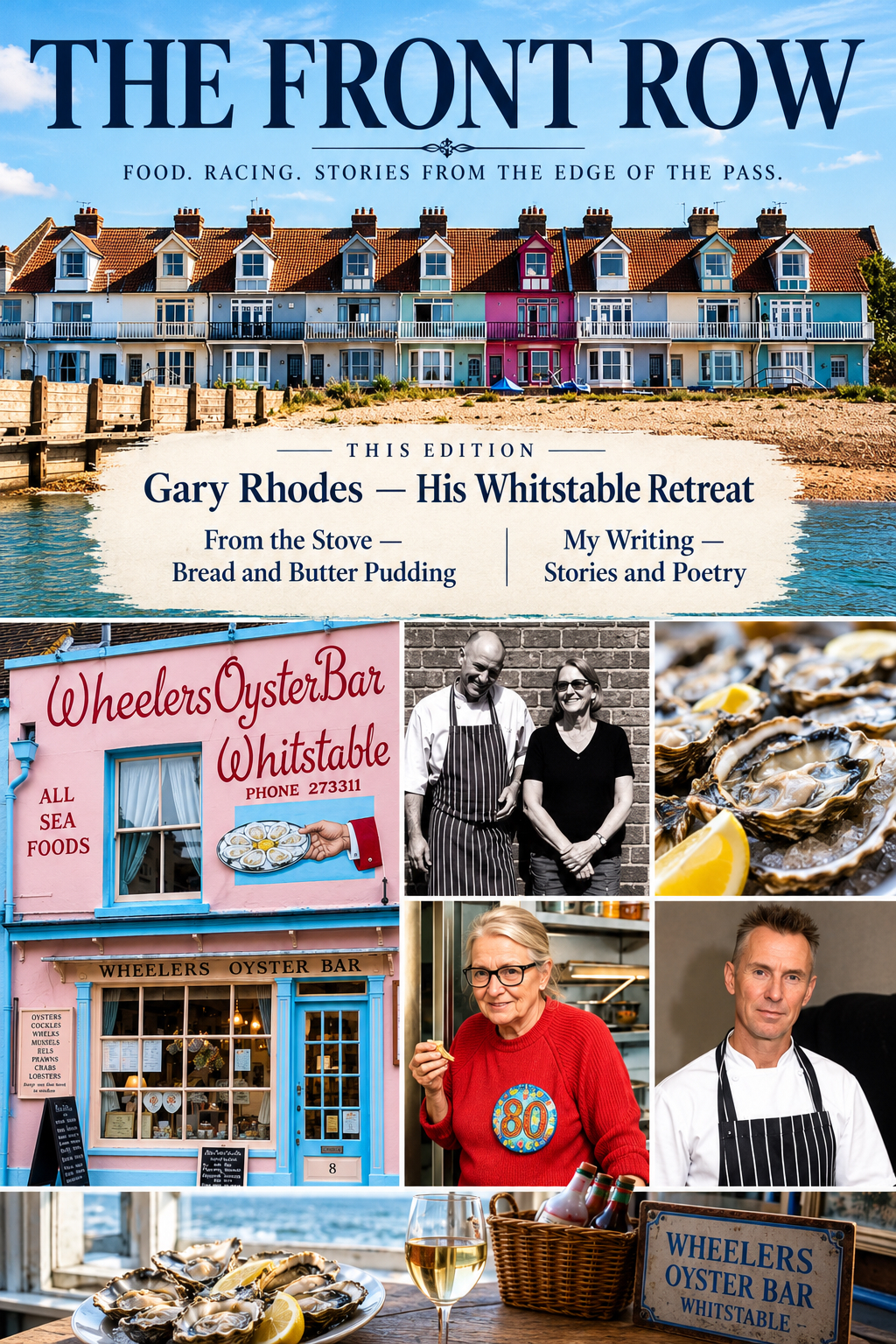
PART ONE: GARY RHODES — HIS WHITSTABLE RETREAT
The Chef, the Beach Hut and Wheelers — Early 1990s
The public knew Gary Rhodes for his cooking, his television appearances and his ambition. But away from the kitchen, everyone needs somewhere to draw breath.
For Gary, Whitstable offered just that.
This is a quieter story, rooted in my family’s connection to the town: Delia Fitt’s beach hut, Wheelers Oyster Bar and a corner of the Kent coast where life could move at a rather more forgiving pace.
🏖️ Early 1990s — A Place to Step Away
In the early 1990s, Gary’s career was gathering momentum. His talent was attracting attention, and the demands of professional life were growing. Long hours in the kitchen and an increasingly public profile left precious little room to switch off.
Gary knew Whitstable well and enjoyed spending time there. In those days, the town had a quieter, salt-worn character, far removed from the bustle of the big cities.
His retreat was a beach hut owned by Delia Fitt, my father’s cousin.
It wasn’t an ordinary beach hut. Delia’s was surprisingly well-equipped, comfortable enough to offer a genuine escape beside the sea. Gary rented it for periods of time, giving him somewhere to step away from the demands of work and enjoy the coast.
There was something appealing about the contrast. Inside a professional kitchen, every second counts. By the sea, the tide keeps its own schedule.
Away from the noise and expectations, Whitstable offered a different pace of life: fresh air, open skies and a chance to recharge.
🦪 Wheelers Oyster Bar — 8 High Street
When hunger called, it was just a short walk up the High Street to Wheelers Oyster Bar, one of Whitstable’s most distinctive seafood institutions.
Gary appreciated good food, and Wheelers had plenty to recommend it: fresh seafood, the front oyster bar and an intimate dining room with the feel of a cosy, old-fashioned living room. It was a place with character, steeped in local history and far removed from the formality of fine dining.
Delia ran the restaurant and owned the beach hut, too. She welcomed everyone on equal terms, from fishermen and tourists to mayors and rising television chefs.
For Gary, Wheelers offered the opportunity to enjoy fresh oysters, brown bread and butter, and the company of friends away from the demands of professional life. Fellow chefs and industry acquaintances would sometimes join him, sharing a meal and a few laughs around the wooden tables.
There was no need for ceremony or celebrity. At Wheelers, the pleasure was in the seafood, the company and the feeling of being somewhere you could simply be yourself.
👨🍳 Behind the Pass — Mark Stubbs
Behind every enduring restaurant is someone who understands that consistency matters as much as creativity.
Mark Stubbs became a central figure in Wheelers’ kitchen, helping to revive and run the restaurant alongside Delia. Together, they were associated with the award-winning cookbook The Oyster Seekers, celebrating the seafood and traditions that have long defined Whitstable.
Mark’s place in the story is an important one. Restaurants may attract attention through famous visitors, but their reputations are built day after day in the kitchen: in the ingredients chosen, the standards maintained and the plates sent out.
That is the work that keeps a place like Wheelers going.
🌿 The Family Behind the Food
Wheelers Oyster Bar is more than a restaurant. It’s part of Whitstable’s history, and for my family, part of our own.
Delia Fitt, my father’s cousin, was born and raised in Whitstable. She grew up in the family business before taking over from her mother, Martha. She recently celebrated her eightieth birthday and remains closely associated with the restaurant that has been such a significant part of her life.
She ran the business, shucked the oysters and owned the beach hut that became part of Gary’s Whitstable story.
My sister-in-law worked alongside Delia in those days, serving oysters and helping keep the restaurant running. It was hands-on work that demanded stamina, good humour and an understanding of people.
My brother grows the micro herbs, baby salads and vegetables that find their way onto the plates. It’s a garden-to-plate connection that brings another branch of the family into the story.
Then there’s my nephew, Tristan Fitt, who began his working life as a chef at Wheelers. He went on to work at The Ledbury and Raymond Blanc’s Le Manoir aux Quat’Saisons, taking that early experience into some of Britain’s best-known kitchens.
Different generations, different paths, but a shared connection to food.
🕊️ A Legacy by the Sea
Gary Rhodes left us far too young. His connection with Whitstable offers a quieter glimpse of the man beyond the television cameras: the beach hut, the walk to Wheelers and the opportunity to enjoy good food and company away from the pressures of professional life.
The story continues through the people who keep Wheelers alive. Delia remains central to its identity, Mark Stubbs continues to lead the kitchen, and my brother’s produce still finds its way onto the plates.
The tide comes in, the town carries on, and Wheelers remains part of Whitstable’s story.
For me, that’s what makes this more than a tale about a famous chef. It’s about family, a place with a history of its own, and the people whose work gives it a future.
PART TWO: FROM THE STOVE
Gary Rhodes’s Bread and Butter Pudding
Some dishes need no reinvention. They need good ingredients, sound technique and a cook who knows when to stop.
Gary Rhodes brought a professional touch to British classics, and bread and butter pudding is a fitting example of the kind of comfort food that rewards careful preparation.
This version features a rich custard and a crisp, caramelised sugar topping. It’s a proper pudding, made with familiar ingredients and a little attention to detail.
Recipe adapted from Gary Rhodes’s published bread-and-butter pudding recipe.
Serves: 6–8
Preparation time: 30 minutes
Soaking time: 20–30 minutes
Cooking time: 20–30 minutes, plus time to caramelise the topping
Ingredients
- 12 slices crustless white bread
- 50g unsalted butter, softened
- 1 vanilla pod, split lengthways, or vanilla extract
- 400ml double cream
- 400ml whole milk
- 8 large egg yolks
- 175g caster sugar, plus extra for the topping
- 25g sultanas
- 25g raisins
Method
1. Prepare the bread
Lightly butter each slice of bread and cut into triangles. Set aside.
2. Make the custard
Pour the milk and double cream into a saucepan. Scrape the seeds from the vanilla pod into the pan and add the pod itself.
Heat gently until steaming and just below simmering. Remove from the heat and allow the vanilla to infuse briefly. If using vanilla extract, stir it in after heating.
Meanwhile, whisk the egg yolks and caster sugar together in a heatproof bowl until combined. Gradually pour the hot cream mixture over the yolks, whisking continuously to prevent the eggs from scrambling.
For a particularly smooth custard, strain the mixture through a fine sieve.
3. Assemble the pudding
Arrange the buttered bread triangles in a lightly buttered baking dish, scattering the sultanas and raisins between the layers.
Pour the warm custard evenly over the bread, ensuring the slices are well moistened. Leave to soak for 20–30 minutes.
4. Bake in a water bath
Preheat the oven to 180°C conventional / 160°C fan / Gas Mark 4.
Place the baking dish inside a larger roasting tin. Carefully pour warm water into the tin until it comes approximately halfway up the sides of the dish.
Bake for 20–30 minutes, checking towards the end of the cooking time. The custard should be just set, with a slight wobble in the centre. Avoid overcooking, as the custard will continue to firm up as it rests.
Carefully remove the dish from the water bath and allow it to stand briefly.
5. Caramelise the topping
Sprinkle a generous, even layer of caster sugar over the surface. Place under a hot grill until the sugar melts and caramelises, watching closely to prevent burning.
Alternatively, use a kitchen blowtorch, moving it continuously across the surface.
6. Serve
Serve warm, allowing the caramelised sugar to provide a crisp contrast to the soft bread and rich custard. A little pouring cream makes a traditional accompaniment.
From my kitchen to yours
Bread and butter pudding proves that familiar ingredients can produce something memorable when the technique is right.
Get the custard right, give the bread time to absorb it, and keep a close eye on the heat.
No unnecessary garnish. Just good cooking.
⸻
PART THREE: MY WRITING
Hot Off My Pen — Stories and Poetry from The Front Row
The kitchen and the racecourse aren’t the only places where people reveal themselves. Sometimes the most interesting stories begin with a bad decision, a buried secret or a truth someone has spent years avoiding.
My fiction explores crime, quiet intrigue, social observation and the uncomfortable corners of human nature. Here are three stories from my writing desk.
🥃 THE DRIFTER
He called it freedom. The truth was that he was running from the one thing he couldn’t outrun: himself.
Dean-Anthony lived for that breathless pause before a race finished. He drifted through towns, tracks and lives, always moving on. But every road has an end. Eventually, the people you owe come to collect — not just your money, but the years you’ve spent running away.
“You don’t recognise a mistake when you make it. You call it a chance. You call it luck. You call it love.”
✨ THE SAME SKIN
Harrison learned that strength meant being useful. Freya taught him it meant being seen.
Harrison had always been drawn to women he thought he could fix. It felt safer that way. Then Freya walked into his café: calm, scarred and not looking to be rescued.
A tender story about guarded hearts, the difference between helping and truly understanding someone, and the courage it takes to let another person see you as you are.
“The sea batters it until it forgets how to cut anyone. You don’t have to be sharp to be strong.”
🖌️ PORTRAIT OF A NUDE
Blackwood Manor kept her hidden for ninety years. Someone was prepared to kill to keep the secret buried.
A painting no one dares discuss. A secret powerful enough to destroy a family.
When Rupert Findlay opens the frame, he’s dead — and the portrait is gone. DI Trish Harlow begins to unravel a web of forbidden love, a vanished painter, a child erased from history and a letter waiting almost a century to be read.
At Blackwood Manor, the past has a habit of refusing to stay buried.
“Believe none of what they tell you.”
⸻
🗓️ COMING NEXT TIME
Next time, we step back into the world of Dorothy Paget — heiress, gambler and one of racing’s most extraordinary characters.
There’ll be midnight wagers, legendary horses such as Golden Miller, and a woman who lived entirely by her own rules.
I’ll also be looking ahead to the 2027 Cheltenham Festival, with National Hunt horses to follow and a few names that may have slipped under the radar.
Thank you for taking your seat at The Front Row.
Whether you’re cooking, betting or simply getting through the week, keep it simple, keep showing up, and never fall in love with your own certaint.
Leave a Comment
I hope you enjoyed this post. If you would like to, please leave a comment below.