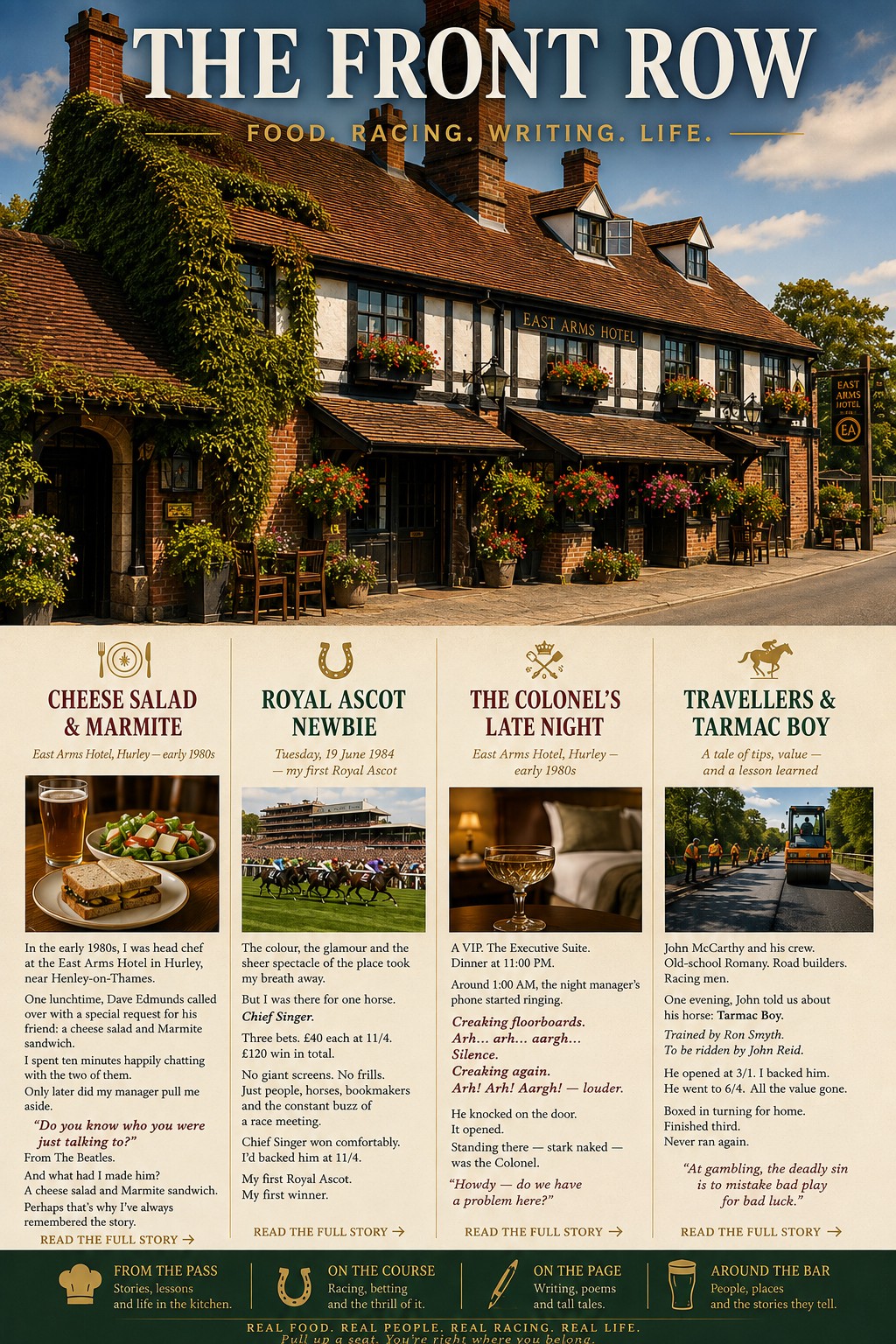
THE FRONT ROW
WELCOME / ABOUT
Welcome back to The Front Row.
If you’re looking for polished platitudes, curated lifestyles, or hollow advice — you’re still in the wrong place.
No unnecessary garnish. No filters. No fine print.
Just honest observations, real experience, hard‑earned lessons, and the occasional tale best kept behind closed doors.
These are my stories — from the pass, the bar, the racecourse, and the road. Real food, real people, real racing — and the quiet truths that stay with you long after service ends, the crowd fades, and the horses have passed the post.
This time around, we’re heading back to the East Arms — and beyond. More memories, more lessons, and a few more stories that probably shouldn’t be told in polite company.
Pull up a seat. You’re right where you belong.
🧀 CHEESE SALAD & MARMITE
East Arms Hotel, Hurley — early 1980s
In the early 1980s, I was head chef at the East Arms Hotel in Hurley, near Henley-on-Thames.
After service, I’d often wander into the bar for a drink. One evening, I got talking to a regular about wine, food, and his experiences at The Waterside Inn — then widely regarded as one of the finest restaurants in the country.
He used to say: “I always take my clients and business associates to The Waterside Inn — but I like coming here for real food.”
That line stayed with me.
Over the months, our conversations covered catering, food, his business, show business, and music. His name was Dave Edmunds — of Rockpile — and he was a genuinely nice man.
The Waterside Inn was, of course, where the great Michel Roux reigned. He was a huge influence on me. My own career was never about chasing Michelin stars — but you couldn’t help admiring the man, his standards, his discipline, and what he achieved. He influenced a generation of chefs, Andrew Fairlie among them.
Then came one lunchtime that I remember particularly well.
Dave called over to the kitchen with a special request. He had a friend with him and wanted two bar snacks. He introduced his companion, who I took to be a local farmer.
“Could you do a cheese salad and Marmite sandwich for my friend, and a toasted steak sandwich for me?”
“Of course. No problem.”
I didn’t think twice about it. I prepared the food and, while they waited, spent ten minutes chatting away happily with the two of them.
It was only later that my manager pulled me aside.
“Do you know who you were just talking to?”
“No.”
“That was George Harrison. From The Beatles.”
I have to admit, I felt slightly foolish. Not because I hadn’t recognised him — I’ve never been particularly starstruck — but because I’d just spent ten minutes happily chatting to one of the most famous musicians in the world while assuming he was a local farmer.
And what had I made him? A cheese salad and Marmite sandwich.
Perhaps that’s why I’ve always remembered the story. There was no fuss, no celebrity treatment, no elaborate tasting menu. Just two men dropping into a country hotel, a chef doing his job, and a very simple lunch.
Sometimes the best memories are the ones you don’t realise you’re making at the time.
And that cheese salad and Marmite sandwich? I’d like to think George Harrison enjoyed it.
🏇 ROYAL ASCOT NEWBIE
Tuesday, 19 June 1984 — my first Royal Ascot
Another unforgettable memory from my days at the East Arms came on Tuesday, 19 June 1984 — the day I went to Royal Ascot for the first time.
Ronnie was a small man in stature, but larger than life in personality. He was in his late sixties then and still worked part‑time at the hotel, helping with the washing‑up. He’d been a gunner in the Navy when he was a young man, before spending much of his working life as a bin man. But there was another side to him. In his younger days, he’d been an accomplished pianist and had even won a local award for his playing.
Racing, though, was the constant. He’d followed horses all his life. It was the one subject that could really get him going, and he knew his racing.
It was Ronnie who suggested we go to Royal Ascot. He had two tickets for the Heath enclosure, and I was more than happy to accept one.
I didn’t really know what to expect. The colour, the glamour, and the sheer spectacle of the place took my breath away. I’d never experienced anything quite like it. But, if I’m honest, I wasn’t there for the hats, the dresses, or the pageantry.
I was there for one horse. Chief Singer. And I had one bet.
The Heath was on the far side of the course and, in those days, had a wonderfully informal, almost carnival atmosphere. There were picnics, families, portable bars, and row upon row of bookmakers. No giant screens. No corporate hospitality. No frills. Just people, horses, bookmakers, and the constant buzz of a race meeting.
And then there was the Royal Procession. I’d never seen it so close. The Queen looked magnificent as she made her way past, and for someone experiencing Royal Ascot for the first time, the whole thing was quite something.
But my attention soon turned back to the betting. I walked the bookmakers and placed three bets of £40 at 11/4 on Chief Singer — £120 win in total. It was a serious bet for me in those days. I bought Ronnie a beer and settled down to wait for the third race: the St James’s Palace Stakes.
Chief Singer
Chief Singer was no ordinary horse. Only a few weeks earlier he’d finished second to the brilliant El Gran Senor in the 2,000 Guineas at Newmarket — a race I’d backed El Gran Senor in myself: £200 win at 2/1, the biggest bet I’d placed up to that point. El Gran Senor was something special. For Chief Singer to finish second to him told you there was plenty of ability there. Now, at Royal Ascot, I was hoping he’d prove it.
From where Ronnie and I stood, we couldn’t see the whole race. There were no big screens to follow the action, so you relied on what you could hear and what unfolded in front of you.
And then they came. I heard them before I properly saw them — the thunder of hooves, the crack of the whip, the creak of leather, and the roar of the crowd. Then I spotted him. Chief Singer. Ray Cochrane was driving him home — and there was no doubt about the result.
Chief Singer won comfortably. He was the favourite at 85/40, beat Keen into second, with Kalim third. I’d backed him at 11/4. And my first Royal Ascot had produced a winner.
Looking Back
It’s funny what stays with you. You might think it would be the money — £120 was a lot of money to me then — and seeing a horse you’d backed win at Royal Ascot was certainly something to remember. But it isn’t the bet I remember most.
I remember the Heath. I remember the bookmakers packed along the rails, the picnics, the noise, and the excitement. I remember seeing the Royal Procession for the first time. I remember the sound of those horses coming past when you couldn’t quite see everything that was happening.
And I remember Ronnie. A former Navy gunner, an old bin man, a prize‑winning pianist, and a lifelong racing man — standing beside a young chef who was experiencing his first Royal Ascot. He’d given me the ticket. Chief Singer gave me the winner. And for one afternoon in June 1984, Ronnie and I had the best seat in the house.
🦞 THE COLONEL’S LATE NIGHT
East Arms Hotel, Hurley — early 1980s
Another story from the East Arms that still makes me smile.
We were told a VIP was arriving for a one‑night stay. His PA had booked the Executive Suite — our best room, on the top floor — plus a single room nearby for his chauffeur‑bodyguard. Dinner for two was arranged for 11:00 PM. The restaurant closed at 9:30, but I agreed to an exception — he was flying in from America and coming straight from Heathrow.
The order was simple but generous: a dozen native oysters, two Lobster Thermidor, green salad, pink champagne, and chocolates. The chauffeur‑bodyguard would have a steak sandwich. Rod, our general manager, would serve it.
The guest arrived just after 10:30 PM — a large, broad man in his sixties, bald, rugged features. He checked in quietly and went straight to his room. His chauffeur had a pint of Guinness and ate his sandwich in the bar. All very orderly.
Around 1:00 AM, the night manager’s phone started ringing. Then the complaints began.
From the room below, guests could clearly hear:
Creaking floorboards.
Arh… arh… aargh…
Silence.
Creaking again.
Arh! Arh! Aargh! — louder this time.
It went on for over an hour.
Eventually, the guest below called again, increasingly agitated, insisting it sounded like someone being murdered upstairs. Enough was enough. The night manager went up to investigate. He knocked gently.
The door opened. Standing there — stark naked — was the Colonel. Behind him, a young woman sat up in bed, pulling the sheets around her, clearly embarrassed.
The manager froze.
The Colonel smiled. “Howdy — do we have a problem here?”
“Very sorry, sir,” the manager said, recovering himself. “But would you mind keeping the noise down? The other guests are complaining.”
The door closed. That was that.
At 4:00 AM, the chauffeur drove the young woman home. The Colonel checked out later that morning and left a very handsome tip.
In Hindsight
Only afterwards did the whispers start. The Colonel was said to be an arms dealer, and the young woman part of the arrangement. Whether it was business, pleasure, or both, I’ll never know.
What I do know is that we all did very well that week. He left £200 — a significant sum at the time — and certainly made an impression on the East Arms.
Some guests you forget the next day. Others you never forget.
🐎 TRAVELLERS & TARMAC BOY
A tale of tips, value — and a lesson learned
My final story from those days — and one that’s stayed with me ever since.
One evening we were joined by a large group of road workers, fresh off shift. They were resurfacing the Oxford Road between Maidenhead and Assendon — and they were thirsty.
They weren’t the usual regulars we were used to. The foreman propped himself at the bar, announced he was picking up the tab, and told the lads to order whatever they wanted. His name was John McCarthy.
A big, rounded man with a prominent nose and a flushed, weather‑beaten face — proof, if ever it was needed, of an appetite for a pint or two. He told us he was old‑school Romany, his heritage rich and deep. Traditionally, his people had worked the land. In modern Britain, opportunity knocked — and road building kept the community in work. They travelled the country, going wherever the work took them.
The head barman got talking. Over weeks, they’d share racing tips, claiming family in every stable across Britain and Ireland. Tips and so‑called inside information were as common as rabbits in the nearby fields. If you’ve ever travelled that stretch of Oxford Road, you’ll know exactly what I mean. Some came true — but most would have cost you dear had you backed them.
One evening, John told both the barman and myself that he owned a racehorse: Tarmac Boy. Trained by Ron Smyth, to be ridden by John Reid.
He explained the colt had been campaigned deliberately out of his depth — finishing well down the field in his first two runs, making him look slower than he was. Now dropped into a race where conditions would suit him perfectly.
As weeks passed, some regulars started drifting away. Snobbery was at the heart of it. They didn’t like the travellers using their local. It wasn’t quiet disapproval either — one incident went too far: two of the group poached and slaughtered a deer from the royal estate, then tried selling the venison from a van. Police were called. But for those who got to know them, there was far more to them than the locals saw.
The Race — and the Lesson
Tarmac Boy should have been around 20/1 — the Sporting Life had him at 33/1. Instead, he opened at 3/1. Half of Maidenhead’s betting regulars seemed to have backed him. Hardly a secret — everyone had heard the same whisper.
I placed £100 win at 3/1. And watched as he shortened further, going 6/4 before the off. All that supposed inside information had collapsed the price. The value was gone — but I’d already placed my bet.
With John Reid in the saddle, the horse travelled well enough — but turning for home, he got boxed in. No room, no way through, no chance to show what he could do. He kept on, but couldn’t get out. Finished third.
And that was it. He never ran again.
The Takeaway
It was a painful lesson — and one I’ve never forgotten.
Don’t listen to other people’s so‑called inside information. And never, ever accept poor value. If the price has gone before you get your bet on — walk away. The story is always better than the price when everyone else has heard the same whisper.
Years later, John Reid would go on to secure his greatest victory — winning the 1992 Epsom Derby on Dr Devious. But that day, with Tarmac Boy, the lesson was clear.
“At gambling, the deadly sin is to mistake bad play for bad luck.”
Leave a Comment
I hope you enjoyed this post. If you would like to, please leave a comment below.