JOHNNY “LIGHTS” HURNDALL
When Gamblers Were Characters
There was a time when you could walk into any British racecourse betting ring and know, within minutes, who mattered.
No television pundit told you. No computerised form guide, no algorithm, no dozen betting apps flashing prices in your hand.
You simply watched.
You watched the bookmakers.
You watched the punters.
And — if you were particularly lucky — you watched Johnny “Lights” Hurndall.
A Self‑Made Man
Johnny was unmistakable — solid London through and through. Stocky, unpolished, with little formal schooling, yet he lived in a fine house on a quiet, exclusive road near Epsom — paid for entirely by gambling.
At fifteen he was already earning his way: touting tickets and selling perfume, jewellery, and umbrellas along Oxford Street. He learned the betting game the hard way — or as he put it, being “ironed out with great regularity.” He lost often. But he did something most don’t: he learned from every defeat.
By his early forties, what set him apart was simple: he didn’t pretend to know everything. Clerking for a bookmaker at New Cross dogs, he’d watched hundreds lose and a handful win. The winners, he noticed, hardly bet at all. They chose their moments. They knew whom to trust.
Johnny didn’t try to beat the form. He beat the room. He made his money by knowing who knew. He spent his life hovering along the betting rails, listening, watching, learning whose judgement carried weight — and whose didn’t.
Big Ears, Brave Pocket
He built his fortune on two things: sharp ears and nerve.
When reliable whispers came through for a horse called Shape Along The Line, he backed it and collected £30,000 — roughly £97,000 in today’s money. Four years later, strong money came for the debutante Forest Flower at 7‑4 — he staked £20,000, worth about £65,000 today. But even those paled beside his greatest win.
In 1989, a private line came directly from Dick Hern — the legendary trainer of two Derby winners — who said he had never been more confident than he was about Nashwan winning the Blue Riband. Johnny listened. He bet big. His ears and nerve won him £75,000 — an extraordinary £242,000 in today’s terms — in a single afternoon.
The Man Who Listened
Where others trusted only their own eyes, Johnny trusted good information. He understood people. He understood value. And, perhaps most importantly, he understood the betting ring.
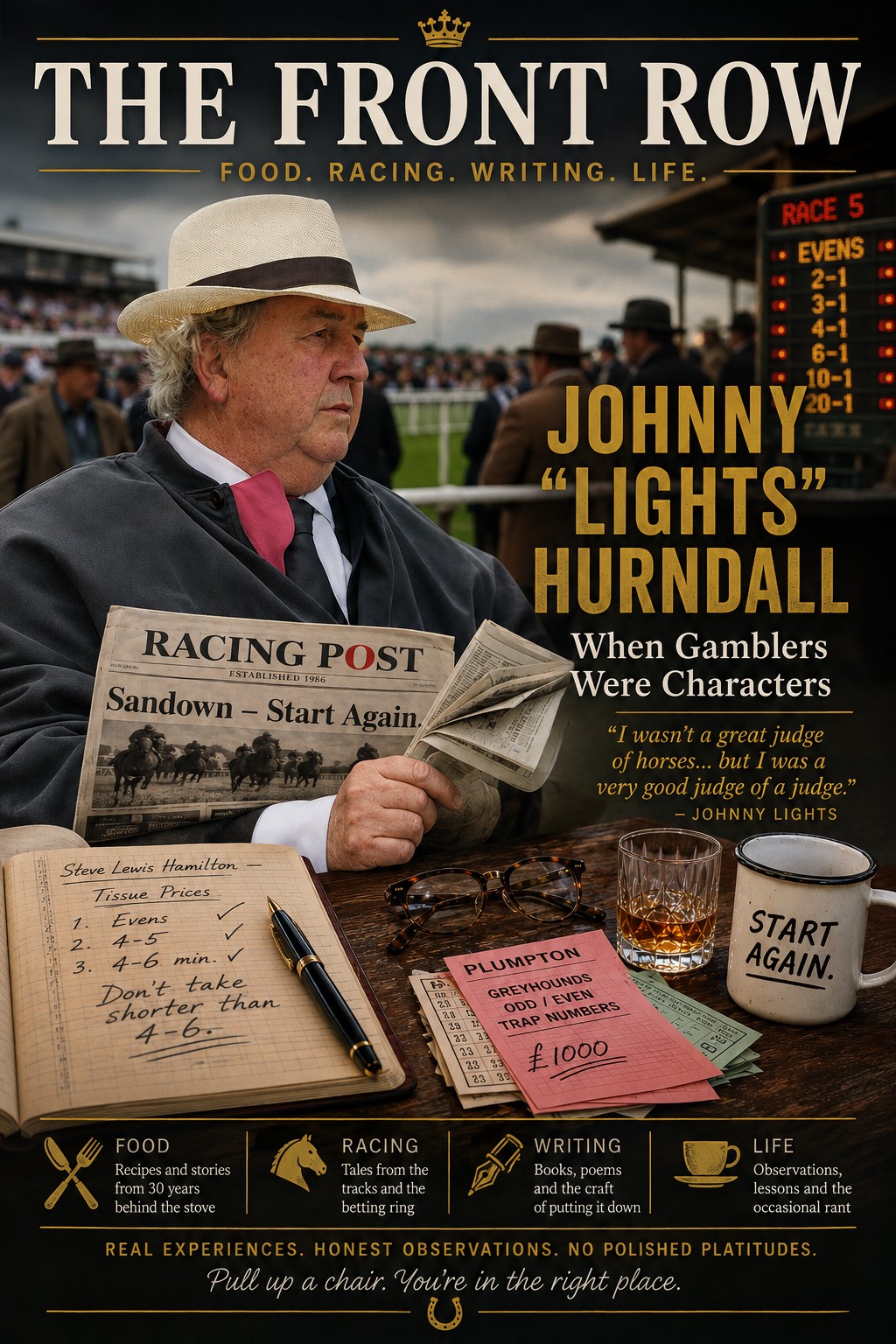
“I wasn’t a great judge of horses… but I was a very good judge of a judge.”
That single observation tells you almost everything about him. He never pretended to see the future in a horse’s stride. He found those who could — and paid them for their insight. Steve Lewis Hamilton was one such man. Johnny paid for his “tissue” prices — his own private form guide — and then had the courage to back that judgement with everything he had.
Enquiries, Odds, and One Terrible Mistake
Johnny also saw angles others missed — especially stewards’ enquiries. When bookmakers faced huge liabilities on the runner‑up, they’d hedge by offering generous odds against the favourite keeping the race. Johnny would say “yes, please” — and make tens of thousands reading the room better than anyone else.
But even the best can crack.
In 1991 at Royal Ascot, Rock Hopper was odds‑on favourite for the Hardwicke Stakes, only to be narrowly beaten. The jockey objected, claiming interference in the final furlong. Johnny watched, judged, and backed his opinion — £44,000, or roughly £123,000 today — that the result would stand.
The stewards agreed there had been no late interference… then ruled interference earlier in the straight and threw the winner out.
For twenty‑four hours, Johnny forgot his own golden rule. He chased. He tried to smash his way out. And he lost another £56,000 — close on £156,000 today. In one terrible day, he’d wiped out nearly £280,000 of his own money.
That is why there was always a quiet, troubled look in his eye. He knew what it felt like to be broke. And he was terrified of going back there.
“Start Again.”
Perhaps the finest phrase ever associated with Johnny Lights comes from a day at Sandown. He had suffered a heavy defeat, backing a well‑supported favourite that failed. Someone turned to him afterwards.
Someone turned to him afterwards.
“What do we do now?”
Johnny’s answer was simple.
“Start again.”
That is the professional gambler’s philosophy in four words. The race is over. The money is gone. The result cannot be changed. So you dust yourself down — and you start again.
No excuses. No conspiracy theories. No blaming the jockey, the ground, the stewards, or the bloke standing three places away who supposedly brought bad luck.
Start again.
And Then There Was the Entertainment
Of course, racing people being racing people, professionalism only went so far.
There is another story from Plumpton. Between races, Johnny and Dudley found themselves sheltering from the rain inside the course betting shop. Plumpton and rain were, after all, old friends.
With racing temporarily suspended, the two men found another market. Odd or even trap numbers in a greyhound race showing on the television. Four‑figure bets. Just for something to do.
That tells you everything about the gambling mentality. For most people, a four‑figure bet would be an event. For men like Johnny and Dudley? It could be light entertainment between races.
The Old Travelling Fraternity
Johnny’s life was defined as much by the people he met as the bets he struck. He travelled the country for decades, moving from racecourse to racecourse, and encountered every great character of the betting world.
He recalled travelling with Eddie “The Shoe” — seeing more of him than his own wife. There was John the Beard, and Big Alan, who kept turning up long after everyone else had faded away. He remembered the mysterious, well‑backed son of a Maharaja who vanished as quietly as he had arrived.
The World That Disappeared
Johnny belonged to an era when the betting ring was a living, breathing community. Information moved person‑to‑person. Prices were negotiated. Reputations mattered. Trust mattered. Bookmakers knew which punters they wanted on their books. Punters knew which bookmakers would stand them.
Johnny’s greatest talent was never picking winners. It was knowing who could pick winners. Something no algorithm can truly replace.
The Last of the Great Characters
Johnny “Lights” Hurndall died at Epsom Hospital on 10 March 2023, aged 74, after years of serious illness.
By then, the world he inhabited had changed beyond recognition. The old betting ring had been transformed by technology, exchanges, and online markets. Yet Johnny never lost his affection for the game. Even when his health failed, the Racing Post stayed close. The stakes may have shrunk — but the interest never did.
Because for Johnny, gambling was never simply about money. It was the people. The prices. The arguments. The anticipation. And above all else — that feeling when your horse crosses the line in front.
He put it best himself:
“Still think there’s no better sensation than backing a winner.”
So let’s leave him there. Not as some mythical genius. But as one of the very last great characters of the British betting ring. A man who listened, who learned, who bet brave — and who, win or lose, always knew how to say:
Start again.
COMING NEXT TIME
A story from the back of the kitchen. Another tale from the rails. A recipe that has long been a favourite of mine. Or perhaps something completely different.
That’s the beauty of this place — no box to stay inside.
Thank you for stepping up to The Front Row. Pull up a chair, leave your ego at the door, and remember: whether you’re weighing up a price, judging a man, or simply getting through the week — keep it simple, keep showing up, and never fall in love with your own certainty.
See you next time.
Leave a Comment
I hope you enjoyed this post. If you would like to, please leave a comment below.